
DOI:
10.1039/C3RA47206J
(Communication)
RSC Adv., 2014,
4, 7623-7626
Interception of benzyne with thioethers: a facile access to sulfur ylides under mild conditions†
Received
2nd December 2013
, Accepted 8th January 2014
First published on 9th January 2014
Abstract
Reactive benzyne generated from o-(trimethylsilyl)phenyl triflate under the action of CsF has been trapped in situ by thioethers to give sulfonium ylides, which in turn have been intercepted by isatins to give rise to corresponding spiroepoxy oxindoles in moderate to high yields. This reaction provides a facile and efficient synthesis of spiroepoxy oxindoles.
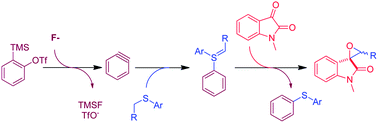
Since being discovered in 1930,1 sulfonium ylides have been involved in various transformations, such as epoxidation of aldehydes/ketones,2 aziridination of imines,3 cyclopropanation of conjugated enones/enoates and their congeners,2c,4 as well as 2,3-Wittig rearrangement of allylic/propargyl sulfonium ylides,5 providing invaluable synthetic methods. Recently, Aggarwal group has made great advances in sulfonium ylide mediated catalytic asymmetric epoxidation.6 The Tang laboratory has also achieved a series of excellent asymmetric Michael addition/cyclization cascades triggered by sulfonium ylides;4c,7 moreover Xiao and colleagues have disclosed several efficient heterocyclic synthesis featuring formal [4 + 1] cycloaddition on sulfonium ylides.8 Although there exist a handful of methods for sulfonium ylide formation,9 deprotonation of corresponding sulfonium salts constitutes the major avenue to the ylide formation due to their inherent benefits (Method A, Fig. 1).10 Reaction of thioethers with carbenes/metal carbenoids constitutes a second consequential approach which has found broad applications (Method B, Fig. 1).10a,11 Another elegant yet undeveloped strategy for sulfonium ylide formation, namely, nucleophilic attack of alkyl thioether on benzyne followed by an intramolecular 1,4-proton shift (Method C, Fig. 1)12 has been almost totally neglected since its debut, wherein the o-fluorophenylmagnesium bromide was employed as the benzyne precursor, as few further investigations have followed.13 The poor compatibility of these protocols with some common functional groups seriously limited their applications.
 |
| | Fig. 1 Three strategies to generate sulfonium ylide. | |
Recent flourishing advances in the area of aryne chemistry have brought new reactivities and applications to these highly reactive intermediates.14 This resurgence in aryne chemistry is attributed largely to the introduction of o-(trimethylsilyl)aryl triflates, by Kobayashi et al., as convenient and efficient aryne precursors that require only very mild conditions (weakly basic fluoride anion source and ambient temperature) to promote the in situ formation of corresponding arynes.15 We therefore decided to use o-(trimethylsilyl)aryl triflate to revisit the thioether/benzyne strategy of sulfonium ylide formation, hoping to develop new synthetic processes. Here we report a convenient one-pot synthesis of epoxyoxindoles16 via this thioether/benzyne strategy.
We chose cinnamyl p-tolyl sulfide (2a) and N-methyl isatin (3a) as benzyne interceptor and sulfonium ylide interceptor respectively to test this strategy.17 Thus a mixture of 1, 2a, and 3a with cesium fluoride (1/2a/3a/CsF
:
1.2/1.5/1.0/3.0) in anhydrous acetonitrile was vigorously stirred overnight at room temperature. A pair of diastereoisomers (cis-4a and trans-4a) was isolated in 25% yield, and the by-product phenyl tolyl thioether 5a was also collected and identified. These observations confirmed our proposal. Brief screening of solvents quickly distinguished acetonitrile as a better reaction medium than other solvents such as tetrahydrofuran, ethyl acetate, N,N-dimethylformamide and dichloromethane. Further optimization was carried out in acetonitrile and the results were shown in Table 1. When the reaction mixture was stirred overnight at 40 °C, the epoxide isomers 4aa was obtained in 87% yield (entry 2), much higher than both at 25 °C (entry 3, 68%) and at 80 °C (entry 4, 41%). With the isatin 3a as limiting reagent, the reaction gave diastereomers 4aa in 68% yield at 40 °C (entry 5). Interestingly, the modest Dr value obtained at room temperature improved toward the trans-product evidently as the reaction temperature increased (entries 1–4).
Table 1 Optimization of reaction conditionsa

|
| Entry |
1/2a/3a/CsF |
T (°C) |
Yieldb (%) |
Drc (cis/trans) |
| All reactions were performed on 0.25 mmol of N-methyl isatin 3a with o-(trimethylsilyl)aryl triflate 1, thioether 2a, and CsF in anhydrous acetonitrile. Sum of isolated yields of cis-4aa and trans-4aa after column chromatography, based on the isatin. Determined by the isolated yields of two isomers. Yield based on 1. |
| 1 |
1.2/1.5/1.0/3.0 |
25 |
68 |
56/44 |
| 2 |
1.2/1.5/1.0/3.0 |
40 |
87 |
44/56 |
| 3 |
1.2/1.5/1.0/3.0 |
60 |
65 |
35/65 |
| 4 |
1.2/1.5/1.0/3.0 |
80 |
41 |
21/79 |
| 5 |
1.0/1.0/1.6/3.0 |
40 |
68d |
27/73 |
At this stage, the optimal conditions in Table 1 were set as standards (conditions for entry 2 Table 1) for further studies. A number of substituted isatins 3b–k were subjected to the standard conditions to test the substitution effects on isatin aromatic ring (Table 2). These data demonstrated that the electronic property undoubtedly exerts profound effects on the reactions, notably manifested by the yields of the corresponding 5-subtituted spiroepoxy oxindoles 4, which roughly parallel with the donating/withdrawing abilities of their 5-subtituents (entries 1–7). Strong electron donating 5-methoxyl group gave 4ac in a yield as low as 32%, while strong electron withdrawing 5-NO2 and 5-F groups delivered 4ag and 4af in 84% and 93% yields respectively; isatins 3b, 3d and 3e bearing relatively weaker electron donating groups on 5-position resulted in moderate yields. 7-Cl isatin 3k under standard conditions achieved better yield (entry 11) than its 5- and 6-congeners (entries 5 and 9); and 4-Br isatin 3h showed a less negative impact on the yield in comparison to its 5-epimer (entry 8 vs. 4), yet still less than the parent isatin 3a (entry 1). The impressive electronic and positional effects, though lacking concrete rationale at this time, may indicate that the epoxidation of isatin proceeded stepwise with the first step, namely, the nucleophilic attack of ylide on the isatin carbonyl group, as the rate limiting step. Overall, this tandem reaction is fairly non-diastereoselective, even though the steric effect at 4-position favours the cis-isomer more than the anti-isomer as exhibited by the highest cis/trans ratio of 76/24 presented in Table 2 entry 8 probably due to steric effect.
Table 2 Substituent effects on isatin aromatic ringa

|
| Entry |
Istatin 3, R |
Product 4 yieldb % |
Drc (cis : trans) |
| All reactions were performed on 0.25 mmol of isatins 3 with o-(trimethylsilyl)aryl triflates 1 (1.2 equiv.), thioether 2a (1.5 equiv.), and CsF (3.0 equiv.) in anhydrous acetonitrile at 40 °C overnight. Sum of isolated yields of cis-4 and trans-4 after column chromatography, based on the isatin. Determined by the isolated yields of two isomers. |
| 1 |
3a, H |
4aa, 87 |
44 : 56 |
| 2 |
3b, 5-CH3 |
4ab, 50 |
54 : 46 |
| 3 |
3c, 5-OMe |
4ac, 32 |
59 : 41 |
| 4 |
3d, 5-Br |
4ad, 36 |
53 : 47 |
| 5 |
3e, 5-Cl |
4ae, 58 |
43 : 57 |
| 6 |
3f, 5-F |
4af, 93 |
33 : 67 |
| 7 |
3g, 5-NO2 |
4ag, 84 |
45 : 55 |
| 8 |
3h, 4-Br |
4ah, 64 |
76 : 24 |
| 9 |
3i, 6-Cl |
4ai, 42 |
45 : 55 |
| 10 |
3j, 6-F |
4aj, 31 |
43 : 57 |
| 11 |
3k, 7-Cl |
4ak, 70 |
49 : 51 |
With isatin 3f as epoxidation acceptor, a series of thioethers 2 were examined under standard conditions, the results are charted in Table 3 allylic, benzylic and simple alkyl aryl thioethers all give good to excellent yields. As previously observed, the diastereoselectivities are normally low and steric bulkiness seems be an important factor which favours cis-isomers over their trans-counterparts. More sterically demanding benzylic thioethers 2c–f reversed the cis/trans ratio with an exception of 2-NO2 benzylic sulfide 4bf whose strong dipolar nature may be involved to some extent in the transition state.
Table 3 The substrate scope of thioethersa

|
| Entry |
Sulfide 2, Ar, R |
Product 4 yieldb (%) |
Drc (cis : trans) |
| All reactions were performed on 0.25 mmol of isatins 3a with o-(trimethylsilyl)aryl triflates 1 (1.2 equiv.), thioether 2 (1.5 equiv.), and CsF (3.0 equiv.) in anhydrous acetonitrile at 40 °C overnight. Sum of isolated yields of cis-4 and trans-4 after column chromatography, based on the isatin. Estimated on the isolated yield. Determined via the 1H NMR of the crude product. Z-PV = Z-phenylvinyl. |
| 1 |
2a, p-MePh, Z-PV |
4af, 93 |
33 : 67 |
| 2 |
2b, p-MePh, 2-NO2Ph |
4bf, 99 |
31 : 69d |
| 3 |
2c, p-MePh, 2-ClPh |
4cf, 74 |
57 : 43d |
| 4 |
2d, p-MePh, 3-FPh |
4df, 89 |
74 : 26 |
| 5 |
2e, p-MePh, 3-ClPh |
4ef, 83 |
81 : 19 |
| 6 |
2f, p-MePh, 4-ClPh |
4ff, 92 |
70 : 30 |
| 7 |
2g, p-MePh, CHCH2 |
4gf, 73 |
46 : 56 |
| 8 |
2h, Ph, Ph |
4hf, 83 |
61 : 39 |
| 9 |
2i, Ph, Me |
4if, 85 |
47 : 53 |
The structure of these spiroepoxides has been established by NMR spectra and high resolution mass spectra. Specifically, four pairs of representative diastereoisomers of 4af, 4ag, 4ff and 4gf were each submitted to acquire 2D 1H–1H NOESY spectrum. The presence of cross-peaks at the 4-H next to the fluoride atom and the epoxide H set a key diagnosis interactions which distinguished the cis-configuration from its anti-counterpart without doubt (refer to the NOESY spectra in ESI†). The relative stereochemistry of the others was assigned by analogy to those four pairs.
A possible mechanism for this process has been outline in Fig. 2. O-(trimethylsilyl)aryl triflate 1 is converted to the reactive benzyne 6, which is attacked by thioether 2 delivering intermediate zwitterion 7. Immediate intramolecular 1,3-proton shift from the alkyl carbon onto the aromatic carbon produces sulfonium ylide 8. Reaction of 8 with isatin 3 gives the spiroepoxide 4 via intermediate 9.
 |
| | Fig. 2 Proposed mechanism for the cascade of benzyne formation, sulfonium ylide formation and epoxidation. | |
Conclusions
In summary, we have established a one pot process to spiro epoxyoxindoles. This method features two successive in situ capturing steps of reactive intermediates in very mild conditions. The use of o-(trimethylsilyl)aryl triflate as benzyne source upon a fluoride activation is the base for this improved protocol.
Acknowledgements
We thank the Natural Science Foundation of China (21002032 and 21272077), Shanghai Pujiang Program (11PJ1403100), Priority Academic Program Development of Jiangsu Higher Education Institutions (PAPD), and the Natural Science Foundation of Jiangsu Province (SBK201321632) for financial support.
Notes and references
- C. K. Ingold and J. A. Jessop, J. Chem. Soc., 1930, 713 RSC.
-
(a) A. W. Johnson and R. B. LaCount, J. Am. Chem. Soc., 1961, 83, 417 CrossRef CAS;
(b) E. J. Corey and M. Chaykovsky, J. Am. Chem. Soc., 1962, 84, 3782 CrossRef CAS;
(c) E. J. Corey and M. Chaykovsky, J. Am. Chem. Soc., 1965, 87, 1353 CrossRef CAS;
(d) B. M. Trost and R. F. Hammen, J. Am. Chem. Soc., 1973, 95, 962 CrossRef CAS;
(e) N. Furukawa, Y. Sugihara and H. Fujihara, J. Org. Chem., 1989, 54, 4222 CrossRef CAS;
(f) A.-H. Li, L.-X. Dai, X.-L. Hou, Y.-Z. Huang and F.-W. Li, J. Org. Chem., 1996, 61, 489 CrossRef CAS PubMed;
(g) A. Piccinini, S. A. Kavanagh, P. B. Connon and S. J. Connon, Org. Lett., 2010, 12, 608 CrossRef CAS PubMed;
(h) O. Illa, M. Namutebi, C. Saha, M. Ostovar, C. C. Chen, M. F. Haddow, S. Nocquet-Thibault, M. Lusi, E. M. McGarrigle and V. K. Aggarwal, J. Am. Chem. Soc., 2013, 135, 11951 CrossRef CAS PubMed.
-
(a) A.-H. Li, L.-X. Dai and X.-L. Hou, Chem. Commun., 1996, 491 RSC;
(b) A.-H. Li, L.-X. Dai, X.-L. Hou and M.-B. Chen, J. Org. Chem., 1996, 61, 4641 CrossRef CAS PubMed;
(c) V. K. Aggarwal, A. Thompson, R. V. H. Jones and M. C. H. Standen, J. Org. Chem., 1996, 61, 8368 CrossRef CAS;
(d) A.-H. Li, Y.-G. Zhou, L.-X. Dai, X.-L. Hou, L.-J. Xia and L. Lin, Angew. Chem., Int. Ed., 1997, 36, 1317 CrossRef CAS;
(e) T. Saito, M. Sakairi and D. Akiba, Tetrahedron Lett., 2001, 42, 5451 CrossRef CAS;
(f) V. K. Aggarwal, E. Alonso, G. Fang, M. Ferrara, G. Hynd and M. Porcelloni, Angew. Chem., Int. Ed., 2001, 40, 1433 CrossRef CAS;
(g) A. Solladié-Cavallo, M. Roje, R. Welter and V. Šunjić, J. Org. Chem., 2004, 69, 1409 CrossRef PubMed.
-
(a) F. Krollpfeiffer and H. Hartmann, Chem. Ber., 1950, 83, 90 CrossRef CAS;
(b) E. J. Corey and M. Chaykovsky, J. Am. Chem. Soc., 1962, 84, 867 CrossRef CAS;
(c) S. Ye, Z.-Z. Huang, C.-A. Xia, Y. Tang and L.-X. Dai, J. Am. Chem. Soc., 2002, 124, 2432 CrossRef CAS PubMed;
(d) L.-W. Ye, X.-L. Sun, C.-Y. Zhu and Y. Tang, Org. Lett., 2006, 8, 3853 CrossRef CAS PubMed;
(e) Y. Cheng, J. An, L.-Q. Lu, L. Luo, Z.-Y. Wang, J.-R. Chen and W.-J. Xiao, J. Org. Chem., 2010, 76, 281 CrossRef PubMed;
(f) S. L. Riches, C. Saha, N. F. Filgueira, E. Grange, E. M. McGarrigle and V. K. Aggarwal, J. Am. Chem. Soc., 2010, 132, 7626 CrossRef CAS PubMed.
-
(a) J. E. Baldwin, R. E. Hackler and D. P. Kelly, J. Am. Chem. Soc., 1968, 90, 4758 CrossRef CAS;
(b) J. E. Baldwin, R. E. Hackler and D. P. Kelly, Chem. Commun., 1968, 537 RSC;
(c) G. M. Blackburn, W. D. Ollis, J. D. Plackett, C. Smith and I. O. Sutherland, Chem. Commun., 1968, 186 RSC;
(d) W. Kirmse and M. Kapps, Chem. Ber., 1968, 101, 994 CrossRef CAS;
(e) R. W. C. Cose, A. M. Davies, W. D. Ollis, C. Smith and I. O. Sutherland, J. Chem. Soc. D, 1969, 293 RSC;
(f) E. Vedejs and J. P. Hagen, J. Am. Chem. Soc., 1975, 97, 6878 CrossRef CAS;
(g) V. Cere, C. Paolucci, S. Pollicino, E. Sandri and A. Fava, J. Org. Chem., 1978, 43, 4826 CrossRef CAS;
(h) M. P. Doyle, J. H. Griffin, M. S. Chinn and D. Van Leusen, J. Org. Chem., 1984, 49, 1917 CrossRef CAS;
(i) E. Vedejs, Acc. Chem. Res., 1984, 17, 358 CrossRef CAS;
(j) E. Vedejs, J. D. Rodgers and S. J. Wittenberger, J. Am. Chem. Soc., 1988, 110, 4822 CrossRef CAS;
(k) M. Ma, L. Peng, C. Li, X. Zhang and J. Wang, J. Am. Chem. Soc., 2005, 127, 15016 CrossRef CAS PubMed;
(l) D. Crich, Y. Zou and F. Brebion, J. Org. Chem., 2006, 71, 9172 CrossRef CAS PubMed;
(m) S. Braverman and M. Cherkinsky, Top. Curr. Chem., 2007, 275, 67 CrossRef CAS.
-
(a) V. K. Aggarwal, H. Abdel-Rahman, R. V. H. Jones, H. Y. Lee and B. D. Reid, J. Am. Chem. Soc., 1994, 116, 5973 CrossRef CAS;
(b) V. K. Aggarwal, J. G. Ford, S. Fonquerna, H. Adams, R. V. H. Jones and R. Fieldhouse, J. Am. Chem. Soc., 1998, 120, 8328 CrossRef CAS;
(c) V. K. Aggarwal, E. Alonso, G. Hynd, K. M. Lydon, M. J. Palmer, M. Porcelloni and J. R. Studley, Angew. Chem., Int. Ed., 2001, 40, 1430 CrossRef CAS;
(d) V. K. Aggarwal and C. L. Winn, Acc. Chem. Res., 2004, 37, 611 CrossRef CAS PubMed.
-
(a) J.-C. Zheng, C.-Y. Zhu, X.-L. Sun, Y. Tang and L.-X. Dai, J. Org. Chem., 2008, 73, 6909 CrossRef CAS PubMed;
(b) X.-L. Sun and Y. Tang, Acc. Chem. Res., 2008, 41, 937 CrossRef CAS PubMed;
(c) B.-H. Zhu, J.-C. Zheng, C.-B. Yu, X.-L. Sun, Y.-G. Zhou, Q. Shen and Y. Tang, Org. Lett., 2009, 12, 504 CrossRef PubMed;
(d) B.-H. Zhu, R. Zhou, J.-C. Zheng, X.-M. Deng, X.-L. Sun, Q. Shen and Y. Tang, J. Org. Chem., 2010, 75, 3454 CrossRef CAS PubMed.
-
(a) L.-Q. Lu, Y.-J. Cao, X.-P. Liu, J. An, C.-J. Yao, Z.-H. Ming and W.-J. Xiao, J. Am. Chem. Soc., 2008, 130, 6946 CrossRef CAS PubMed;
(b) L.-Q. Lu, Z.-H. Ming, J. An, C. Li, J.-R. Chen and W.-J. Xiao, J. Org. Chem., 2011, 77, 1072 CrossRef PubMed;
(c) L.-Q. Lu, J.-R. Chen and W.-J. Xiao, Acc. Chem. Res., 2012, 45, 1278 CrossRef CAS PubMed;
(d) J. An, L.-Q. Lu, Q.-Q. Yang, T. Wang and W.-J. Xiao, Org. Lett., 2013, 15, 542 CrossRef CAS PubMed;
(e) Y. Cheng, X.-Q. Hu, S. Gao, L.-Q. Lu, J.-R. Chen and W.-J. Xiao, Tetrahedron, 2013, 69, 3810 CrossRef CAS PubMed.
-
(a) D. Michelot, G. Linstrumelle and S. Julia, J. Chem. Soc., Chem. Commun., 1974, 10 RSC;
(b) E. Vedejs and G. R. Martinez, J. Am. Chem. Soc., 1979, 101, 6452 CrossRef CAS;
(c) T. Cohen, Z. Kosarych, K. Suzuki and L. C. Yu, J. Org. Chem., 1985, 50, 2965 CrossRef CAS;
(d) A. Padwa and J. R. Gasdaska, J. Org. Chem., 1986, 51, 2857 CrossRef CAS;
(e) T. J. Chow, U.-K. Tan and S.-M. Peng, Synth. Commun., 1988, 18, 519 CrossRef CAS;
(f) T. R. Hoye and C. J. Dinsmore, Tetrahedron Lett., 1992, 33, 169 CrossRef CAS;
(g) K. Hioki, S. Tani and Y. Sato, Synthesis, 1995, 649 CrossRef CAS PubMed;
(h) A. Padwa, J. M. Kassir, M. A. Semones and M. D. Weingarten, J. Org. Chem., 1995, 60, 53 CrossRef CAS.
-
(a) B. M. Trost and L. S. Melvin, Sulfur ylides: emerging synthetic intermediates, Academic Press, 1975 Search PubMed;
(b) J. S. Clark, Nitrogen, Oxygen, and Sulfur Ylide Chemistry: A Practical Approach in Chemistry, Oxford University Press, 2002 Search PubMed.
-
(a) G. Andrews and D. A. Evans, Tetrahedron Lett., 1972, 13, 5121 CrossRef;
(b) W. Ando, S. Kondo, K. Nakayama, K. Ichibori, H. Kohoda, H. Yamato, I. Imai, S. Nakaido and T. Migita, J. Am. Chem. Soc., 1972, 94, 3870 CrossRef CAS;
(c) P. A. Grieco, D. Boxler and K. Hiroi, J. Org. Chem., 1973, 38, 2572 CrossRef CAS;
(d) M. P. Doyle, W. H. Tamblyn and V. Bagheri, J. Org. Chem., 1981, 46, 5094 CrossRef CAS;
(e) G. Shi, Y. Xu and M. Xu, Tetrahedron, 1991, 47, 1629 CrossRef CAS;
(f) V. K. Aggarwal, J. G. Ford, A. Thompson, R. V. H. Jones and M. C. H. Standen, J. Am. Chem. Soc., 1996, 118, 7004 CrossRef CAS;
(g) Y. Zhang and J. Wang, Coord. Chem. Rev., 2010, 254, 941 CrossRef CAS PubMed.
-
(a) G. M. Blackburn and W. D. Ollis, Chem. Commun., 1968, 1261 RSC;
(b) G. M. Blackburn, W. D. Ollis, C. Smith and I. O. Sutherland, J. Chem. Soc. D, 1969, 99a RSC.
-
(a) M. Hori, T. Kataoka, H. Shimizu and N. Ueda, Tetrahedron Lett., 1981, 22, 3071 CrossRef CAS;
(b) J. Nakayama, A. Kimata, H. Taniguchi and F. Takahashi, Bull. Chem. Soc. Jpn., 1996, 69, 2349 CrossRef CAS.
-
(a) T. T. Jayanth, M. Jeganmohan, M.-J. Cheng, S.-Y. Chu and C.-H. Cheng, J. Am. Chem. Soc., 2006, 128, 2232 CrossRef CAS PubMed;
(b) M. Jeganmohan, S. Bhuvaneswari and C.-H. Cheng, Angew. Chem., Int. Ed., 2009, 48, 391 CrossRef CAS PubMed;
(c) G. Y. J. Im, S. M. Bronner, A. E. Goetz, R. S. Paton, P. H. Y. Cheong, K. N. Houk and N. K. Garg, J. Am. Chem. Soc., 2010, 132, 17933 CrossRef CAS PubMed;
(d) X. Huang and T. Zhang, J. Org. Chem., 2010, 75, 506 CrossRef CAS PubMed;
(e) R. V. Kolakowski and L. J. Williams, Nat. Chem., 2010, 2, 303 CrossRef CAS PubMed;
(f) K. Z. Laczkowski, D. Garcia, D. Pena, A. Cobas, D. Perez and E. Guitian, Org. Lett., 2011, 13, 960 CrossRef CAS PubMed;
(g) S. M. Bronner, J. L. Mackey, K. N. Houk and N. K. Garg, J. Am. Chem. Soc., 2012, 134, 13966 CrossRef CAS PubMed;
(h) H. Yoshida, S. Kawashima, Y. Takemoto, K. Okada, J. Ohshita and K. Takaki, Angew. Chem., Int. Ed., 2012, 51, 235 CrossRef CAS PubMed;
(i) A. V. Dubrovskiy and R. C. Larock, Tetrahedron, 2013, 69, 2789 CrossRef CAS PubMed;
(j) D. Rodriguez-Lojo, A. Cobas, D. Pena, D. Perez and E. Guitian, Org. Lett., 2012, 14, 1363 CrossRef CAS PubMed;
(k) F. Sha, L. Wu and X. Huang, J. Org. Chem., 2012, 77, 3754 CrossRef CAS PubMed;
(l) H. Ren, C. Wu, X. Ding, X. Chen and F. Shi, Org. Biomol. Chem., 2012, 10, 8975 RSC;
(m) T. R. Hoye, B. Baire, D. Niu, P. H. Willoughby and B. P. Woods, Nature, 2012, 490, 208 CrossRef CAS PubMed;
(n) C. Hall, J. L. Henderson, G. Ernouf and M. F. Greaney, Chem. Commun., 2013, 49, 7602 RSC;
(o) D. Niu, P. H. Willoughby, B. P. Woods, B. Baire and T. R. Hoye, Nature, 2013, 501, 531 CrossRef CAS PubMed;
(p) B. Baire, D. Niu, P. H. Willoughby, B. P. Woods and T. R. Hoye, Nat. Protoc., 2013, 8, 501 CrossRef CAS PubMed;
(q) R. Karmakar, P. Mamidipalli, S. Y. Yun and D. Lee, Org. Lett., 2013, 15, 1938 CrossRef CAS PubMed;
(r) S. Y. Yun, K.-P. Wang, N.-K. Lee, P. Mamidipalli and D. Lee, J. Am. Chem. Soc., 2013, 135, 4668 CrossRef CAS PubMed;
(s) K.-P. Wang, S. Y. Yun, P. Mamidipalli and D. Lee, Chem. Sci., 2013, 4, 3205 RSC.
-
(a) Y. Himeshima, T. Sonoda and H. Kobayashi, Chem. Lett., 1983, 1211 CrossRef CAS;
(b) D. J. Atkinson, J. Sperry and M. A. Brimble, Synthesis, 2010, 911 CAS;
(c) S. M. Bronner and N. K. Garg, J. Org. Chem., 2009, 74, 8842 CrossRef CAS PubMed.
-
(a) C. Palumbo, G. Mazzeo, A. Mazziotta, A. Gambacorta, M. A. Loreto, A. Migliorini, S. Superchi, D. Tofani and T. Gasperi, Org. Lett., 2011, 13, 6248 CrossRef CAS PubMed;
(b) M. S. Shmidt, I. A. Perillo, M. González and M. M. Blanco, Tetrahedron Lett., 2012, 53, 2514 CrossRef CAS PubMed;
(c) L. Hong and R. Wang, Adv. Synth. Catal., 2013, 355, 1023 CrossRef CAS.
-
(a) P. Bravo, G. Gaudiano and A. Umani-Ronchi, Gazz. Chim. Ital., 1970, 100, 652 CAS;
(b) V. Schulz, M. Davoust, M. Lemarie, J.-F. Lohier, S. J. S. De, P. Metzner and J.-F. Briere, Org. Lett., 2007, 9, 1745 CrossRef CAS PubMed.
Footnote |
| † Electronic supplementary information (ESI) available: General experimental information, detailed procedures, characterize data of compounds, copies of 1H and 13C NMR spectra for selected compounds. See DOI: 10.1039/c3ra47206j |
|
| This journal is © The Royal Society of Chemistry 2014 |
Click here to see how this site uses Cookies. View our privacy policy here.