Masoumeh Hajjaria,
Mehdi Ardjmanda and
Meisam Tabatabaei*b
aChemical Engineering Department, Islamic Azad University, South Tehran Branch, Tehran, Iran
bBiofuel Research Team (BRTeam), ABRII, 31535-1897 Karaj, Iran. E-mail: meisam_tab@yahoo.com; Fax: +98 26 32701067; Tel: +98 26 32703536
First published on 11th March 2014
Nano cerium oxide, a combustion-improving fuel additive, was investigated for its impact on biodiesel oxidative stability. The findings of the present study revealed for the first time that nano cerium oxide addition at the concentrations generally used to improve combustion (<100 ppm) severely reduced the oxidative stability of biodiesel.
Nitrogen oxide emissions – another disadvantage of biodiesel – known as NOx are produced during the combustion of biodiesel and pose serious problems to both public health and the environment.5 In light of that, a number of investigations have aimed at addressing the mentioned drawbacks of biodiesel by addition of different additives e.g. metal based additives to biodiesel and its blends,5–7 On the other hand, new approaches and advances achieved in nanotechnology have encouraged researchers to take advantages of such metal-based additives in their nano-size.8 For instance, Sajith et al. (2010) and Hong (2011) mentioned that nanosized metal oxides (e.g. nano cerium oxide and nano aluminium oxide) exhibited significantly higher activities and resulted in better impacts on combustion characteristics of fuels when compared to the conventional additives.6,9 Moreover, another important advantage of nano-sized metal additives over their micron-sized counterparts would be the prevention of fuel injector and filter clogging.10 Such improvement could be ascribed to the fact that at these dimensions the surface-area-to-volume ratio of the particles increases considerably, leading to a larger contact surface area and consequently more efficient performance.6,11
Among the additives studied nano cerium oxide has attracted a great deal of attention recently under various labels such as combustion improver, engine performance improver, combustion-chamber surface cleaner,12 and NOx emission reducer. Arul Mozhi Selvan et al. and Sajith et al.6,13 studied the effects of cerium oxide nanoparticles on the engine performance and emission characteristics and physicochemical properties of biodiesel and diesel biodiesel blends. They found a significant reduction of harmful emissions, and improved brake thermal efficiency owing to the enhanced catalytic activity. Oxonica, a UK-based company also manufactured a fuel additive, Envirox, consisting of cerium oxide nanoparticulate, and reported fuel savings of 10% when it was added to diesel fuel due to (a) better catalytic effect between diesel and air and (b) better oxygen absorption and consequently reduced NOx emissions.14 In a different study, Jung et al. studied the kinetics of oxidative combustion of biodiesel in the presence of cerium oxide nanoparticles and revealed significantly increased oxidation rate in the combustion chamber.15 Despite all these promising attributes associated with the application of nano cerium oxide as a combustion enhancer, however, little is known about its impact on the stability of biodiesel and its shelf life.
Therefore, the present study was set to achieve an insight into the potential positive or negative impacts of nano cerium oxide on oxidative stability of biodiesel. To accomplish that, nano cerium oxide suspensions of neat biodiesel produced from sunflower and waste cooking oils (SOB and WCOB respectively) were examined using the Rancimat method (EN14112).
| Property | Unit | SOB | WCOB | Limits |
|---|---|---|---|---|
| Density | g cm−3 | 0.86 | 0.87 | 0.86–0.90 |
| 40 °C viscosity | mm2 s−1 | 3.9 | 5.2 | 1.9–6.0 |
| Flash point | °C | 178.3 | 170.2 | >130 |
| Acid value | mg KOH per g | 0.15 | 0.6 | <0.5 |
| Moisture | % Volume | 0.045 | 0.05 | <0.05 |
| Iodine value | g iodine per 100 g | 58.5 | 109 | 120 |
| Oxidation stability | Biodiesel feedstock | Nano cerium oxide dosing levels (ppm) | ||||
|---|---|---|---|---|---|---|
| 0 | 50 | 100 | 200 | 500 | ||
| Induction period (IP) | Sunflower oil | 1.48 | 0.81 | 0.83 | 1.47 | 2.05 |
| Waste cooking oil | 0.17 | 0.09 | 0.11 | 0.13 | 0.23 | |
As presented in Fig. 1, nano cerium oxide worsened the oxidative stability of both biodiesel samples at the lowest concentration investigated (i.e. 50 ppm) but caused slight improvements in comparison with neat biodiesel samples when concentrations over 200 ppm were used. Nonetheless, even at the highest concentration of 500 ppm, nano cerium oxide addition failed to meet the ASTM/EN requirement for biodiesel oxidative stability (the induction period of 6 h). On the other hand, application of nano-additives such as nano cerium oxide at concentrations over 100 ppm for improving fuel combustion characteristics is economically impractical.
![]() | ||
| Fig. 1 IP values determined using Rancimat test method for biodiesel samples dosed with 0–500 ppm nano cerium oxide. | ||
Given the worsening effect of nano cerium oxide addition (within its concentration range as combustion improver, <100 ppm) on biodiesel oxidative features and in order to still be able to benefit its combustion improving effects i.e. NOx reduction, the application a conventional antioxidant – propyl gallate (PrG) (200–1000 ppm) – was also considered in the present study. The results obtained revealed that 500 and 1000 ppm PrG were required to reach an induction period of above 6 h, for sunflower biodiesel and WCO biodiesel, respectively, in the presence of 100 ppm nano cerium oxide. Whereas, significantly lower concentrations of 200 and 800 ppm for neat sunflower and WCO biodiesel samples, respectively, were required to meet the standard (Fig. 2).
![]() | ||
| Fig. 2 IP values determined using Rancimat test method for neat and 100 ppm nano-additivated biodiesel samples versus the concentration of propyl gallate. | ||
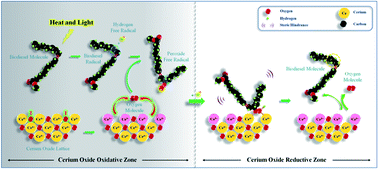
In case of the effect of nano cerium oxide on biodiesel stability, based on the Rancimat results obtained, nano cerium oxide's effect on biodiesel molecules did not follow a certain improving or deteriorating trend. More precisely, despite the sharp reduction occurred in oxidative stability of the neat biodiesel samples by the addition of 50–100 ppm of nano cerium oxide, the stability increased slightly as the additive concentration increased to 500 ppm. In fact, nano cerium oxide seems to have mainly acted as an oxidizing agent for biodiesel molecules and facilitated peroxide radicals production by donating oxygen species to the biodiesel radicals (Fig. 4), while exerted some antioxidant capabilities when it was present at high concentrations. It is worth quoting that anti-free radical and antioxidant properties of this material have been previously observed in biological systems such as DNA molecules, brain cells, neurons, visual cells and lipid cells of living organisms.17,18 For instance, Estevez and Erlichman argued that nano ceria acts as a protective agent against oxidative cell damages by moderately reducing the potent oxidizing agents in cells i.e. reactive oxygen species (ROS) accumulation.18
Cerium in nano cerium oxide lattice can reversibly bind oxygen and shift between Ce4+ and Ce3+ states under oxidizing and reducing conditions.19 The loss of oxygen and the reduction of Ce4+ to Ce3+ are accompanied by the creation of oxygen vacancies in the nanoparticle lattice. Ce3+ lattice defects as well as the resultant oxygen vacancies are abundant at the surface of nano ceria.18,20,21 These oxygen vacancies can absorb oxygen free radicals, neutralize them and then release oxygen molecules to the media around them.20 It has been reported that the concentration of Ce3+ ions on the surface of the particle increases by reducing nanoparticle size. Consequently, these would lead to increased anti-free radical ability of ceria nanoparticles.22 Because of all these properties, several studies have proposed that nano ceria could act as free-radical scavenger.21 These free radicals including peroxide and hydroxyl radicals could be produced during the degradation of biodiesel as well. However, based on the findings of the present study, nano cerium oxide (in practical concentrations) did not seem capable of scavenging the large biodiesel peroxide radicals.
To describe the different effects of nano cerium oxide in low and high dosing levels a presumption could be postulated: at low concentrations, cerium oxide lattice structure seems incapable of getting sufficiently close to the peroxide radicals produced during the first step of biodiesel degradation to scavenge them. This is due to the high steric hindrance of large biodiesel peroxide radicals. Under such conditions, only the oxygen donating property of cerium oxide could be observed whereas at high concentrations of nano cerium oxide, the accumulation of nanoparticle species around the peroxide radicals seems to overcome the steric hindrance. Then, the nanoparticles surround the peroxides produced in the propagation step of biodiesel oxidation chain reactions and prevent their contact with the other biodiesel molecules. Thus, further degradation of biodiesel molecules is inhibited by converting the free radicals to the former biodiesel molecules. This assumption is schematically shown in Fig. 4.
| This journal is © The Royal Society of Chemistry 2014 |