
DOI:
10.1039/C3RA46806B
(Paper)
RSC Adv., 2014,
4, 7634-7639
A fast in situ seeding route to the growth of a zeolitic imidazolate framework-8/AAO composite membrane at room temperature
Received
18th November 2013
, Accepted 7th January 2014
First published on 10th January 2014
Abstract
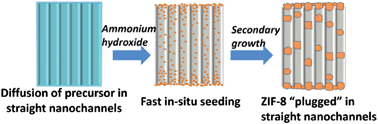
A new zeolitic imidazolate framework-8 (ZIF-8) composite membrane was prepared by a fast in situ seeding method. The commercial anodic aluminum oxide (AAO) membrane was used as the support, which was immersed in the ZIF-8 precursor solution to allow the solution to diffuse into the AAO nanochannels. Ammonium hydroxide was then added to quickly nucleate ZIF-8 nanocrystals in the AAO channels as seeds. After secondary growth at room temperature, the ZIF-8/AAO composite membrane was obtained with ZIF-8 nanocrystals plugged in the AAO nanochannels, and the membrane exhibited high gas separation performance with H2/CO2 and H2/N2 ideal selectivities of 6.38 and 4.19, respectively. For comparison, only a layer of ZIF-8 was formed on the AAO membrane surface by a normal dip-coating method with ammonium hydroxide pre-added in the precursor solution, and the resulting membrane was not dense and continuous.
1. Introduction
The basic building blocks of zeolitic imidazolate frameworks (ZIFs) are metals and imidazolate linkers that form 3D tetrahedral frameworks and resemble zeolite topologies.1,2 As a subclass of metal organic frameworks (MOFs), ZIFs have been extensively investigated in recent years mainly due to their exceptional stability, flexible framework and tunable pore size.1,3,4 In particular, ZIF-8 is one of the most studied ZIFs that is composed of Zn2+ and 2-methylimidazole ligands, forming the sodalite (SOD) structure with large cavities (11.6 Å) and small pore apertures (3.4 Å).1,5 ZIFs have shown numerous potential applications like gas sorption, gas separation, drug delivery, catalysis and sensing.6–10 Among them, the processing of ZIFs as thin films or membranes is a fast developing field and the preparation of defect-free and high performance ZIF layers is still challenging.11,12
Various strategies have been developed to prepare ZIF membranes and thin films on porous substrates. In order to increase the adhesion and compatibility between ZIFs and the porous substrate, surface modifications are generally applied by introducing nanocrystal seeds,13–15 imidazolate linkers as the reactive seeding,16–18 and organic couple agents such as polyethyleneimine7,19 and 3-aminopropyltriethoxysilane (APTES).20,21 Recently, we developed a contra-diffusion method for preparation of ZIF-8 films on porous nylon membrane, where no surface modification was required.22 Similarly, Jeong et al. developed in situ counter-diffusion method to form ZIF-8 membranes. The zinc source was pre-deposited in the porous alumina support and then diffused out in the 2-methylimidazole solution to form ZIF-8 membrane at the interface of the porous support, and the resulting ZIF-8 membranes exhibited high separation performance toward propylene over propane.23 By combining APTES chemical modification and counter-diffusion method, Yang et al. prepared ZIF-8 membranes on the macroporous tube, showing remarkably high H2 permeance.24 To enable the preparation of ZIF membranes by contra-diffusion (counter-diffusion) method, the precursor solution has to slowly diffuse in the porous support. Only a limited number of porous supports with particular pore size and structure could be used for this purpose. Another challenge to the membrane preparation is to synthesize the separation membrane as thin as possible, ideally only to “plug” the pores of the support to form the non-defective membrane.25 However, the generally used porous supports have irregular and random pore geometry, it is not practical to effectively plug the pores by using the above mentioned methods.
Anodic aluminum oxide (AAO) membrane with straight nanochannels and narrow pore size distributions have been studied for the separation of larger biomolecules and also used for the fabrication of nanowires and mesoporous materials in the confined straight channels.26,27 Sutter et al. successfully embedded MOF HKUST-1 along the channels of AAO membrane by a dynamic step-by-step methodology, where the MOF HKUST-1 nanocrystals were attached in AAO channels by cyclic flow of four solutions in the AAO channels: copper acetate solution, absolute ethanol, 1,3,5-benzenetricarboxylic acid solution and absolute ethanol.28 However, by using the static step-by-step immersion method, only small amount of HKUST-1 particles could be prepared near the both ends of AAO nanochannels.
In the present study, ZIF-8 nanoparticles were plugged in AAO nanochannels to form the continuous and defect-free ZIF-8/AAO composite membrane by using a fast in situ seeding method, followed by a secondary growth. Ammonium hydroxide was used in the seeding process to accelerate the nucleation of ZIF-8 by deprotonating organic ligands for coordination reaction.4,29–31 The AAO membrane was firstly immersed in the ZIF-8 precursor solution containing zinc nitrate, 2-methylimidazole and methanol. The precursor solution diffused into the AAO channels (Fig. 1a), and ammonium hydroxide was then added into the solution to promote the fast nucleation of ZIF-8, where the precursor solution in AAO channels transferred into ZIF-8 nanocrystals as seeds (Fig. 1b). The resulting ZIF-8/AAO composite membrane was obtained after secondary growth synthesis (Fig. 1c), and the composite membrane exhibited high separation performance of H2 over CO2 and N2. As comparison, AAO membrane was attempted to seed by immersing in the ZIF-8 precursor solution with pre-added ammonium hydroxide. However, only a layer of ZIF-8 film could be prepared on the top of AAO membrane.
 |
| | Fig. 1 The schematic of the fast in situ seeding method for preparing ZIF-8/AAO composite membrane. | |
2. Experimental section
2.1. Materials
Zinc acetate dihydrate (Zn(CH3COO)2·2H2O, 98%), 2-methylimidazole (Hmim, C4H6N2, 99%) and ammonium hydroxide solution (NH3, 28–30% aqueous solution) were purchased from Sigma-Aldrich, Australia and used without further purification. Methanol (absolute) was purchased from Merck, Australia. The AAO membranes (diameter: φ 13 mm, thickness: 0.1 mm, pore size: φ 100 nm) used here were Whatman Anodisc membranes.
2.2. Fast in situ seeding to the growth of ZIF-8/AAO membrane
AAO membrane was seeded by the fast in situ seeding method, followed by the secondary growth to “plug” the straight nanochannels by ZIF-8 particles to form the separation membrane. In a typical process, 0.082 g of Hmim (1 mmol) was dissolved in 9.6 g of methanol, 0.11 g of zinc acetate dihydrate (0.5 mmol) was then added into under stirring at room temperature. An AAO membrane was immersed vertically in the above clear solution by using a homemade holder and then ultrasonic treated for 5 min to allow the precursor diffuse into the straight nanochannels. After that 0.06 g of ammonia hydroxide solution (1 mmol NH3) was dropwise added into the solution and ultrasonically treated for another 5 min. The final precursor solution had a Zn
:
Hmim
:
NH3
:
CH3OH molar composition of 1
:
2
:
2
:
300. The solution gradually turned into milk-like suspension and was kept still at room temperature (∼20 °C) for 1 h. The seeded AAO membrane was then taken out from the milky solution and washed with methanol and air-dried at 80 °C for 10 min. The milk-like suspension was centrifugated and washed with methanol for several times, and then dried at 60 °C overnight to harvest ZIF-8 nanocrystals.
The secondary growth solution was prepared by dissolving 0.11 g of (0.5 mmol) zinc acetate dihydrate and 0.082 g of Hmim (1 mmol) into 9.6 g of methanol without addition of ammonia hydroxide. The seeded AAO membrane was immersed vertically in the synthesis solution and kept still for 4 h at room temperature. Afterwards, the resulting ZIF-8/AAO composite membrane was taken out and washed with methanol for three times and dried at 60 °C overnight. The repeated growth of ZIF-8/AAO composite membrane was conducted twice of the secondary growth as above using the fast in situ seeded AAO membrane as the starting material.
2.3. ZIF-8 seeding with ammonium hydroxide pre-added precursor solution
As comparison, AAO membrane was seeded with ammonium hydroxide pre-added precursor solution. The seeding process is very similar as above. In a typical process, an AAO membrane was immersed in the little cloudy precursor solution with a Zn
:
Hmim
:
NH3
:
CH3OH molar composition of 1
:
2
:
2
:
300. The precursor solution was then ultrasonic treated for 5 min, and kept still at room temperature for 1 h to complete the seeding process. The secondary growth of ZIF-8 was carried out in the same way as described above.
2.4. Characterization
Powder X-ray diffraction (XRD) patterns were recorded on a Rigaku Mini Flex 600 diffractometer with Cu Kα radiation (15 mA and 40 kV) at a scan rate of 2° min−1 with a step size of 0.02°. Scanning electron microscopy (SEM) images were obtained by using a FEI-NOVA NanoSEM 450 scanning electron microscope operated at 10 kV. The cross-section was obtained by breaking the AAO composite membrane using tweezers. Transmission electron microscopy (TEM) micrographs were taken using a JEOL JEM-2100F instrument at an acceleration voltage of 200 kV. The same instrument was used for taking selected area electron diffraction (SAED) patterns. Samples were collected from the ZIF-8 seeding solutions and dispersed on a copper-supported carbon film. Nitrogen adsorption–desorption isotherms were measured using a volumetric adsorption analyzer (Micromertics ASAP 2020) at liquid nitrogen temperature (77 K). All the samples were ground into powder and degassed at 120 °C for 4 h prior to analysis. Surface areas were estimated by Brunauer–Emmett–Teller (BET) method. Thermogravimetric analysis was carried out with SII Exstar TG/DTA 6300 from 30 to 700 °C at a heating rate of 5 °C min−1 under air flow.
2.5. Gas permeation
Gas permeation was tested with the same method described in our previous work.22 The ZIF-8/AAO composite membrane was firstly attached to a porous stainless steel stand (pore size: ∼200 nm), which was then fixed in a sample holder by using Torr Seal epoxy resin (Varian). Before each measurement, the composite membrane was dried at 100 °C for 2 h to remove physisorbed species (e.g., H2O). The gas permeation tests were performed at 20 °C on pure H2, N2 and CO2. In each measurement, the membrane permeation system was vacuumed for 30 min to remove residual gas before a different gas was introduced. The pressure rise of the permeate stream was measured with a Series 901 Transducer (MKS). The permeance Pi of a single gas was calculated by:
Where Ni is the permeating flow rate of component i (mol s−1); Δpi is the transmembrane pressure difference of component i (Pa), and A is the membrane area (m2). The ideal selectivity Sij is defined as the ratio of the two permeances Pi and Pj.
3. Results and discussion
3.1. ZIF-8 nanosized seeds
For the ZIF synthesis, the nucleation rate is crucial to the particle sizes. The introduction of basic media, such as sodium formate23,32 and amine,16,29–31,33 would be favorable to deprotonate organic ligands and accelerate the nucleation rate, leading to small-sized particles. Fig. 2a shows XRD pattern of the particles collected from the milky suspension after 1 h seeding. The XRD pattern is exactly same as the simulated SOD-type ZIF-8 structure. The average crystal size is ca. 20 nm calculated by the Scherrer equation. TEM image (Fig. 2b) shows spherical particles being 20 nm in size, which are in good agreement with the XRD result. SAED pattern (inset of Fig. 2b) reveals strong broadening diffraction rings of the different planes, indicating that ZIF-8 nanocrystals are small and very sensitive to the high energy of the electron beam.33 The as-synthesized ZIF-8 crystals show a type I nitrogen sorption isotherm in Fig. 2c, revealing the microporous nature of the ZIF-8 crystals. The BET surface area and microporous volume of the ZIF-8 nanocrystals are 1173 m2 g−1 and 0.85 cm3 g−1, respectively. In addition, the nitrogen isotherm exhibits a second step at a relative high pressure (P/Po > 0.6) with an obvious adsorption–desorption hysteresis loop corresponding to interparticle mesopores.
 |
| | Fig. 2 XRD pattern (a), TEM image and SAED pattern (inset) (b) and nitrogen sorption isotherm (c) of ZIF-8 nanocrystals prepared with a Zn : Hmim : NH3 : CH3OH molar composition of 1 : 2 : 2 : 300. | |
3.2. Fast in situ seeding to prepare ZIF-8/AAO composite membrane
Fig. 3a–c show the SEM images of the commercial AAO membrane, which contains smooth straight channels with diameter of ca. 200 nm and smaller apertures (∼100 nm). The XRD pattern in Fig. 4 indicates a characteristic amorphous structure.34 After fast in situ seeding process, SEM images (Fig. 3d–f) show a lot of nanocrystals are scattered on the surface of AAO substrate, and some nanoparticles are attached on the inner wall of the straight nanochannels. Although the XRD pattern in Fig. 4 is relatively weak, the main characteristic peaks can be identified to ZIF-8. After the secondary growth, XRD peak intensities of ZIF-8 obviously become stronger. The top-view SEM image in Fig. 3g indicates that a well-grown polycrystalline structure can be clearly observed. Defects such as pinholes or cracks are not found in the entire membrane surface. From the cross-section SEM images in Fig. 3h and i, it can be seen that ZIF-8 nanoparticles on the surface are “plugged” in the AAO nanochannels (white arrow). ZIF-8 crystals inside the straight nanochannels form a bar-like structure (blue arrows) that is tightly adhered to the inner wall. More ZIF-8 crystals were quickly grown on the top surface of AAO membrane, which would block the ZIF-8 precursor solution further diffuse into the nanochannels. Due to limited precursor solution could be reached into the nanochannels, only a very short bar structure could be formed inside the channels. The distribution of the bar-like structure is dominated by the location of ZIF-8 seeds formed in the fast in situ seeding process. In addition, the bar-like ZIF-8 nanocrystals form a very thin separation membrane that is expected to have better gas separation performance.
 |
| | Fig. 3 SEM images of blank AAO membrane (a–c), fast in situ seeded AAO membrane with ZIF-8 nanocrystals (d–f) and the ZIF-8/AAO composite membrane after subsequent secondary growth (g–i). Top-view images (a, d, g) and cross-section images (b, c, e, f, h, i). | |
 |
| | Fig. 4 XRD patterns of the ZIF-8/AAO composite membrane in different synthetic period. | |
With a repeated growth in a fresh solution, the XRD peaks of ZIF-8 in Fig. 4 are much stronger. The top-view SEM image of the repeated growth ZIF-8 layer is shown in Fig. 5a. ZIF-8 particles become larger as compared to the secondary growth membrane, which results in apparent grain boundaries. The cross-section SEM image in Fig. 5b shows ZIF-8 grains extruded out from the nanochannels and form a thin separate layer about 0.5 μm in thickness. Because commercial AAO membrane is thermally stable below 700 °C,34 the ZIF-8 loading amounts of the composite membranes can be roughly calculated by the weight loss in TG curves (Fig. 5c), assuming no adsorbates exist in the structure above 250 °C and all weight loss is contributed from the structural degradation from ZIF-8 [Zn(C4H5N2)2; Mw = 229] to zinc oxide [ZnO; Mw = 81]. The result shows the ZIF-8 loading amounts increase from 6.2% for the secondary growth sample to 15.5% for the repeated growth one. The nitrogen sorption isotherms of the two composite membranes are shown in Fig. 5d, and their BET surface areas are 101 and 216 m2 g−1, respectively.
 |
| | Fig. 5 Top-view (a) and cross-section (b) SEM images of the ZIF-8/AAO composite membranes after repeated growth. TGA curves (under air flow) (c) and nitrogen adsorption–desorption isotherms (d) of the ZIF-8/AAO composite membranes. | |
3.3. ZIF-8 seeding with ammonium hydroxide pre-added precursor solution (normal seeding)
For comparison, AAO membrane was seeded by immersing into the ZIF-8 precursor solution pre-added with ammonium hydroxide. Fig. 6a shows the top-view SEM image of the AAO membrane, where only small amount of nanocrystals are deposited on the surface of the porous support. However, there is no nanoparticles found inside the nanochannels (Fig. 6b). After a secondary growth in a fresh solution, the SEM images in Fig. 6c and d show a continuous ZIF-8 layer with intercrystal gaps on the surface of AAO membrane with a thickness of ca. 0.35 μm. In contrast to the aforementioned ZIF-8/AAO composite membrane that ZIF-8 crystals are “plugged” into the nanochannels, this ZIF-8 layer shows a very clear interface as shown in Fig. 6d, suggesting no ZIF-8 nanocrystals are grown from the nanochannels of the AAO support. This result confirms that the seeding process is crucial to the preparation of ZIF-8/AAO composite membrane. ZIF-8 precursor solution with ammonium hydroxide could not efficiently reach into the nanochannels even with an ultrasonic assistance. This is due to a lot of ZIF-8 nuclei (nanocrystals) have already formed in the precursor solution (a little cloudy) before the immersion of AAO membrane, and the ZIF-8 nuclei quickly grow into nanoparticles in the solution and consume all the nutrients. The size of the nanocrystals is relatively big and capillary force might not be enough to bring them into the nanochannels. Moreover, the nanocrystals might aggregate (Fig. 2b) that prevents them from entering the nanopores of AAO membrane. On the contrary, during the fast in situ seeding process, the clear ZIF-8 precursor solution without ammonium hydroxide can easily diffuse into the channel (Fig. 1a) and then fast in situ crystallized into ZIF-8 seeds with the assistance of ammonia hydroxide solution (Fig. 1b).
 |
| | Fig. 6 SEM images of AAO membrane seeded with ammonium hydroxide pre-added precursor solution (a, b) and ZIF-8/AAO composite membrane after subsequent secondary growth (c, d). Top-view images (a, c) and cross-section images (b, d). | |
3.4. Gas separation performance of the ZIF-8/AAO composite membrane
Single gas permeation experiments (H2, CO2 and N2) were carried out to examine the quality of the ZIF-8/AAO composite membranes. In comparison, single gas permeation on the blank AAO membrane was tested. It shows a H2 permeance of 63.1 × 10⁻⁷ mol m−2 s−1 Pa−1 with H2/CO2 and H2/N2 ideal selectivities of 1.01 and 1.23, respectively, indicating the AAO support has no gas separation selectivity due to its large pore diameter. However, after the fast in situ seeding and secondary growth of ZIF-8, the gas permeance of the ZIF-8/AAO composite membrane drastically decreases, showing H2, CO2, N2 permeance of 1.34 × 10⁻⁷, 0.21 × 10⁻⁷ and 0.32 × 10⁻⁷ mol m−2 s−1 Pa−1, respectively. The ideal selectivities increase to 6.38 for H2/CO2 and 4.19 for H2/N2, which are higher than the corresponding Knudsen diffusion selectivity (H2/CO2: 4.69; H2/N2: 3.74).22,35 For the ZIF-8/AAO composite membrane prepared by the repeated growth, it exhibits a little higher gas separation performance due to the higher thickness of the ZIF-8 layer (H2/CO2 and H2/N2 ideal selectivities of 7.64 and 4.67, respectively), but showing a relatively low gas permeance (H2 permeance of 0.84 × 10⁻⁷ mol m−2 s−1 Pa−1). For the composite membrane prepared by a normal seeding and secondary growth, their ideal selectivities (H2/CO2: 3.08, H2/N2: 2.97) are less than the Knudsen diffusion selectivity, suggesting such composite membrane has defects and is not suitable for gas separation.
4. Conclusion
We demonstrated a novel technique for the preparation of ZIF-8/AAO composite membrane by a new in situ seeding method at room temperature. The ZIF-8 precursor solution was firstly diffused into the AAO channel and fast in situ crystallized by introducing ammonium hydroxide. After the secondary growth, ZIF-8 nanocrystals are plugged in the AAO nanochannels and the ZIF-8/AAO composite membrane exhibits high gas separation performance with H2/CO2 and H2/N2 ideal selectivities of 6.38 and 4.19, respectively. The channel-plugging of ZIF-8 crystals are proved to be effective for gas separation as compared to the membrane prepared by a normal seeding method. Repeated growth of ZIF-8/AAO composite membrane could increase the gas separation performance with H2/CO2 and H2/N2 ideal selectivities of 7.64 and of 4.67, respectively.
Acknowledgements
This work was supported by the Australian Research Council and Monash University. M. H. would like to thank the Department of Chemical Engineering at Monash University for supporting his visiting research. J. Y. thanks Monash University for the Monash Fellowship. H. W. thanks the Australian Research Council for a Future Fellowship.
Notes and references
- K. S. Park, Z. Ni, A. P. Cote, J. Y. Choi, R. Huang, F. J. Uribe-Romo, H. K. Chae, M. O'Keeffe and O. M. Yaghi, Proc. Natl. Acad. Sci. U. S. A., 2006, 103, 10186–10191 CrossRef CAS PubMed.
- A. Phan, C. J. Doonan, F. J. Uribe-Romo, C. B. Knobler, M. O'Keeffe and O. M. Yaghi, Acc. Chem. Res., 2010, 43, 58–67 CrossRef CAS PubMed.
- D. Fairen-Jimenez, S. A. Moggach, M. T. Wharmby, P. A. Wright, S. Parsons and T. Dueren, J. Am. Chem. Soc., 2011, 133, 8900–8902 CrossRef CAS PubMed.
- M. He, J. F. Yao, L. X. Li, K. Wang, F. Y. Chen and H. T. Wang, ChemPlusChem, 2013, 78, 1222–1225 CrossRef CAS.
- X. C. Huang, Y. Y. Lin, J. P. Zhang and X. M. Chen, Angew. Chem., Int. Ed., 2006, 45, 1557–1559 CrossRef CAS PubMed.
- R. Banerjee, H. Furukawa, D. Britt, C. Knobler, M. O'Keeffe and O. M. Yaghi, J. Am. Chem. Soc., 2009, 131, 3875–3877 CrossRef CAS PubMed.
- H. Bux, A. Feldhoff, J. Cravillon, M. Wiebcke, Y. S. Li and J. Caro, Chem. Mater., 2011, 23, 2262–2269 CrossRef CAS.
- H. L. Jiang, B. Liu, T. Akita, M. Haruta, H. Sakurai and Q. Xu, J. Am. Chem. Soc., 2009, 131, 11302–11303 CrossRef CAS PubMed.
- N. Chang, Z. Y. Gu and X. P. Yan, J. Am. Chem. Soc., 2010, 132, 13645–13647 CrossRef CAS PubMed.
- G. Lu, O. K. Farha, W. N. Zhang, F. W. Huo and J. T. Hupp, Adv. Mater., 2012, 24, 3970–3974 CrossRef CAS PubMed.
- T. Yang, Y. Xiao and T.-S. Chung, Energy Environ. Sci., 2011, 4, 4171–4180 CAS.
- A. W. Thornton, D. Dubbeldam, M. S. Liu, B. P. Ladewig, A. J. Hill and M. R. Hill, Energy Environ. Sci., 2012, 5, 7637–7646 CAS.
- H. Bux, F. Liang, Y. Li, J. Cravillon, M. Wiebcke and J. Caro, J. Am. Chem. Soc., 2009, 131, 16000–16001 CrossRef CAS PubMed.
- S. R. Venna and M. A. Carreon, J. Am. Chem. Soc., 2010, 132, 76–78 CrossRef CAS PubMed.
- Y. C. Pan and Z. P. Lai, Chem. Commun., 2011, 47, 10275–10277 RSC.
- M. C. McCarthy, V. Varela-Guerrero, G. V. Barnett and H.-K. Jeong, Langmuir, 2010, 26, 14636–14641 CrossRef CAS PubMed.
- Y. X. Hu, X. L. Dong, J. P. Nan, W. Q. Jin, X. M. Ren, N. P. Xu and Y. M. Lee, Chem. Commun., 2011, 47, 737–739 RSC.
- L. X. Li, J. F. Yao, R. Z. Chen, L. He, K. Wang and H. T. Wang, Microporous Mesoporous Mater., 2013, 168, 15–18 CrossRef CAS PubMed.
- Y. S. Li, F. Y. Liang, H. G. Bux, W. S. Yang and J. Caro, J. Membr. Sci., 2010, 354, 48–54 CrossRef CAS PubMed.
- A. S. Huang, H. Bux, F. Steinbach and J. Caro, Angew. Chem., Int. Ed., 2010, 49, 4958–4961 CrossRef CAS PubMed.
- A. S. Huang, N. Y. Wang, C. L. Kong and J. Caro, Angew. Chem., Int. Ed., 2012, 51, 10551–10555 CrossRef PubMed.
- J. F. Yao, D. H. Dong, D. Li, L. He, G. S. Xu and H. T. Wang, Chem. Commun., 2011, 47, 2559–2561 RSC.
- H. T. Kwon and H. K. Jeong, J. Am. Chem. Soc., 2013, 135, 10763–10768 CrossRef CAS PubMed.
- Z. Xie, J. H. Yang, J. Q. Wang, J. Bai, H. M. Yin, B. Yuan, J. M. Lu, Y. Zhang, L. Zhou and C. Y. Duan, Chem. Commun., 2012, 48, 5977–5979 RSC.
- S. Miachon, E. Landrivon, M. Aouine, Y. Sun, I. Kumakiri, Y. Li, O. P. Prokopova, N. Guilhaurne, A. Giroir-Fendler, H. Mozzanega and J. A. Dalmon, J. Membr. Sci., 2006, 281, 228–238 CrossRef CAS PubMed.
- X. Y. Zhang, L. D. Zhang, G. W. Meng, G. H. Li, N. Y. Jin-Phillipp and F. Phillipp, Adv. Mater., 2001, 13, 1238–1241 CrossRef CAS.
- B. Platschek, A. Keilbach and T. Bein, Adv. Mater., 2011, 23, 2395–2412 CrossRef CAS PubMed.
- M. Maksoud, N. Roques, S. Brandes, L. Arurault and J. P. Sutter, J. Mater. Chem. A, 2013, 1, 3688–3693 CAS.
- M. He, J. F. Yao, L. X. Li, Z. X. Zhong, F. Y. Chen and H. T. Wang, Microporous Mesoporous Mater., 2013, 179, 10–16 CrossRef CAS PubMed.
- J. F. Yao, M. He, K. Wang, R. Z. Chen, Z. X. Zhong and H. T. Wang, CrystEngComm, 2013, 15, 3601–3606 RSC.
- M. He, J. F. Yao, Q. Liu, Z. X. Zhong and H. T. Wang, Dalton Trans., 2013, 42, 16608–16613 RSC.
- M. Shah, H. T. Kwon, T. Vu, S. Sachdeva and H.-K. Jeong, Microporous Mesoporous Mater., 2013, 165, 63–69 CrossRef CAS PubMed.
- J. Cravillon, R. Nayuk, S. Springer, A. Feldhoff, K. Huber and M. Wiebcke, Chem. Mater., 2011, 23, 2130–2141 CrossRef CAS.
- A. Kirchner, K. J. D. MacKenzie, I. W. M. Brown, T. Kemmitt and M. E. Bowden, J. Membr. Sci., 2007, 287, 264–270 CrossRef CAS PubMed.
- G. S. Xu, J. F. Yao, K. Wang, L. He, P. A. Webley, C. S. Chen and H. T. Wang, J. Membr. Sci., 2011, 385, 187–193 CrossRef PubMed.
|
| This journal is © The Royal Society of Chemistry 2014 |
Click here to see how this site uses Cookies. View our privacy policy here.