DOI:
10.1039/C3RA46229C
(Paper)
RSC Adv., 2014,
4, 7035-7040
Copper-promoted cascade reaction of active methylenes with MBH-acetates of acetylenic aldehydes to functionalized cyclopentenes†
Received
29th October 2013
, Accepted 8th November 2013
First published on 19th November 2013
Abstract
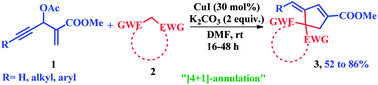
One-pot synthesis of substituted cyclopentenes was accomplished through a copper-mediated [4 + 1]-annulation of active methylene compounds with Morita–Baylis–Hillman (MBH) acetates of acetylenic aldehydes. The reaction sequence involves the cascade allylic substitution/5-exo-dig-carbocyclization, which was effective in providing methylene, alkylidene as well as arylidene cyclopentenes.
Introduction
Cyclopentyl moiety is one of the important carbocyclic framework present in a number of bio-active natural products as well as pharmaceuticals and has attracted lot of attention for its synthesis.1 Consequently, a range of methods have been developed for the synthesis of functionalized cyclopentyl derivatives. Among these methods, the classical thermal cyclization of an alkyne-bearing enolizable carbonyl group compounds, Conia-ene reaction, is a captivating method to obtain exocyclic-methylene cyclopentane products2 and in few occasions the products are alkyl/arylidene cyclopentanes.3 To the best of our knowledge, there is a very limited number of methods known for the synthesis of functionalized cyclopentenes through alkyne-based cyclization reactions.4 This is particularly true for cyclopentenes with spirocyclic nature, which are common structural components in many bio-active natural products. For instance, jatamanin M, menellin A, trans-α-necrodol, (+)-oshalagrenol, sequosemperivirin-A, α-vetispirene are bio-active natural products having cyclopentene embedded in their structure (Fig. 1).5 Therefore, it is expedient to have an efficient method for the synthesis of functionalized cyclopentenes.
 |
| | Fig. 1 Selected bio-active natural products having cyclopentene. | |
Very recently, we have reported an access to functionalized arylidene cyclopentenes under metal-free reaction conditions through the base-promoted [4 + 1]-annulation of Morita–Baylis–Hillman acetates of acetylenic aldehydes (C4-synthon) with active methylenes involving tandem allylic substitution followed by 5-exo-dig-carbocyclization.6 However, the inaccessibility of either methylene or alkylidene cyclopentenes was a constraint of the above method. To overcome this, further studies have been carried out with the objective of finding appropriate reaction conditions to obtain the alkylidene/methylene cyclopentenes, emphasizing on spirocyclic-cyclopentenes.
Morita–Baylis–Hillman (MBH) adducts and their derivatives have been proven to be one of the most flexible synthons in the rapid formation of useful heterocycles and carbocycles through various transformations.7 MBH-acetates/carbonates have also been utilized in the synthesis of substituted cyclopentenes via the phosphine-catalyzed annulation reaction.8 In continuation of our work on MBH-chemistry of acetylenic aldehydes,9 herein we wish to report the [4 + 1]-annulation of Morita–Baylis–Hillman acetates of acetylenic aldehydes with 1,1′-bisnucleophiles affording methylene and alkylidene as well as arylidene cyclopentenes under mild reaction conditions (Scheme 1).
 |
| | Scheme 1 Synthesis of functionalized cyclopentenes. | |
Results and discussion
As our aim is to identify the suitable reaction conditions for MBH-acetate of acetylenic aldehyde bearing on alkyl group on alkyne functionality, the preliminary studies were performed by the reaction of MBH-acetate 1a with ethyl cyanoacetate (2a).
The reaction of 1a with 2a in the presence of K2CO3 provided the dialkylated product 4a in 72% yield at room temperature without giving any cyclized product (entry 1, Table 1). Change of base to Cs2CO3 resulted in no reaction even after 48 h at room temperature (entry 2, Table 1). From our earlier study, it was observed that the reaction of MBH-acetates of acetylenic aldehydes with active methylene derivatives proceeds through allylic substitution followed by conjugate addition in anti-fashion. This was supported by the faster reactivity of MBH-acetates having electron-deficient aromatics on alkyne functionality when compared to electron-rich aryl groups and no reactivity of MBH-acetates having alkyl group on alkyne.6 Therefore, we envisaged that the use of alkyne activators in the presence of base might promote the conjugate addition. Hence, I2/NaHCO3 system and the combination of Au–Ag catalysis/NaHCO3 were tested and found that they were ineffective to promote even the alkylation neither at rt nor at 70 °C (entry 3 and 4, Table 1). Inspired by Balme et al. results,10 we were prompted to use a Cu-catalyst for activation of alkyne and gratified to see that the reaction proceeded to give the expected cyclopentene 3a (37%) in the presence of 10 mol%-CuI along with the monoalkylated compound 5a in 42% yield (entry 5, Table 1).11 Subsequent optimization revealed that the use of 30 mol% CuI furnished 3a in 74% yield (entry 6, Table 1). Absence of base however did not show any progress in the reaction (entry 7, Table 1).
Table 1 Optimization of reaction conditions

|
| Entry |
Reagent system/T (°C) |
Time (h) |
Product/yielda (%) |
| Isolated yield. |
| 1 |
K2CO3 (2.5 equiv.) DMF/80 °C |
16 |
4a/72 |
| 2 |
Cs2CO3 (2 equiv.) DMF/80 °C |
48 |
— |
| 3 |
NaHCO3 (3 equiv.) I2 (3 equiv.)/CH3CN/rt – 70 °C |
24 |
— |
| 4 |
AuCl (PPh3) (0.1 equiv.) AgSbF6 (0.1 equiv.) NaHCO3 (12 equiv.)/EDC/rt |
24 |
— |
| 5 |
K2CO3 (2.5 equiv.)/CuI (0.1 equiv.) DMF/rt |
36 |
3a/37 5a/42 |
| 6 |
K2CO3 (2 equiv.)/CuI (0.3 equiv.) DMF/rt |
48 |
3a/74 |
| 7 |
CuI (0.3 equiv.) DMF/rt |
48 |
— |
With the optimized conditions in hand, we next examined the scope of this [4 + 1]-annulation reaction with various active methylene derivatives as 1,1′-bis-nucleophiles and MBH-acetates of acetylenic aldehydes having different substitution on alkyne functionality and the results are summarized in Table 2. First, the reaction of MBH-acetate 1a and 1b having n-propyl and n-hexyl substitution on alkyne functionality, respectively, with other acyclic active methylene compounds, ethyl acetoacetate (2b) and ethyl picolinoylacetate (2c), was smoothly proceeded to give the corresponding alkylidene cyclopentenes, 3b to 3f, in good yields. To further expand the range of substrates, cyclic bis-nucleophiles were explored which are expected to offer the spiro-carbocycles, key structural frameworks in several bio-active natural products.1
Table 2 Synthesis of alkylidene cyclopentenes
Accordingly, MBH-acetate 1a was treated with 5,5-dimethyl-1,3-cyclohexanedione (2d) under CuI/K2CO3 conditions and the formation of spiro-carbocycle 3g in 80% yield was observed. Similarly, 1b was also reacted with 2d to give the spiro-cycle 3h in 83% yield. This success encouraged us to study the reactivity of additional cyclic bisnucleophiles such as 1,3-cyclopentanedione (2e) and 3,3-dimethyl barbutyric acid (2f), with MBH-acetates 1a and 1b. Interestingly, all these reactions afforded the corresponding spiro-cyclopentene derivatives, 3i to 3k, in good yields. Noteworthy to mention that, to the best of our knowledge there is only one example known in the literature using cyclic-1,3-diketone towards cyclopentane synthesis in Conia-ene reaction.12 Therefore, the present method provides an easy access to spiro-cyclopentenes. Additionally, the reaction of phenyl sulphonylacetophenone (2g) with MBH-acetate 1a also afforded the corresponding cyclopentene 3l in 85% yield. The stereo chemical assignment of exocyclic trisubstituted olefin was studied on compound 3b using NOE experiments, which showed as Z-geometry (Fig. 2).
 |
| | Fig. 2 Key NOE enhancement of compound 3b. | |
We continued to elucidate the scope of the present [4 + 1]-annulation with MBH-acetate 1c having terminal alkyne functionality. The reactions of 1c with different acyclic bisnucleophiles 2a and 2b as well as the cyclic bisnucleophile 2d progressed successfully to give the corresponding methylene-cyclopentenes 3m, 3n and 3o, respectively (Scheme 2).
 |
| | Scheme 2 Reactions of MBH-acetate 1c. | |
Finally, the reactions of MBH-acetates bearing aryl groups on the alkyne with cyclic active methylene 2d were also investigated fruitfully to obtain the corresponding arylidene spiro-cyclopentenes 3p and 3q in 85% and 81% yield, respectively. It is important to disclose that these reactions furnished the inseparable mixture of compounds in the absence of CuI (Scheme 3).
 |
| | Scheme 3 Reactions of MBH-acetates 1d and 1e. | |
A possible reaction mechanism is shown in Scheme 4. In the first step, MBH-acetate 1a reacts with 2a in the presence of base to provide mono-alkylated compound 5a.13 Then, it is anticipated that CuI promotes the K2CO3-mediated 5-exo-dig-carbocyclization through I and II involving anti-addition on alkyne to give the cyclopentene 3a.10a,b The intermediate compound 5a was isolated and fully characterized (entry 5, Table 1). Further, 5a was also independently treated with 30 mol%-CuI/K2CO3 in DMF and the successful formation of 3a was observed. This method is a new variation of Conia-ene type reaction, providing cyclopentenes having Z-geometry on exocyclic olefin, while in the Conia-ene reaction the products are cyclopentanes with E-geometry as it proceeds through a concerted transition state leading to syn-addition to the alkyne.
 |
| | Scheme 4 Proposed mechanism. | |
Conclusions
In summary, we have developed an approach to the construction of functionalized cyclopentenes using copper-mediated tandem cyclization reactions of MBH-acetates of acetylenic aldehydes and active methylene compounds. This approach allows one to make the methylidene, alkylidene as well as arylidene cyclopentenes in a single step with a wide substrate scope. The synthesis of various spiro cyclic-cyclopentenes is a salient feature of the method. We believe that the present protocol is a complementary approach to the existing methods, which can find applications in the synthesis of cyclopentenes.
Experimental
General
All the reactions were performed under nitrogen in oven-dried glassware. Commercially available reagents were used, unless otherwise indicated. Solvents ethyl acetate and petroleum ether were distilled prior to use for column chromatography. Column chromatography was carried out with silica gel (60–120 mesh). 1H and 13C NMR spectra were recorded in CDCl3 with 300 MHz and 500 MHz instruments at ambient temperature. Chemical shifts were measured in ppm scale with TMS as internal reference and coupling constants were expressed in Hertz (Hz). The shifts were measured relative to the TMS (0 ppm) and CDCl3 (77.0 ppm). All 13C NMR spectra were proton decoupled. Infrared (IR) spectra were recorded on a Perkin-Elmer 400 FTIR spectrophotometer as KBr matrix. High resolution mass spectra (HRMS) were recorded on Agilent Technologies 6510 Q-TOF spectrometer.
General experimental procedure. To a stirred solution of MBH-acetate 1 (1.0 mmol) and active methylene compound 2 (1.1 mmol) in DMF (5.0 mL) at 0 °C, CuI (0.3 mmol) and K2CO3 (2.0 mmol) were added under N2 atmosphere. Then the resulting heterogeneous mixture was slowly (∼20 min) brought to rt and continued stirring at rt for the specified time. After completion of the reaction (monitored by TLC), it was diluted with ethyl acetate (50 mL) and washed with cold water (2 × 20 mL) and brine (15 mL). The ethyl acetate layer was dried over Na2SO4 and concentrated under reduced pressure to obtain the crude material. Then, it was purified by column chromatography over silica gel to get the corresponding cyclopentene 3.
(Z)-1-Ethyl-3-methyl-5-butylidene-1-cyanocyclopent-3-ene-1,3-dicarboxylate (3a). Yield 74%; colorless liquid; 1H NMR (CDCl3, 300 MHz): δ 6.91 (br s, 1H), 6.01 (t, J = 7.9 Hz, 1H), 4.29 (q, J = 7.1 Hz, 2H), 3.78 (s, 3H), 3.41 (s, 2H), 2.50–2.34 (m, 1H), 2.29–2.13 (m, 1H), 1.57–1.39 (m, 2H), 1.33 (t, J = 7.1 Hz, 3H). 0.96 (t, J = 7.3 Hz, 3H); 13C NMR (CDCl3, 75 MHz): δ 167.4, 164.2, 141.3, 141.0, 136.2, 133.4, 117.9, 63.3, 51.8, 46.8, 44.0, 31.1, 22.0, 13.9, 13.6; IR (KBr):
max 2961, 2873, 2245, 1743, 1717, 1610, 1252, 1110, 1051, 746 cm−1; MS (ESI): m/z 300 (M + Na)+; HRMS (ESI): m/z calcd for C15H20NO4 (M + H)+: 278.1387, found: 278.1398.
(Z)-1-Ethyl-3-methyl-1-cyano-5-heptylidenecyclopent-3-ene-1,3-dicarboxylate (3b). Yield 72%; brown liquid, 1H NMR (CDCl3, 300 MHz): δ 6.91 (s, 1H), 6.01 (t, J = 7.5 Hz, 1H), 4.29 (q, J = 7.5 Hz, 2H), 3.78 (s, 3H), 3.41 (s, 2H), 2.50–2.35 (m, 1H), 2.30–2.13 (m, 1H), 1.53–1.21 (m, 11H), 0.88 (t, J = 6.8 Hz, 3H); 13C NMR (CDCl3, 125 MHz): δ 167.3, 164.1, 141.2, 140.8, 136.4, 133.4, 117.9, 63.2, 51.8, 46.8, 43.9, 31.5, 29.3, 28.9, 22.4, 28.6, 13.9, 13.8; IR (KBr):
max 3452, 2928, 2857, 2245, 1740, 1717, 1611, 1251, 1094, 747 cm−1; MS (ESI): m/z 342 (M + H)+; HRMS (ESI): m/z calcd for C19H19O5NNa (M + Na)+: 364.1155, found: 364.1171.
(Z)-1-Ethyl-3-methyl-1-acetyl-5-butylidenecyclopent-3-ene-1,3-dicarboxylate (3c). Yield 62%; brown liquid; 1H NMR (CDCl3, 300 MHz): δ 6.91 (s, 1H), 6.02 (t, J = 7.5 Hz, 1H), 4.30–4.08 (m, 2H), 3.77 (s, 3H), 3.49 (d, J = 18.1 Hz, 1H), 3.08 (d, J = 18.1 Hz, 1H), 2.43–1.92 (m, 5H), 1.52–1.35 (m, 2H), 1.28 (t, J = 7.5 Hz, 3H), 0.92 (t, J = 7.5 Hz, 3H); 13C NMR (CDCl3, 75 MHz): δ 202.0, 170.3, 164.9, 143.9, 141.4, 137.2, 132.8, 67.9, 61.8, 51.7, 40.6, 32.1, 25.7, 22.2, 13.8, 13.9; IR (KBr):
max 3450, 2960, 1714, 1610, 1251, 1102, 751, 622 cm−1 MS (ESI): m/z 312 (M + Na)+; HRMS (ESI): m/z calcd for C16H23O5 (M + H)+ 295.1540, found 295.1556.
(Z)-1-Ethyl-3-methyl-1-acetyl-5-heptylidenecyclopent-3-ene-1,3-dicarboxylate (3d). Yield 65%; brown liquid; 1H NMR (CDCl3, 300 MHz): δ 6.91 (s, 1H), 6.02 (t, J = 7.5 Hz, 1H), 4.29–4.16 (m, 2H), 3.77 (s, 3H), 3.49 (d, J = 18.1 Hz, 1H), 3.09 (d, J = 18.1 Hz, 1H), 2.37–1.94 (m, 5H), 1.43–1.21 (m, 11H), 0.88 (t, J = 7.5 Hz, 3H); 13C NMR (CDCl3, 75 MHz): 202.2, 170.3, 165.5, 143.3, 141.3, 137.4, 135.1, 61.8, 61.3, 51.7, 50.1, 40.7, 31.6, 30.2, 29.1, 29.0, 25.8, 22.5, 14.0; IR (KBr):
max 2928, 1716, 1610, 1251, 1437, 772, 623 cm−1; MS (ESI): m/z 359 (M + Na)+; HRMS (ESI): m/z calcd for C19H29O5 (M + H)+: 337.2010, found: 337.2021.
(E/Z)-1-Ethyl-3-methyl-5-butylidene-1-picolinoylcyclopent-3-ene-1,3-dicarboxylate (3e). Yield 57%; (28
:
72 E
:
Z). Brown liquid; 1H NMR (CDCl3, 300 MHz): δ 8.71–8.56 (m, 1H), 8.12–8.04 (m, 1H), 7.90–7.79 (m, 1H), 7.55–7.37 (m, 1H), 6.92 (s, 1H), 6.10 (t, J = 7.9 Hz, 1H), 4.27–3.90 (m, 3H), 3.73 (s, 3H), 2.92 (d, J = 18.9 Hz, 1H), 2.46–2.10 (m, 2H), 1.54–1.18 (m, 2H), 1.06 (t, J = 7.1 Hz, 3H), 0.90 (t, J = 7.1 Hz, 3H); 13C NMR (CDCl3, 75 MHz): δ 193.8, 170.6, 165.2, 151.3, 148.1, 144.1, 141.0, 137.5, 136.8, 134.9, 126.8, 123.3, 61.2, 51.4, 43.3, 40.7, 31.9, 22.3, 13.8, 13.6; IR (KBr):
max 3450, 2959, 1708, 1613, 1244, 1186, 770 cm−1; MS (ESI): m/z 379 (M + Na)+ HRMS (ESI): m/z calcd for C20H24O5N (M + H)+: 358.1649, found 358.1642.
(E/Z)-1-Ethyl-3-methyl-5-heptylidene-1-picolinoylcyclopent-3-ene-1,3-dicarboxylate (3f). Yield 52%; (20
:
80 E
:
Z); brown liquid; 1H NMR (CDCl3, 300 MHz): δ 8.60 (d, J = 3.7 Hz, 1H), 8.12 (d, J = 7.5 Hz, 1H), 7.85 (dt, J = 7.5, 1.5 Hz, 1H), 7.43 (dt, J = 7.5, 1.5 Hz, 1H), 6.92 (s, 1H), 6.10 (t, J = 7.5 Hz, 1H), 4.25–4.05 (m, 2H), 3.99 (d, J = 18.8 Hz, 1H), 3.72 (s, 3H), 2.92 (d, J = 18.8 Hz, 1H), 2.19 (q, J = 7.5 Hz, 2H), 1.39–1.23 (m, 8H), 1.06 (t, J = 7.5 Hz, 3H), 0.87 (t, J = 6.8 Hz, 3H); 13C NMR (CDCl3, 75 MHz): δ 193.8, 170.6, 165.3, 151.5, 148.1, 144.1, 141.0, 137.7, 136.8, 132.9, 126.7, 123.3, 64.1, 61.2, 51.4, 43.4, 31.7, 30.0, 29.2, 29.0, 22.5, 14.0, 13.7; IR (KBr):
max 3450, 2926, 2855, 1709, 1611, 1436, 1244, 1097, 747 cm−1; MS (ESI): m/z 400 (M + H)+; HRMS (ESI): m/z calcd for C23H29O5NNa (M + Na)+: 422.1937, found 422.1950.
(Z)-Methyl-4-butylidene-8, 8-dimethyl-6,10-dioxospiro[4.5]dec-2-ene-2-carboxylate (3g). Yield 80%; semi solid; 1H NMR (CDCl3, 300 MHz): δ 6.98 (br. s, 1H), 6.15 (t, J = 7.3 Hz, 1H), 3.72 (s, 3H), 3.09 (s, 2H), 2.90 (d, J = 14.5 Hz, 2H), 2.54 (d, J = 14.5 Hz, 2H), 1.79–1.52 (m, 3H), 1.51–1.35 (m, 1H), 1.22 (s, 3H), 1.03 (s, 3H), 0.87 (t, J = 7.3 Hz, 3H); 13C NMR (CDCl3, 75 MHz): δ 203.7, 187.3, 145.5, 139.2, 136.7, 129.1, 72.8, 51.6, 51.3, 44.7, 33.8, 31.1, 30.3, 27.1, 21.7, 13.8; IR (KBr):
max 2956, 2874, 1709, 1604, 1244, 1185, 1106, 1062, 747 cm−1; MS (ESI): m/z 327 (M + Na)+; HRMS (ESI): m/z calcd for C18H24NaO4 (M + Na)+ 327.1567, found 327.1568.
(Z)-Methyl-4-heptylidene-8,8-dimethyl-6,10-dioxospiro[4.5]dec-2-ene-2-carboxylate (3h). Yield 83%; pale yellow semi solid; 1H NMR (CDCl3, 300 MHz): δ 6.97 (s, 1H), 6.15 (t, J = 7.5 Hz, 1H), 3.72 (s, 3H), 3.09 (s, 2H), 2.89 (d, J = 14.3 Hz, 2H), 2.53 (d, J = 14.3 Hz, 2H), 1.43–1.09 (m, 11H), 0.96–0.81 (m, 6H); 13C NMR (CDCl3, 125 MHz): 205.4, 164.8, 143.4, 137.4, 134.8, 131.3, 72.3, 51.8, 37.9, 31.5, 30.0, 29.8, 29.6, 29.4, 29.5, 28.7, 27.8, 22.4, 13.98; IR (KBr):
max 3409, 2955, 2858, 1704, 1608, 1437, 1250, 1093, 74–8 cm−1; MS (ESI): m/z 369 (M + Na)+; HRMS (ESI): m/z calcd for C21H31O4 (M + H)+: 347.2217, found: 347.2213.
(Z)-Methyl-4-butylidene-6,9-dioxospiro[4.4]non-2-ene-2 carboxylate (3i). Yield 63%; colorless oil; 1H NMR (CDCl3, 500 MHz): δ 6.99 (t, J = 1.6 Hz, 1H), 5.86 (t, J = 7.6 Hz, 1H), 3.74 (s, 3H), 3.06–2.98 (m, 2H), 2.93 (s, 2H), 2.92–2.84 (m, 2H), 1.76–1.52 (m, 2H), 1.63 (quintet, J = 7.4 Hz, 1H), 1.38 (sextet, J = 7.4 Hz, 1H), 0.86 (t, J = 7.3 Hz, 3H); 13C NMR (CDCl3, 75 MHz): δ 212.1, 164.4, 143.7, 132.9, 132.3, 126.3, 64.0, 51.7, 43.2, 35.5, 34.0, 21.9, 13.7; IR (KBr):
max 2959, 2872, 1722, 1436, 1252, 1173, 1107, 747 cm−1; MS (ESI): m/z 285 (M + Na)+; HRMS (ESI): m/z calcd for C15H18NaO4 (M + Na)+: 285.1097, found: 285.1104.
(Z)-Methyl-4-heptylidene-6,9-dioxospiro[4.4]non-2-ene-2-carboxylate (3j). Yield 59%; brown liquid; 1H NMR (CDCl3, 300 MHz): δ 6.99 (s, 1H), 5.86 (t, J = 7.5 Hz, 1H), 3.74 (s, 3H), 3.27–3.10 (m, 6H), 1.76–1.52 (m, 2H), 1.37–1.17 (m, 8H), 0.87 (t, J = 6.9 Hz, 3H); 13C NMR (CDCl3, 125 MHz): δ 212.0, 164.4, 143.7, 143.5, 132.8, 132.5, 64.0, 51.7, 43.1, 35.5, 32.1, 31.4, 28.8, 28.5, 22.3,13.9; IR (KBr):
max 2929, 1725, 1437, 1254, 1108, 991, 772 cm−1; MS (ESI): m/z 327 (M + Na)+; HRMS (ESI): m/z calcd for C18H25O4 (M + H)+: 305.1747, found 305.1735.
(Z)-Methyl-4-butylidene-7,9-dimethyl-6,8,10-trioxo-7,9-diazaspiro[4.5]dec-2-ene-2-carboxylate (3k). Yield 86%; pale yellow solid, m. p = 126–128 °C; 1H NMR (CDCl3, 500 MHz): δ 7.02 (s, 1H), 5.91 (t, J = 7.7 Hz, 1H), 3.76 (s, 3H), 3.36 (s, 6H), 3.23 (s, 2H), 1.75 (t, J = 7.3 Hz, 2H), 1.37 (q, J = 7.3 Hz, 2H), 0.83 (t, J = 7.3 Hz, 3H); 13C NMR (CDCl3, 75 MHz): δ 170.0, 164.3, 150.8, 145.6, 142.7, 133.8, 132.8, 56.4, 51.7, 46.8, 31.9, 28.8, 21.8, 13.7; IR (KBr):
max 3420, 3084, 2961, 2925, 2853, 1679, 1749, 1609, 1440, 1376, 1284, 1108, 1052, 752 cm−1; MS (ESI): m/z 343 (M + Na)+; HRMS (ESI): m/z calcd for C16H21O5N2 (M + H)+: 321.1445, found: 341.1444.
(Z)-Methyl-4-benzoyl-3-butylidene-4-(phenylsulfonyl)cyclopent-1-enecarboxylate (3l). Yield 85%; brown liquid; 1H NMR (CDCl3, 500 MHz): δ 8.08 (d, J = 8.5 Hz, 2H), 7.75 (d, J = 8.5 Hz, 2H), 7.58–7.46 (m, 4H), 7.39–7.33 (m, 2H), 6.91 (s, 1H), 6.10 (dd, J = 6.4, 9.1 Hz, 1H), 3.82 (d, J = 19.6 Hz, 1H), 3.76 (s, 3H), 3.45 (d, J = 19.6 Hz, 1H), 2.13–2.05 (m, 1H), 1.81–1.71 (m, 1H), 1.17–1.06 (m, 1H), 0.83–0.72 (m, 1H), 0.56 (t, J = 7.3 Hz, 3H); 13C NMR (CDCl3, 125 MHz): δ 193.0, 164.2, 144.2, 141.3, 140.3, 136.7, 131.5, 133.8, 133.7, 133.1, 128.5, 128.2, 128.3, 82.6, 51.8, 40.9, 31.9, 21.6, 13.4; IR (KBr):
max 2957, 2928, 2866, 1711, 1680, 1441, 1315, 1247, 1144, 1082, 765, 687, 603 cm−1.
1-Ethyl-3-methyl-1-cyano-5-methylenecyclopent-3-ene-1,3-dicarboxylate (3m). Yield 64%; brown solid, m. p = 98–100 °C; 1H NMR (CDCl3, 300 MHz): δ 6.95 (s, 1H), 5.69 (s, 1H), 5.61 (s, 1H), 4.40–4.25 (m, 2H), 3.81 (s, 3H), 3.60 (d, J = 18.1 Hz, 1H), 3.30 (d, J = 18.1 Hz, 1H), 1.33 (t, J = 7.5 Hz, 3H); 13C NMR (CDCl3, 125 MHz): 166.2, 163.9, 149.1, 138.5, 138.2, 118.5, 116.2, 63.6, 52.6, 48.6, 41.5, 13.8; IR (KBr):
max 3445, 2958, 2247, 1738, 1712, 1246, 1089, 938, 751, 622 cm−1; elemental analysis: C 61.44, N 5.87, H 5.22.
1-Ethyl-3-methyl-1-acetyl-5-methylenecyclopent-3-ene-1,3-dicarboxylate (3n). Yield 57%; brown liquid; 1H NMR (CDCl3, 300 MHz): δ 6.93 (s, 1H), 5.64 (s, 1H), 5.53 (s, 1H), 4.26 (q, J = 6.8 Hz, 2H), 3.79 (s, 3H), 3.49 (d, J = 18.1 Hz, 1H), 3.16 (d, J = 18.1 Hz, 1H), 2.22 (s, 3H), 1.29 (t, J = 6.8 Hz, 3H); 13C NMR (CDCl3, 75 MHz): δ 200.6, 169.6, 164.6, 148.8, 140.9, 137.1, 117.4, 68.5, 62.0, 51.8, 38.8, 29.6, 13.9; IR (KBr):
max 3456, 2958, 2957, 1736, 1253, 1102, 770 cm−1; MS (ESI): m/z 291 (M + K).
Methyl-8,8-dimethyl-4-methylene-6,10-dioxospiro[4.5]dec-2-ene-2-carboxylate (3o). Yield 73%; white solid, m. p = 144–146 °C; 1H NMR (CDCl3, 300 MHz): δ 6.74 (s, 1H), 5.51 (s, 1H), 5.21 (s, 1H), 3.78 (s, 3H), 3.28 (s, 2H), 2.85 (d, J = 15.1 Hz, 2H), 2.63 (d, J = 15.1 Hz, 2H), 1.16 (s, 3H), 0.94 (s, 3H); 13C NMR (CDCl3, 75 MHz): δ 204.2, 164.5, 151.4, 139.6, 138.5, 113.9, 72.9, 51.5, 37.6, 29.84, 29.5, 27.6; IR (KBr):
max 3401, 3077, 2957, 2861, 1715, 1612, 1250, 1090, 646 cm−1; MS (ESI): m/z 285 (M + Na)+; HRMS (ESI): m/z calcd for C15H19O4 (M + H)+: 263.1278, found 263.1264.
(Z)-Methyl-4-benzylidene-8,8-dimethyl-6,10-dioxospiro[4.5]dec-2-ene-2-carboxylate (3p). Yield 85%; white solid, m. p = 107–109 °C; 1H NMR (CDCl3, 300 MHz): δ 7.32–7.18 (m, 3H), 7.13 (d, J = 7.7 Hz, 2H), 7.05 (d, J = 7.7 Hz, 2H), 3.76 (s, 3H), 3.05 (s, 2H), 2.55 (d, J = 15.6 Hz, 2H), 2.09 (d, J = 15.6 Hz, 2H), 0.99 (s, 3H), 0.36 (s, 3H); 13C NMR (CDCl3, 75 MHz): δ 206.0, 164.3, 144.7, 136.7, 132.2, 133.1, 128.9, 127.9, 127.3, 70.5, 51.7, 51.2, 45.8, 29.9, 27.2, 29.4; IR (KBr):
max 3392, 2948, 1707, 1604, 1433, 1360, 1259, 1241, 1094, 930, 749, 637 cm−1; MS (ESI): m/z 361 (M + Na)+; HRMS (ESI): m/z calcd for C21H22NaO4 (M + Na)+: 361.1410, found 361.1413.
(Z)-Methyl-4-(4-methoxybenzylidene)-8,8-dimethyl-6,10-dioxospiro[4.5]dec-2-ene-2-carboxylate (3q). Yield 81%; white solid, m. p = 127–129 °C; 1H NMR (CDCl3, 300 MHz): δ 7.13 (s, 1H), 7.06 (s, 1H), 6.97 (d, J = 8.6, 2H), 6.77 (d, J = 8.6 Hz, 2H), 3.76 (s, 6H), 3.06 (d, J = 1.5 Hz, 2H), 2.59 (d, J = 15.8 Hz, 2H), 2.16 (d, J = 15.8 Hz, 2H), 1.02 (s, 3H), 0.48 (s, 3H); 13C NMR (CDCl3, 125 MHz): δ 206.1, 164.5, 158.9, 145.1, 144.5, 132.5, 132.4, 130.3, 129.2, 113.4, 70.9, 55.2, 51.7, 51.3, 45.9, 30.2, 29.6, 27.5; IR (KBr):
max 3397, 2957, 1703, 1604, 1509, 1246, 1178, 1.31, 830, 637 cm−1; MS (ESI): m/z 391 (M + Na)+; HRMS (ESI): m/z calcd for C22H24O5 (M + H)+: 369.1697, found 369.1697.
(E)-1-Ethyl-5-methyl-2-cyano-4-(hex-2-yn-1-ylidene) pentanedioate (5a). Yield 82%; colorless liquid; 1H NMR (CDCl3, 500 MHz): δ 6.87 (t, J = 2.2 Hz, 1H), 4.31–4.23 (m, 2H), 3.96 (dd, J = 7.1, 9.0 Hz, 1H), 3.79 (s, 3H), 3.21–3.09 (m, 2H), 2.43 (dt, J = 2.2, 7.0 Hz, 2H), 1.62 (dd, J = 7.1, 7.3 Hz, 2H), 1.32 (t, J = 7.0 Hz, 3H), 1.03 (t, J = 7.3 Hz, 3H); 13C NMR (CDCl3, 75 MHz): δ 166.1, 165.4, 148.2, 134.8, 115.8, 107.2, 76.5, 62.8, 52.2, 39.8, 36.1, 29.4, 21.9, 13.8, 13.4; IR (KBr):
max 2964, 2874, 2213, 1748, 1714, 1438, 1266, 1200, 1097, 1031, 758 cm−1; MS (ESI): m/z 300 (M + Na)+; HRMS (ESI): m/z calcd for C15H20NaNO4 (M + Na)+: 300.1206, found: 300.1221.
Acknowledgements
P. K thank the Council of Scientific and Industrial Research (CSIR), New Delhi, for research fellowship. C. R. R is grateful to DST, New Delhi for funding this project (SR/S1/OC-66/2011).
Notes and references
-
(a) J. A. Marshall and S. F. Brady, J. Org. Chem., 1970, 35, 4068 CrossRef CAS;
(b) R. Kaiser and P. Naegeh, Tetrahedron Lett., 1972, 13, 2009 CrossRef;
(c) B. Diblas, E. Faitorusso, S. Magno, L. Mayoi, C. Pedone, C. Santacroci and D. Sica, Tetrahedron, 1976, 32, 473 CrossRef;
(d) C. Pathirana, W. Fenical, E. Corcoran and J. Clardy, Tetrahedron Lett., 1993, 34, 3371 CrossRef CAS;
(e) P. W. Collins and S. W. Djuric, Chem. Rev., 1993, 93, 1533 CrossRef CAS;
(f) R. J. Clark, B. L. Stapleton and M. J. Garson, Tetrahedron, 2000, 56, 3071 CrossRef CAS;
(g) W. Oppolzer and F. Flachsmann, Helv. Chim. Acta, 2001, 84, 416 CrossRef CAS;
(h) R. H. Chen and M. A. Xiang, US2002/0111484 A1, USA, 2002;
(i) S. Das, S. Chandrasekhar, J. S. Yadav and R. Gree, Chem. Rev., 2007, 107, 3286 CrossRef CAS PubMed;
(j) H. Zhi-You, L. Dong, L. Huan, L. Yan-Fei, N. Gang, Z. Qing-Jian, L. Li, S. Yi-Kang, S. Hua, C. Ruo-Yun and Y. De-Quan, J. Nat. Prod., 2012, 75, 1083 CrossRef PubMed;
(k) C. D. Manoj, A. M. Nicholas and E. T. David, Successful Strategies for the Discovery of Antiviral Drugs, RSC Drug discovery, 2013, U. K Search PubMed.
- For selected references, see:
(a) J. M. Conia and P. L. Perchec, Synthesis, 1975, 1 CrossRef CAS;
(b) G. Mandville and J. M. Conia, Nouv. J. Chim., 1981, 5, 137 CAS;
(c) N. Tsukada and Y. Yamamoto, Angew. Chem., Int. Ed. Engl., 1997, 36, 2477 CrossRef CAS;
(d) J. J. Kennedy-Smith, S. T. Staben and F. D. Toste, J. Am. Chem. Soc., 2004, 126, 4526 CrossRef CAS PubMed;
(e) S. Montel, D. Bouyssi and G. Balme, Adv. Synth. Catal., 2010, 352, 2315 CrossRef CAS;
(f) C. L. Chin, C. F. Liao, H. J. Liu, Y. C. Wong, M. T. Hsieh, P. K. Amancha, C. P. Chang and K. S. Shia, Org. Biomol. Chem., 2011, 9, 4778 RSC;
(g) A. Matsuzawa, T. Mashiko, N. Kumagai and M. Shibasaki, Angew. Chem., Int. Ed., 2011, 50, 7616 CrossRef CAS PubMed.
-
(a) G. Fournet, G. Balme and J. Gore, Tetrahedron, 1991, 47, 6293 CrossRef CAS;
(b) H. Ito, Y. Makida, A. Ochida, H. Ohmiya and M. Sawamura, Org. Lett., 2008, 10, 5051 CrossRef CAS PubMed;
(c) D. Chen-Liang, S. Ren-Jie, L. Yi-Lin and L. Jin-Heng, Adv. Synth. Catal., 2009, 351, 3096 CrossRef;
(d) L. Yan Chan, S. Kim, Y. Park and P. H. Lee, J. Org. Chem., 2012, 77, 5239 CrossRef PubMed.
-
(a) G. Fournet, G. Balme and J. Gore, Tetrahedron, 1991, 47, 6293 CrossRef CAS;
(b) H. Ito, Y. Makida, A. Ochida, H. Ohmiya and M. Sawamura, Org. Lett., 2008, 10, 5051 CrossRef CAS PubMed;
(c) D. Chen-Liang, S. Ren-Jie, L. Yi-Lin and L. Jin-Heng, Adv. Synth. Catal., 2009, 351, 3096 CrossRef;
(d) L. Yan Chan, S. Kim, Y. Park and P. H. Lee, J. Org. Chem., 2012, 77, 5239 CrossRef PubMed.
-
(a) L. Sheng, L. Xiao-Hua, S. Yun-Heng, L. Hui-Liang, S. Lei, L. Run-Hui, X. Xi-Ke, Z. Wei-Dong, C. Tao and W. Hui, J. Nat. Prod., 2010, 73, 632 CrossRef PubMed;
(b) N. Baldovini, S. Lavoine-Hanneguelle, G. Ferrando, G. Dusart and L. Lizzani-Cuvelier, Phytochemistry, 2005, 66, 1651 CrossRef CAS PubMed;
(c) N. H. Andersen, M. S. Falcone and D. D. Syrdal, Tetrahedron Lett., 1970, 11, 1759 CrossRef;
(d) C. Xing-Yun, S. Jian-Fan, T. Li-Ying, Y. Xian-Wen, L. Yun-Qiu, H. Hui, Z. Xue-Feng, Y. Bin and L. Yonghong, Chem. Pharm. Bull., 2010, 58, 1391 CrossRef;
(e) L. G. Cool, K. E. Vermillion, G. R. Takeoka and R. Y. Wong, Phytochemistry, 2010, 71, 1545 CrossRef CAS PubMed;
(f) Y.-M. Zhang, N.-H. Tan, M. He, Y. Lu, S.-Q. Shang and Q.-T. Zheng, Tetrahedron Lett., 2004, 45, 4319 CrossRef CAS PubMed.
- C. R. Reddy, P. Kumaraswamy and M. D. Reddy, Org. Biomol. Chem., 2012, 10, 9052 CAS.
- For reviews on MBH-reaction, see:
(a) K. Y. Lee, S. Gowrisankar and J. N. Kim, Bull. Korean Chem. Soc., 2005, 26, 1481 CrossRef CAS;
(b) V. Singh and S. Batra, Tetrahedron, 2008, 64, 4511 CrossRef CAS PubMed;
(c) V. Declerck, J. Martinez and F. Lamaty, Chem. Rev., 2009, 109, 1 CrossRef CAS PubMed;
(d) D. Basavaiah and D. V. Lenin, Eur. J. Org. Chem., 2010, 5650 CrossRef CAS;
(e) D. Basavaiah, B. S. Reddy and S. S. Badsara, Chem. Rev., 2010, 110, 5447 CrossRef CAS PubMed.
-
(a) F. Roth, P. Gygax and G. Frater, Tetrahedron Lett., 1992, 33, 1045 CrossRef CAS;
(b) X. Lu, C. Zhang and Z. Xu, Acc. Chem. Res., 2001, 34, 535 CrossRef CAS PubMed;
(c) Y. Du, X. Lu and C. Zhang, Angew. Chem., Int. Ed., 2003, 42, 1035 CrossRef CAS PubMed;
(d) Y. Du, J. Feng and X. Lu, Org. Lett., 2005, 7, 1987 CrossRef CAS PubMed;
(e) M. E. Krafft and T. F. N. Haxell, J. Am. Chem. Soc., 2005, 127, 10168 CrossRef CAS PubMed;
(f) J. Feng, X. Lu, A. Kong and X. Han, Tetrahedron, 2007, 63, 6035 CrossRef CAS PubMed;
(g) S. Zheng and X. Lu, Org. Lett., 2008, 10, 4481 CrossRef CAS PubMed;
(h) S. Zheng and X. Lu, Org. Lett., 2009, 11, 3978 CrossRef CAS PubMed;
(i) S. Zheng and X. Lu, Tetrahedron Lett., 2009, 50, 4532 CrossRef CAS PubMed;
(j) Q. Zhang, L. Yang and X. Tong, J. Am. Chem. Soc., 2010, 132, 2550 CrossRef CAS PubMed;
(k) M. Schuler, A. Voituriez and A. Marinetti, Tetrahedron: Asymmetry, 2010, 21, 1569 CrossRef CAS PubMed;
(l) H. P. Deng, Y. Wei and M. Shi, Org. Lett., 2011, 13, 3348 CrossRef CAS PubMed;
(m) R. Zhou, J. Wang, H. Song and Z. He, Org. Lett., 2011, 13, 580 CrossRef CAS PubMed;
(n) B. Tan, N. R. Candeias and C. F. Barbas, J. Am. Chem. Soc., 2011, 133, 4672 CrossRef CAS PubMed;
(o) F. Zhong, X. Han, Y. Wang and Y. Lu, Angew. Chem., Int. Ed., 2011, 50, 7837 CrossRef CAS PubMed;
(p) H.-P. Deng, D. Wang, Y. Wei and M. Shi, Beilstein J. Org. Chem., 2012, 8, 1098 CrossRef CAS PubMed.
-
(a) C. R. Reddy, M. D. Reddy, B. Srikanth and K. R. Prasad, Org. Biomol. Chem., 2011, 9, 6027 RSC;
(b) C. R. Reddy, M. D. Reddy and B. Srikanth, Org. Biomol. Chem., 2012, 10, 4280 RSC;
(c) C. R. Reddy, V. R. Rani and M. D. Reddy, J. Org. Chem., 2013, 78, 6495 CrossRef CAS PubMed.
-
(a) D. Bouyssi, G. Balme and J. Gore, Tetrahedron Lett., 1991, 32, 6541 CrossRef CAS;
(b) D. Bouyssi, N. Monteiro and G. Balme, Tetrahedron Lett., 1999, 40, 1297 CrossRef CAS;
(c) N. Coia, D. Bouyssi and G. Balme, Eur. J. Org. Chem., 2007, 3158 CrossRef CAS.
- The prolonged reaction time (48 h) under K2CO3 (2.5 equiv.)/CuI (0.1 equiv.) resulted in the decomposition of intermediate 5a and the yield of the product 3a remained the same.
- M. A. Boaventura, J. Drouin and J. M. Conia, Synthesis, 1983, 801 CrossRef CAS PubMed.
-
(a) Y. J. Im, J. M. Kim and J. N. Kim, Bull. Korean Chem. Soc., 2002, 23, 1361 CrossRef CAS;
(b) A. Nakano, M. Ushiyama, Y. Iwabuchi and S. Hatakeyama, Adv. Synth. Catal., 2005, 347, 1790 CrossRef CAS.
Footnote |
| † Electronic supplementary information (ESI) available: Copies of 1H NMR and 13C NMR spectra of all the new compounds. See DOI: 10.1039/c3ra46229c |
|
| This journal is © The Royal Society of Chemistry 2014 |
Click here to see how this site uses Cookies. View our privacy policy here.