Roshna V. Nair and
Gangadhar J. Sanjayan*
Division of Organic Chemistry, National Chemical Laboratory, Dr Homi Bhabha Road, Pune 411 008, India. E-mail: gj.sanjayan@ncl.res.in; Fax: +91-020-2590-2629; Tel: +91-020-2590-2082
First published on 22nd November 2013
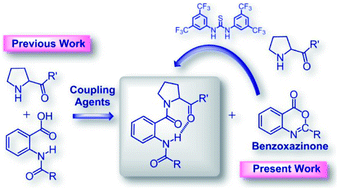
C-terminal activation of N-acylated o-aminobenzoic acids and their derivatives during coupling reactions with amines would often pose a challenge due to the formation of a benzoxazinone intermediate, which may resist reacting with amines. This communication reports a mild approach towards the installation of an amide bond via benzoxazinone ring opening utilizing Schreiner's (thio)urea organocatalyst.
![]() | ||
| Fig. 1 Schematic representation of the possible routes for the synthesis of the Ant–Pro dipeptide unit. Note: numbering of the positions of the benzoxazinone moiety is shown in pink. | ||
We have been interested for quite some time in the development of foldamers containing the Ant–Pro reverse-turn motif (Ant = anthranilic acid, Pro = proline), Fig. 1.4 The striking feature of this motif is its robust 9-membered-ring intramolecular H-bonding network. Occasionally, the formation of a benzoxazinone intermediate causes a drastic fall in the yield of coupled products.5 Owing to the reduced reactivity of benzoxazinones towards amine nucleophiles, we attempted different conditions, such as heating the reaction mixture and under microwave conditions. Unfortunately, these procedures led to only partial conversion of the oxazinone into the product. After extensive effort, we were successful in developing an efficient method for coupling a range of isolated benzoxazinone intermediates via nucleophilic ring-opening utilizing DBU (1,8-diazabicycloundec-7-ene) in DMF containing 4 Å molecular sieves.5
However, in a few cases, this method produced only meagre yields of the coupled product. One such instance was the reaction of 2-(2-azidopropan-2-yl)-2H-benzo[d][1,3]oxazin-4-one 1a, Table 1 (isolated as the major by-product on activation of 2-(2-azido-2-methylpropanamido)benzoic acid) with H-LPro-OBn to obtain compound 2a. Scanty yields of the product isolated under DBU-mediated opening conditions impelled us to explore a carbonyl activation route to open the azlactone moiety. Hence, we employed some lactone activating agents, such as Sc(OTf)3, Ti(OiPr)4 etc., but none of the trials were rewarding (see ESI, page S8,† Table 1).
| a Yield refers to the column-purified product.b Unless specified, the reaction was carried out at room temperature (25 °C).c Conversion calculated from NMR of the crude reaction mixture (see ESI, page S45–S47†).d Reaction was carried out at 40 °C. | ||||
|---|---|---|---|---|
![]() |
||||
| Catalyst (mol%) | Solvent | Time (h) | Product (%)a,b | |
| 1 | 0 | DMSO | 24 | 0 |
| 2 | 10 | DCM | 36 | 76 |
| 3 | 10 | Toluene | 36 | 65 |
| 4 | 10 | THF | 48 | 30c |
| 5 | 10 | DMF | 48 | 40c |
| 6 | 10 | ACN | 48 | 36c |
| 7 | 10 | H2Od | 24 | 53 |
| 8 | 10 | H2O | 48 | 67 |
| 9 | 5 | DMSO | 24 | 71 |
| 10 | 10 | DMSO | 0.5 | 48 |
| 11 | 10 | DMSO | 24 | 81 |
| 12 | 15 | DMSO | 24 | 79 |
Following the trend, we subsequently exploited the property of explicit non-covalent double hydrogen-bonding donor-based (thio)urea organocatalysis.6 Since its inception, rate enhancements for a wide range of reactions, like the Michael reaction,7a–f Claisen rearrangements,7g,h Morita–Baylis–Hillman,7i–l Diels–Alder reactions7m etc., have been observed. Amongst them, Schreiner's N,N′-bis[(3-fluoromethyl) phenyl]-based (thio)urea has emerged as a very efficient catalyst. The requirement of low catalyst loading,8 high competency, moderate binding tendency to the basic sites (unlike Lewis acids),9 improved enantioselectivity10 and possible structure diversification has made it an easy choice for several reactions. The other features include good air and water stability/compatibility and synthetic accessibility.11 Moreover, Schreiner's (thio)urea is well known to act as a modular catalyst in many organic reactions, like the Strecker synthesis, Mannich reaction, Henry reaction, etc.,12 and also in dynamic kinetic resolution of azlactones.13
This desirable (thio)urea catalyst bears rigid hydrogen-bonding sites between the positively polarized ortho-hydrogen atom, the basic thiocarbonyl sulphur and the electron-deficient –CF3 substitution at the meta or para position of the phenyl ring.14 It readily activates the carbonyl group of the substituted 2H-benzo[d][1,3]oxazin-4-one unit, involving the ortho CH bond that binds with the oxygen (Lewis basic site) and facilitates nucleophilic attack of the amine, preferably at the 4th position of the benzoxazinone.
It was observed that the reaction of 1a with H-LPro-OBn proceeded in a reasonable time period, furnishing good yields of the product at room temperature with no racemisation.15 The reaction was carried out in a range of solvents, like toluene, DCM, acetonitrile, THF, DMF, DMSO and water, etc. (Table 1). The rate of the reaction revealed a solvent polarity dependence, making polar solvents more preferable following the trend DMSO > DCM > toluene. Strangely, the reaction failed to reach completion in solvents like DMF, acetonitrile, THF etc., even under a prolonged reaction time. The reaction optimisation revealed 10 mol% of the catalyst in DMSO at room temperature to be the best condition, providing the best yields. The reaction was also attempted in water, which sluggishly completed in 48 h at 25 °C, affording a 67% yield of the product. However, a slight reduction in the yield was observed with an elevated temperature. This examination substantiated the rate dependence of the reaction on the solvent polarity, but that it was independent of temperature.
After successful installation of the amide link between H-LPro-OBn with benzoxazinone 1a, by applying similar reaction conditions, we further explored the coupling of a range of stable oxazinones that are often isolated during oligopeptide synthesis. Different 2-(aliphatic/aromatic) substituted-[1,3]-oxazinones, like 6,7-difluoro-2-phenyl-substituted 1b, 2-nitrophenyl-substituted 1c, etc. were subjected to (thio)urea mediated opening, which provided good to quantitative yields of the coupled products without the formation of any by-products (Table 2). The investigations confirmed that the stability of the oxazinone imparted no influence on the coupling tendency, possibly due to the efficient activation of the carbonyl functionality.
| a Unless specified, the reaction was carried out at 25 °C with oxazinone (1 equiv.) and H-LPro-OBn (1.5 equiv.).b Yield calculated after 8% oxazinone recovery.c Yield calculated after 48% oxazinone recovery. | ||||||
|---|---|---|---|---|---|---|
![]() |
||||||
| –R | –R1 | –R2 | Time (h) | Conversion (%) | Yield (%)a | |
| 2a | ![]() |
H | H | 24 | 100 | 81 |
| 2b | ![]() |
F | F | 36 | 92 | 70b |
| 2c | ![]() |
H | H | 9 | 100 | 97 |
| 2d | ![]() |
H | H | 24 | 100 | 75 |
| 2e | ![]() |
OiBu | H | 48 | 52 | 91c |
According to earlier investigations on acylanthranils,16 having electron withdrawing groups at the 6th position or positioning any electron deficient group on the phenyl ring is considered to disfavour o-acetamidobenzamide formation (required for the desired reaction). This is due to the fact that the introduction of electron withdrawing groups at the 6th position would in turn increase the electrophilicity of the 2nd position of the benzoxazinone, making it more susceptible towards nucleophile attack (undesirable reaction). On the other hand, the introduction of electron releasing groups at the same position presumably enhances the electron density at the 2nd position and would favour nucleophilic attack at the 4th position.16b Interestingly, activation by (thio)urea was shown to selectively activate the carbonyl of the oxazinone moiety, making the carbonyl carbon more electrophilic and thereby facilitating the desired coupling reaction, irrespective of the electron density of the phenyl ring.
The reactivity pattern of different oxazinones that follows the order: 1c > 1a > 1d > 1b > 1e with amine H-Pro-OBn evidently supports our predictions (considering the completion time of the reaction and the yield of the isolated product).
Proline is a very well known organocatalyst used in various reactions that involve carbonyl activation as the key step.17 Thus, our next concern was to assess the role of proline in catalysis. We therefore carried out a set of reactions with the selected stable oxazinone 1c and a series of different chiral/achiral amines and a few flexible/constrained amino acids (Table 3). Interestingly, the reaction of 1c with piperidine and (S)-phenyl-ethylamine proceeded rapidly towards completion, furnishing excellent yields to afford 2f and 2g, respectively. On comparing primary and secondary amines, the reaction rate was observed to be faster for the primary amine i.e. propylamine. On the other hand, the reaction of 1c with H-DVal-OMe provided a good yield, furnishing up to 89% of the product 2i, but completion of the reaction needed 36 h. Steric hindrance imparted by germinal dimethyl groups of H-Aib-OMe (α-aminoisobutyric acid methyl ester) also affected the rate drastically, where 82% of the product was isolated from the slow reaction, with only 60% conversion of the reactants into product 2h. The reactivity of the amines is presumably negatively influenced by the methoxycarbonyl group. However, the smooth reactivity of chiral (S)-phenylethylamine in 10 min revealed that the hindrance at the α-position didn't affect the reactivity at the 2nd position of the oxazinone, but imparted a drastic influence on the reaction time. Primary amines without any α-substitution, like propylamine, proceeded to completion, affording a 97% yield of the product 2j within a short duration of 3 min.
Synthetic Procedure for 2a–k: 1,3-bis(3,5-bis(trifluoromethyl)phenyl)thiourea (10 mol%) was added to a solution of oxazinone (1 equiv.) and amine (1.5 equiv.) in DMSO (1 mL). The reaction was stirred and constantly monitored by TLC. After maximum conversion of the oxazinones, water (2 mL) was added to the reaction mixture. The product was extracted into DCM (3 × 5 mL) from the aqueous layer. The organic layers were pooled together and washed with a KHSO4 solution, followed by brine. The organic layer was then dried over Na2SO4 and was evaporated in vacuo to afford the coupled product. The crude product was then purified by column chromatography.
Footnote |
| † Electronic supplementary information (ESI) available: General experimental procedures, 1H, 13C, DEPT-135 NMR spectra and ESI mass spectra of all new compounds are included. See DOI: 10.1039/c3ra45903a |
| This journal is © The Royal Society of Chemistry 2014 |