
Artjom
Maljusch
a,
John B.
Henry
b,
Jakub
Tymoczko
ab,
Aliaksandr S.
Bandarenka
*b and
Wolfgang
Schuhmann
*ab
aAnalytische Chemie – Elektroanalytik & Sensorik, Ruhr-Universität Bochum, Universitätsstr. 150, 44780 Bochum, Germany. E-mail: wolfgang.schuhmann@rub.de
bCenter for Electrochemical Sciences, Ruhr-Universität Bochum, Universitätsstr. 150, 44780 Bochum, Germany. E-mail: aliaksandr.bandarenka@rub.de
First published on 8th November 2013
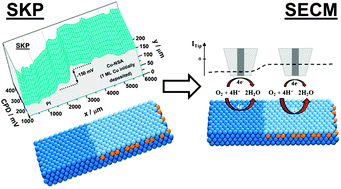
Functional materials, particularly heterogeneous catalysts, are often non-uniform at a microscopic level making their detailed characterisation extremely complex. This complexity inhibits the design and implementation of novel functional materials as such characterisation is a key to understanding interfaces for heterogeneous catalysis. We demonstrate that a combination of Scanning Kelvin Probe (SKP) and Scanning Electrochemical Microscopy (SECM) experiments made over the same sample surface using an integrated SKP–SECM system provides a powerful and robust tool to link basic surface properties with the observed electrocatalytic activity. As the SKP-response can be accurately assessed using modern quantum chemical approaches to benchmark analytical signals for different surface structures with varying compositions, application of an integrated SKP–SECM system can offer valuable insight into the origin of the observed electrocatalytic activity. As model objects, we used Pt(111)-like thin films modified with sub-monolayer and monolayer amounts of Cu atoms located at the electrode surface and in the sub-surface region. The exact position of the Cu atoms relative to the topmost Pt layer greatly affects basic surface properties and governs the electrocatalytic activity of the surface towards various reactions, i.e. the oxygen reduction reaction. SKP–SECM appeared to be a very sensitive tool to monitor those changes as a function of the spatial coordinates.
The ideal combination of techniques should be both informative and affordable. Among those techniques the scanning Kelvin probe (SKP) is a relatively simple, but sensitive technique which can obtain valuable information about the surface status.16 For example, in the case of metals, SKP measures responses which are proportional to work function differences across the surface. These work function differences are a sensitive indicator of the surface condition, which can be affected by adsorbed layers, surface composition, structure, charging and the presence of contaminations.17 Importantly, work function differences can be calculated with quantum chemical approaches for a variety of surfaces with high accuracy.18,19 The relative ease in the ability to calculate and measure benchmark values which are proportional to SKP-values for various surfaces makes the scanning Kelvin probe a good candidate to complement electrochemical microscopy measurements.
In this work, we show how SKP-experiments, performed in the gas phase under close to ambient conditions, when combined with scanning electrochemical microscopy (SECM) measurements, performed over the same sample surface by using the same microelectrode as tip in both techniques, can provide a powerful and robust approach to link basic surface properties with electrocatalytic activity.20 We used Pt(111)-like thin films21 modified with monolayer amounts of Cu atoms22 as model objects. The position of the Cu atoms relative to the topmost Pt layer affects the surface properties23 and controls the electrocatalytic activity of the surface towards the oxygen reduction reaction (ORR).24–27 This combined SKP–SECM technique shows promise as a very sensitive tool to monitor changes in the surface status.
:
1, Sigma-Aldrich, Germany) for 12 hours. To remove SO42−-ions, multiple heating was combined with an ultrasonic treatment and rinsing with Siemens© UltraClear water (0.055 μS cm−1, TOC content <1 ppb). Solutions of 0.1 M HClO4 were prepared using Suprapur® HClO4 (Merck, Germany). Pt wire (Dout = 1 mm, Goodfellow, Germany) was used as counter electrode and a mercury–mercury sulphate (MMS, Schott, Germany) was used as reference electrode. During all electrochemical experiments the reference electrode was kept in a compartment separated from the working solution with a ceramic frit. For benchmark experiments, a commercial Pt(111) single crystal (diameter 0.5 cm, oriented to <0.1°, polished down to 30 nm roughness, obtained from Mateck, Germany) was used. Prior to each experiment it was pre-treated and modified as described in detail elsewhere29 using a specifically designed electrochemical cell for the preparation and characterisation of single crystal electrodes.27,30
Combined SKP–SECM experiments were performed in the recently described integrated SKP–SECM system.10 In the SKP mode of operation the SKP–SECM tip was oscillated with an oscillation amplitude of 9 μm and an oscillation frequency of 1200 Hz. Control of the tip-to-sample distance was performed using an additional alternating current (AC) signal (6.73 Hz, 0.25 Vpp). The corresponding AC current was demodulated by a lock-in amplifier and its value was kept constant by varying the position of the SKP tip above the sample surface. All SKP experiments were performed with a tip-to-sample distance of 5 μm. Model samples were fixed on the sample holder with a small drop of conductive silver filled lacquer (Electrodag® 1415M; Plano, Germany) to ensure stable mounting. An additional drop of the conductive lacquer was placed on the edge of model samples to establish direct electrical contact between the Pt metal film and the sample holder. During SKP measurements a piece of pure Ni (99.999%; Goodfellow, Germany) was placed on the sample holder and was used as reference. All reported contact-potential differences (CPD) values are referred to the CPD value of pure Ni.
![]() | ||
| Fig. 1 Schematics illustrating the preparation of the model Cu–Pt(111) samples for SKP–SECM measurements. | ||
To evaluate the electrochemical and electrocatalytic behaviour of Cu–Pt(111) modified thin films, voltammetric experiments were performed and the results were compared with those obtained using commercial benchmark Pt(111) single crystal electrodes. Fig. 2A compares cyclic voltammograms obtained in Ar-saturated 0.1 M HClO4 for the Pt(111) single crystal and the corresponding Cu–Pt(111) NSA prepared using the same single crystal electrode. The voltammograms are very close to those characteristic of the well-ordered Pt(111) surfaces and Cu–Pt(111) NSAs reported earlier. The oxygen reduction activity corresponds to that of bulk Pt(111)33 and Cu–Pt(111) NSAs reported previously (Fig. 2B).24Fig. 2C and D also show the corresponding data for the model Pt(111)-like thin film and Cu–Pt(111) NSA thin film samples.
Due to the fact that the surface of the thin film samples are a priori more defective than the surface of the bulk single crystals, the characteristic features in the corresponding voltammograms (e.g. the peaks at ∼0.8 V RHE) are less pronounced and the activity towards ORR is slightly lower for Cu–Pt(111) thin films.22 Nevertheless, the electrochemical and, particularly, electrocatalytic properties of both thin film samples are fairly close to those obtained for the benchmark single crystal surfaces making them good model objects for the evaluation of the SKP–SECM approach for detecting slight changes in surface compositions.
Fig. 3 shows the result of the SKP measurement for Cu modified Pt(111)-like thin film model samples. The typical CPD values as measured by SKP above the unmodified Pt(111)-like thin film and modified Cu–Pt(111) NSA regions of the model sample (Fig. 3A) differ by approximately 150 mV. The modified NSA-region systematically reveals higher CPD values as compared to the unmodified surface. In contrast, the Cu overlayer (where Cu atoms constitute the topmost surface layer) showed the opposite trend: the CPD values are systematically lower by approximately 100 mV in the Cu region compared to the unmodified Pt(111)-like thin film surface (Fig. 3B). Additionally, electrochemically deposited Cu clusters further decrease the CPD values by approximately 180 mV compared to the overlayer (Fig. 3C and D). Finally, in a control experiment using a bulk polycrystalline Cu sample the measured CPD values were approximately 260 mV lower than that of the 3D Cu-cluster surface (Fig. 3D).
![]() | ||
| Fig. 3 SKP characterisation of a (A) Pt(111)-like thin film samples partially modified with Cu–Pt(111) NSA, (B) Pt(111)-like thin film sample partially modified with 1 ML of Cu and (C) Pt(111)-like thin film sample partially modified with 3D Cu clusters. Differences in the corresponding CPD values are shown as a function of the spatial coordinates. Fig. 3D represents a schematic diagram showing the relative differences in the measured CPD values between the unmodified and modified surfaces. | ||
Comparing the data for the different modified surfaces in Fig. 3, one can conclude that the CPD values measured using SKP are very sensitive to the position and status of the Cu atoms at the surface, even though the measurements are performed under almost ambient conditions. It should be noted that the measured SKP response likely has contributions that originate from various surface structures, adsorbed water layers, the composition of the gas atmosphere etc., however, when the CPD values are compared to the unmodified Pt(111)-like thin film reference surface under the same conditions, one can reasonably assume that this relative change is closely related to the variation of the work function across the surface. In principle, the measured CPD values can be used as an analytical signal by itself to provide basic information about the surface status. If necessary, quantum chemical approaches such as particularly DFT calculations may provide an independent benchmark value for a wide range of virtually any structure and composition formed at the surface as shown previously.34
The SKP data presented in Fig. 3 also reveal a non-trivial trend in the change of the CPD values as a function of the composition and relative position of Cu ad-atoms. This non-trivial, but in most cases theoretically predictable behaviour of the CPD values and its correlation with the calculated work function changes make SKP measurements a good probe to explore surface properties on a microscopic level.
While theory assisted SKP measurements can provide key information about surface properties, e.g. revealing microscopic domains with different surface status, complementary SKP–SECM measurements can help to link them with the electrocatalytic activity measured using the SECM technique.
Fig. 4A schematically represents the SECM experiment performed in the redox-competition mode on the Pt(111)-like thin film sample partially (right side in Fig. 4A) modified with a Cu–Pt(111) NSA. Fig. 4B shows the results of combined SKP–SECM investigation of the model Pt(111)-like thin film sample partially modified with Cu–Pt(111) NSA (∼1/2 of the sample), comparing the modified and unmodified parts of the surface.
To avoid complete depletion of oxygen in the gap between the SKP–SECM tip and the sample, a potential pulse profile consisting of 3 pulses was applied at the tip while the sample was polarized at a constant potential of 0.175 V which was 25 mV more cathodic than the OCP of the sample. The first potential pulse (P1 = 0.65 V, t1 = 1 s) is a conditioning potential applied to restore diffusional equilibrium after movement of the SECM tip during scanning. The second potential pulse (P2 = 1.5 V, t2 = 0.2 s) is the injection pulse which leads to oxidation of water and injection of oxygen into the gap between tip and sample. The third potential pulse (P3 = 0.2 V, t3 = 0.5 s) is the actual measurement pulse which is sufficiently cathodic to invoke oxygen reduction at the tip. As the sample was continuously polarized at a potential sufficiently cathodic for oxygen reduction, application of the measurement pulse P3 leads to oxygen reduction at the tip and hence to a competition between tip and sample for dissolved O2. With increased local ORR activity of the sample, the remaining amount of O2 which is accessible for the tip decreases leading to smaller cathodic tip currents over areas with higher ORR activity. Cu atoms located in the second layer of the Cu–Pt(111) NSA thin film sample obviously modify the electronic structure of the topmost Pt layer. The concomitant change in the binding energies for reaction intermediates leads to an increasing electrocatalytic activity. Particularly, as shown in Fig. 2, Cu–Pt(111) NSA thin film exhibit significantly higher catalytic activity towards ORR as compared to the unmodified Pt(111)-like thin film surface. Higher cathodic currents observed over the Pt(111)-like thin film (Fig. 4B) therefore clearly indicate the higher catalytic ORR activity of the Cu–Pt(111) NSA thin film surface as compared to that of the unmodified Pt(111)-like thin film surface.
Footnote |
| † Electronic supplementary information (ESI) available. See DOI: 10.1039/c3ra45845h |
| This journal is © The Royal Society of Chemistry 2014 |