Yong Jiaab,
Xin-Yao Yub,
Tao Luob,
Zhen Jinb,
Bai Sunb,
Jin-Huai Liub and
Xing-Jiu Huang*b
aInstitute of Pharmaceutical Chemistry, Department of Pharmacy, Anhui University of Chinese Medicine, Anhui Academy of Chinese Medicine, Hefei 230031, PR China
bResearch Center for Biomimetic Functional Materials and Sensing Devices, Institute of Intelligent Machines, Chinese Academy of Sciences, Hefei 230031, PR China. E-mail: xingjiuhuang@iim.ac.cn; Fax: +86 551 5592420; Tel: +86 551 5591142
First published on 6th January 2014
The self-association of alcohols in water has been demonstrated by a number of special experiments and theoretical work. Here, we report a simple and effective method to investigate the presence of these hydrophobic aggregation areas. Porous ZnO nanostructures were prepared using a simple alcohol assisted solution synthetic method at room temperature. The presence of hydrophobic groups of alcohols resulted in the existence of microheterogeneities and organic aggregations in the mixed solution, which act as a soft template and play key roles in the formation of the porous structure of ZnO. A high reaction temperature resulted in decreased hydrogen bonding between the alcohol and water molecules, and increased hydrophobic interactions among the alcohol molecules as well as increased pore sizes of the ZnO nanostructures. Sphere-like and hexagonal pores were observed, which were a result of the in situ enwrapping of hydrophobic aggregation areas in alcohol aqueous solution.
It is well known that, under optimum conditions, ZnO nanomaterials will be formed in pure water when Zn2+ is reacted with OH− at room temperature.28–30 In our previous work, porous ZnO nanoplates were synthesized at room temperature using polyethylene glycol (PEG) as a template.31 The presence of hydrophobic groups of PEG resulted in the existence of microheterogeneities and PEG aggregations in the mixed aqueous solution, which play key roles in the formation of the porous structures of ZnO. Herein, the microheterogeneity of a series of mixed simple alcohols and water was investigated. The hydrophobic organic aggregations resulting from the hydrophobic groups of the alcohols were enwrapped by the surrounding water. When ZnO was formed, these hydrophobic organic aggregations were enwrapped in ZnO nanoplates, as shown in Scheme 1. So, porous ZnO nanoplates were obtained, and these pores present the size and the shape of the hydrophobic organic aggregations.
![]() | ||
| Scheme 1 Schematic illustration of the formation of the nanopores in ZnO nanoplate in aqueous alcohol solution. | ||
![]() | ||
| Fig. 1 Low-magnification (a and b) and high-magnification (c and d) TEM images of the ZnO prepared in pure water. | ||
![]() | ||
| Fig. 2 TEM images of ZnO prepared in the presence of ethanol (a and b) and ethylene glycol (c and d). | ||
To further confirm the porous structures of the ZnO synthesized in the presence of ethanol, the obtained ZnO products were characterized by HRTEM. Fig. 3 show the HRTEM images and the corresponding SAED pattern. From Fig. 3a and b, a large number of nanopores with a diameter less than 10 nm were clearly observed, which confirms the porous structures of the ZnO products. Fig. 3c presents well-resolved two-dimensional lattice fringes with spacings of 0.52 and 0.28 nm, which are in good agreement with the interspacings of (0001) and (01
0) planes of wurtzite-type ZnO, respectively.31 The SAED shown in Fig. 3d and HRTEM confirm that the as-prepared ZnO nanoplates are single crystalline.
![]() | ||
| Fig. 3 HRTEM images (a–c) and the corresponding SAED pattern (d) of the ZnO nanoplates prepared in the presence of ethanol. | ||
The formation of the nanopores was definitely attributed to the presence of ethanol. Previous reports suggested that, under hydrothermal conditions, the sphere-like hydrophobic aggregations resulting from the surfactant were approximately tens of microns.32 However, in the mixed solution of water and isopropanol, the sphere-like emulsified areas resulting from water were decreased to 200–300 nm.11 The results suggested that, in a certain concentration range, the aggregations formed in hydrothermal conditions are sphere-like, regardless of their type or formation mechanism.11,14–16,32 Apparently, the hydrophobic aggregations resulting from a simple alcohol were far smaller than the ones formed by the surfactant, owing to their short carbon chains. So, the presence of hydrophobic groups of ethanol will result in the formation of microheterogeneities in aqueous solution. Obviously, ZnO cannot nucleate in these hydrophobic aggregations, and as a result these hydrophobic aggregations were preserved and enwrapped in the ZnO plate. Thus, the microheterogeneity of aqueous ethanol solutions should be responsible for the formation of the nanoporous structures of ZnO plates. Accordingly, most of the hydrophobic group aggregations resulting from the ethanol were sphere-like and about 3–5 nm. The results suggest that though ethanol is water-soluble, owing to the strong hydrogen bonding between the hydroxyl groups and water molecules, the microheterogeneity is still formed by the ethyl groups of ethanol.
In ethanol aqueous solution, the hydrophobic aggregations should be related to the hydrogen bonding strength between ethanol and water. Furthermore, it is well known that the hydrogen bonding strength was greatly dependent on the temperature.33–35 High temperature will result in decreased hydrogen bonding and increased hydrophobic interactions between the macromolecular chains.36,37 So, the influence of the reaction temperature on the sizes of the pores was studied. TEM images (Fig. S3, ESI†) of the ZnO nanoplates synthesized at 60 °C confirmed the presence of the large pores. The XRD pattern further confirms the products were ZnO (Fig. S2, ESI†). The diameters of some of the pores were increased to about 10 nm. The large pores imply the presence of the large hydrophobic aggregations, which should be a result of the decreased hydrogen bonding strength between ethanol and water at high temperature.
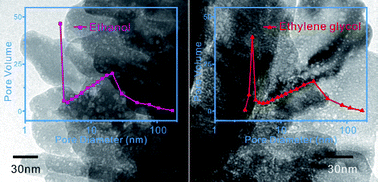
The presence of the nanopores was confirmed by N2 adsorption–desorption isotherms and BJH adsorption pore size distributions shown in Fig. 4. Considering the TEM results, the mesopores around 10–30 nm were resulted from the interspaces between the ZnO nanoplates. For ZnO synthesized with the presence of ethanol and ethylene glycol, the mesopores about 3–4 nm were obviously observed. The results suggested the existence of the mesopores with a diameter of 3–4 nm, which was consistent with the TEM images. However, for ZnO synthesized in pure water, no peak was observed in this region. So, the results definitely confirmed that the formation of the pores was attributed to the presence of the simple alcohol.
![]() | ||
| Fig. 4 N2 adsorption–desorption isotherms (a) and BJH adsorption pore size distributions (b) of the obtained ZnO products. | ||
Furthermore, based on the pore formation process, the organic aggregations should be enwrapped in the nanoplates. To show this, the ZnO products were further characterized by transmittance FTIR and attenuated total reflectance-FTIR (ATR-FTIR), and the results are shown in Fig. 5. From the transmittance FTIR spectrum shown in Fig. 5a, the peak centered at 3387 cm−1 was attributed to the O–H bond stretching vibrations of the physically absorbed water, and the band at 1636 cm−1 was assigned to the H–O–H bending vibrations.38 The peaks at 2926 and 2856 cm−1 can be assigned to νC–H of the ethanol or ethylene glycol. The peaks at 1473 and 900 cm−1 were assigned to the Zn–OH deformation mode,39,40 and the peak at 1384 cm−1 can be assigned to the carbonate-like species or the adsorbed NO3− ions.40–42 The peak centered at 572 cm−1 was the characteristic band of ZnO.43 For the ATR-FTIR spectrum shown in Fig. 5b, the peaks at 1473 and 900 cm−1 also resulted from the deformation mode of Zn–OH. The peak at 1384 cm−1 means the presence of carbonate-like species or the adsorbed NO3− ions. In addition, the strong FTIR peaks around 2200 cm−1 were assigned to adsorbed CO2. However, in the ATR-FTIR spectrum, the νC–H vibrational modes were hardly detected any more. According to the experimental process, the C–H groups can only come from the added ethanol molecules. So, some alcohols were enwrapped in the ZnO plate. The obtained ZnO products prepared in the presence of ethylene glycol were characterized by transmittance FTIR and ATR-FTIR (Fig. S4, ESI†), and the results were similar to the ones synthesized in the presence of ethanol. Furthermore, the ZnO products synthesized in pure water were also characterized by transmittance FTIR and ATR-FTIR, and the results are shown in Fig. 6. Compared with the transmittance FTIR of the ZnO prepared in the presence of ethanol or ethylene glycol, the νC–H vibrational modes were no longer detected. The ATR-FTIR spectrum shown in Fig. 6b is similar to the ones synthesized in the presence of alcohol. The results suggested that no organic species were enwrapped in the ZnO nanoplate, which further confirmed that the C–H groups came from the added alcohol molecules. In addition, the thickness of the nanoplate was obviously larger than the diameter of the pores. Thus, the alcohol molecules were enwrapped in the ZnO nanoplates, which further confirmed the proposed mechanism of the porous structure.
![]() | ||
| Fig. 5 Transmission FTIR (a) and ATR-FTIR (b) spectra of ZnO synthesized in the presence of ethanol. | ||
To further investigate the influence of the types of alcohol on the shape and size of the hydrophobic aggregations, n-propanol, isopropanol, 1,2-propylene glycol, and glycerol mixed aqueous solution were also studied. ZnO nanoplates were prepared using a similar method at room temperature. TEM images suggest that, in the presence of n-propanol, the pores in ZnO plates were obviously larger than those prepared in ethanol and ethylene glycol aqueous solution (Fig. S5, ESI†). It is very interesting that some large hexagonal or quasi-hexagonal pores were formed when using isopropanol as a template, as shown in Fig. 7. For 1,2-propylene glycol and glycerol, large hexagonal pores were also observed (Fig. S7–S9, ESI†). The presence of the enwrapped alcohols was confirmed by FTIR and ATR-FTIR analysis (Fig. S6 and S10, ESI†). The large and hexagonal pores clearly resulted from the large hydrophobic groups because the above four alcohols have three –CHn groups. Therefore, the long carbon chains were in favor of the formation of the large hydrophobic aggregations and the final large pores. However, the pores enwrapped in the ZnO nanoplates, synthesized in the mixed n-butanol and water, were obviously smaller than the ones prepared in mixed three-carbon alcohols and water (Fig. S11, ESI†). Some nanopores were connected together to form threadlike pores. In addition, no hexagonal or quasi-hexagonal pores were formed, which was similar to those in n-propanol. The results suggested that the shape and size of the hydrophobic aggregations were greatly dependent on the type of carbon chain. More work is needed to reveal the formation mechanism of the hexagonal or quasi-hexagonal pores.
Footnote |
| † Electronic supplementary information (ESI) available: Experimental details, SEM, TEM, XRD and FTIR data. See DOI: 10.1039/c3ra45477k |
| This journal is © The Royal Society of Chemistry 2014 |