Xinmin
Liu
,
Gang
Yang
*,
Hang
Li
*,
Rui
Tian
,
Rui
Li
,
Xianjun
Jiang
,
Jiupai
Ni
and
Deti
Xie
Chongqing Key Laboratory of Soil Multi-scale Interfacial Process, College of Resources and Environment, Southwest University, Chongqing 400715, China. E-mail: theobiochem@sina.com; lihangswu@163.com
First published on 20th November 2013
Presented electric double layer theory achieves comparable results with experiments by including steric, polarization and valence effects and is applicable to all ions contrasting the classical theory only to hydrogen ions, which thus capably describes the selective adsorption on charged surfaces and is expected to clarify specific ion effects.
The Gouy–Chapman model with the Poisson–Boltzmann equation as the mathematical basis was born with significant flaws that can result in flawed results, however. Only the ion-surface Coulomb interactions have been taken into account in this model.8 As indicated by the charge density analyses, soil particles,9 proteins,10 membranes11 and a variety of other systems12–14 often establish strong electric fields (usually 108–109 V m−1) at their surfaces. As a result, the adsorbed ions, especially those with relatively large sizes, will be strongly polarized,15,16 and the polarization effect should have been an integral part of interaction forces.17 The reason of neglecting polarization effect is due to that all ions in the Gouy–Chapman model are assumed as point-like charges albeit with consideration of the sign for these charges (+/−).18–20 Whereas the ion exchange experiments17 clearly showed that different ions are selectively adsorbed on the charged surface, which seems contradictory to the point-like charge approximation that ignores the difference of the various ions. Another consequence of this approximation is that the amount of ions adsorbed on the charged surface can be overwhelmingly more than that observed experimentally.19
Owing to the aforementioned deficiencies, the Gouy–Chapman model has been subjected to a number of revisions and improvements.19–23 The correction by inclusion of the steric effect was made by Borukhov et al.,19,20 choosing a lattice-gas version where each lattice site was occupied by at most one ion. This provides a good solution to the adsorption of large ions (e.g., H3PW12O40 with an estimated size of 10 Å). Apparently, the ion sizes we are usually concerned about are substantially smaller. The polarization effect was also considered by Boström et al.;23 nonetheless, the ion polarizabilities that are significantly dependent on the electric field strength have to be derived from ab initio calculations. In this study, we proposed a modified EDL theory accounting for the steric, polarization and valence effects, which was testified to show obvious improvement as compared to the classical theory and good agreement with experimental observations. We then evaluated the respective contributions of the three effects for ion adsorption on the charged surface. Thus, we demonstrated that the steric effect is indispensible to describe all ions with outer electrons, and it is the synergistic interplay of the steric, polarization and valence effects that distinguishes the various electron-inclusive ions. Using this modified theory, the selective adsorption process of the various ions can be quantitatively characterized.
The adsorption of two different ions on the charged surface is a competitive process, which can be described by selectivity coefficient (Ki/j),
![]() | (1) |
According to the classical theory,25 the Coulomb force is the sole source to drive the adsorption process, and thus the interaction energy w(x) is written to be,
| w(x) = ZFφ(x) | (2) |
In eqn (2), Z is the ion valence and F is Faraday constant, whereas φ(x) represents the potential distribution in the EDL (x = 0 − 1/κ), with φ0 corresponding to the surface potential (x = 0).
0 is the Coulomb energy required to carry one mole ion from x = 1/κ to x = 0, and according to the previous results9,26,27 it equals,
0i = ZiFφ0 = 2RT ln(maiS/Niκ) | (3) |
Accordingly, the concentration distribution function (f(x)) and selectivity coefficient (Ki/j) of the classical theory can be expressed as,28
![]() | (4) |
![]() | (5) |
The analytical solution of the Poisson–Boltzmann equation demonstrates m = 2 for 1
:
1 + 1
:
1 mixed electrolytes and
for 1
:
1 + 2
:
1 mixed electrolytes,9,17 wherein f0+ and f02+ refer to the concentrations in bulk solution for the univalent and divalent cations, respectively.
With use of the surface potential φ0 derived from eqn (3) and (5) can be further transformed to,
![]() | (6) |
The classical theory (eqn (6)) is tested for describing the binary exchange reactions on the montmorillonite surface. It can be seen from Fig. 1 that the selectivity coefficients (Ki/j) predicted by the classical theory are far less than those of experimental observations.29 This is due to that the Coulomb force alone cannot account for the adsorption process of electron-inclusive ions.
![]() | ||
| Fig. 1 The selectivity coefficients (Ki/j) of the classical theory as function of Ω (eqn (6)) for (a) Na–Ca and (b) Na–Mg exchange processes on the montmorillonite surface (S = 103.0 m2 g−1). | ||
It is known that the surface charges can establish a strong electric field (usually 108–109 V m−1) towards any common electrolyte solutions (e.g., NaCl or NaNO3 + Mg(NO3)2 mixed solutions) with a depth of several nm, and this will cause serious polarization to adsorbed ions. As a result, the electron cloud configurations of these ions are altered to a degree depending on the distance to the charged surface,15,16 see the Na+ ion in Fig. 2 for an example. That is, the polarization effect should be included in the calculations of interaction energy,
![]() | (7) |
and Ē stand for the ionic dipole moment and electric field in diffusion layer, respectively.
![]() | ||
| Fig. 2 Schematic representation of the competitive adsorption of the hydrogen (H+) and sodium (Na+) ions on the charged surface, where the approximate radii of H+ and Na+ are given (unit in Å). | ||
With consideration of the steric and polarization effects, the interaction energy of ions with the charged surface equals,
![]() | (8) |
Then the selectivity coefficient (Ki/j) of the modified theory can be given as,
![]() | (9) |
Below is an equivalent to eqn (9), and this transformation is similar to that of eqn (6),
![]() | (10) |
In eqn (10),
, where ε and I (I = 0.5ΣaiZ2i) refer to the dielectric constant and ion strength of the electrolyte solution, respectively.
In contrast to the classical theory, the modified theory (eqn (9) and (10)) includes the polarization and steric effects and therefore is expected to be able to describe and distinguish the competitive adsorption of the various ions. As is known to us, the classical theory is applicable to the hydrogen ion (H+).30 H+ consists of merely one proton in the nucleus with no outer electrons, and hence no polarization will be resulted in (
= 0). Compared with other ions, the radius of H+ is so slight that can almost be neglected; that is, φr(H+) ≈ φ0 (Fig. 2), and as a result of eqn (8), we can derive that ΠH = 1. The activities (a) and adsorption quantities (N) of Na+, Ca2+ and H+ listed in Table 1 are available from the ion exchange equilibrium experiments.17,31 When the i ion is selected as H+, eqn (10) can be used to calculate the ΠNa and ΠCa values, equal to 0.19 and 0.27, respectively (Table 1). Both of them are far less than the ΠH value of H+. This indicates that steric effect should be the most significant factor for describing the electron-inclusive ions. The Π values of other ions can be determined in a similar manner.
| a Na | a Ca | a H | N Na | N Ca | N H | Π Na | Π Ca |
|---|---|---|---|---|---|---|---|
| a Units of a and N are mmol L−1 and mmol g−1, respectively. b The average ΠNa and ΠCa values to be used in the text are given in parentheses. | |||||||
| 2.31 | 0.07 | 0.002 | 0.16 | 0.21 | 0.55 | 0.20 | 0.28 |
| 2.21 | 0.05 | 0.001 | 0.17 | 0.21 | 0.56 | 0.19 | 0.28 |
| 3.78 | 0.30 | 0.01 | 0.13 | 0.21 | 0.59 | 0.18 | 0.26 |
| (0.19)b | (0.27)b | ||||||
The selectivity coefficient for Na+ and Ca2+ adsorbed on the charged surface (KCa/Na) is then calculated using the obtained ΠNa and ΠCa values,
| KCa/Na = Ω−0.65 | (11) |
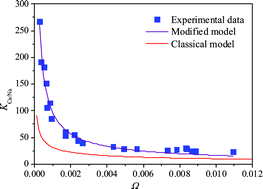
Fig. 3a clearly shows that the modified theory is in good agreement with experimental results. The exponential term equals −0.65 and almost reproduces the experimental value (−0.66).17 In addition, the correlation coefficient 0.96 implies that the modified theory describes satisfactorily the selective adsorption of different ions on the charged surface. On the other hand, the modified theory can be used to obtain the Π values by fitting the experimental data. For the selective adsorption of Na+ and Mg2+ (Fig. 3b), the fitted equation is given as,
| KMg/Na = 1.00Ω−0.62 (R2= 0.95) | (12) |
![]() | ||
| Fig. 3 The selectivity coefficient corresponding to the modified theory as a function of Ω (eqn (10)) for (a) Na–Ca and (b) Na–Mg exchange processes on the montmorillonite surface (S = 103.0 m2 g−1). | ||
The ΠMg value is calculated to be 0.25. The correlation coefficient equals 0.95 and this further validates the modified theory for describing the selective adsorption on the charged surface.
According to the Boltzmann distribution function of the modified theory:
![]() | (13) |
![]() | (14) |
On basis of the Π values obtained thus far, the Boltzmann distribution functions for the discussed ions have been derived:
| fNa(x) = aNae−0.19Fφ(x)/RT | (15) |
| fMg(x) = aMge−0.50Fφ(x)/RT | (16) |
| fCa(x) = aCae−0.54Fφ(x)/RT | (17) |
| fH(x) = aHe−Fφ(x)/RT | (18) |
Among these ions, the hydrogen ion (H+) is also applicable to the classical theory. It can be seen that H+ is significantly different from the ions that have outer electrons. This further evidences the indispensability of steric effect for the electron-inclusive ions, in satisfactory agreement with the above discussions.
In addition, the adsorption process of the various ions on the charged surface can be distinguished by the modified theory. The size difference between two electron-inclusive ions is not so obvious as compared to H+, and accordingly the steric difference among them is less dramatically. For example, the valences of Ca2+ and Mg2+ are identical, and the difference between their exponential terms (−0.04, see eqn (16) and (17)) is a coupling result of the steric and polarization effects. Ca2+ (r ≈ 0.99 Å) has a larger steric hindrance than Mg2+ (r ≈ 0.66 Å) while its adsorption is facilitated by larger polarization owing to a more apt deformation of electron clouds. The slightly larger interaction energy for Ca2+ indicates that the polarization rather than steric effect is slightly preferred as compared to Mg2+. eqn (13) shows that the interaction energy is exponentially proportional to the valence. Ca2+ (r ≈ 0.99 Å) and Na+ (r ≈ 0.98 Å) have very close radii and their steric effects can be considered identical. As seen from eqn (15) and (17), the exponential term of Ca2+ is more than twice as that of Na+ by −0.16. The additional energy (−0.16) should be caused totally by polarization difference. Accordingly, for the case of Ca2+vs. Na+ the difference of polarization effect is almost equivalent to, or even larger than, that of valence effect, because Na+ is also polarized under such strong electric fields; that is, the interaction energy of Na+ (−0.19, eqn (15)) should also include the contribution from polarization effect but not exclusively from valence effect. Accordingly, for the electron-inclusive ions each of the steric, polarization and valence effects plays a definite role during the adsorption on the charged surface. It is the synergistic interplay of the three effects that distinguishes the various ions and makes the theoretical results comparable to experimental observations. Because of the efficient differentiation of the various electron-inclusive ions, the modified theory is expected to helpfully clarify specific ion effects.
| This journal is © The Royal Society of Chemistry 2014 |