Palwinder Singh*a,
Amrinder Singha,
Jagroop Kaura and
Wolfgang Holzerb
aDepartment of Chemistry, UGC Sponsored Centre for Advanced Studies, Guru Nanak Dev University, Amritsar-143005, India. E-mail: Palwinder_singh_2000@yahoo.com; Fax: +91 183-2258819; Tel: +91 183 2258802 ext. 3495
bDepartment of Drug and Natural Product Synthesis, University of Vienna, Althanstrasse, 14, A-1090, Wein, Austria
First published on 27th November 2013
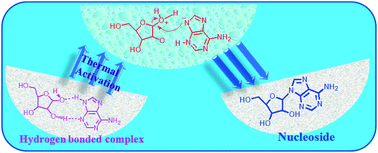
Glycosylation of nucleobases is achieved by heating metal free aqueous solution of nucleobase and sugar. It seems that abstraction of N9/N1 H by C1′-OH promotes N9/N1(nucleobase)-C1′ (sugar) covalent bond formation.
Working quite close to the reported experimental protocols,14,15 accepting ‘water as the first life’ and hence its role in the development of other molecules of life, present experiments were performed in aqueous medium. Assuming that presence of metal salts in water may promote side reactions, two type of water viz. ultrapure water (water sample-I) and tap water (water sample-II) (Table S1 in ESI†) was used as reaction medium. Solution of adenine and D-ribose in acetonitrile/ethanol–water (1
:
9) (water sample-I with composition as shown in Table S1†) was heated at 60–70 °C for 8 days. ACN/ethanol was used for solubility purpose only. Progress of the reaction was monitored with TLC as well as with ESI-MS16 (electrospray ionization mass spectrometry). After 5 days, a peak at m/z 268.1045 appeared in the mass spectrum of reaction mixture. While reactants were still there, reaction mixture was worked up after 8 days (general procedure). About 50% adenine and D-ribose were recovered along with isolation of a white solid product, 15%, mp 234 °C, [α]D = −30° (1 M, NaOH), m/z 268.1047 ([M + H]+) (Fig. S1 in ESI†) indicating the possibility of formation of adenosine (calcd m/z 268.1040, [M + H]+) (1, Scheme 2). Comparison of LC-MS of this product (trace 1, Fig. 1a) with commercial sample of adenosine (trace 2, Fig. 1a) and mass corresponding to LC peak (Fig. 1b) supported the formation of adenosine 1. Furthermore, ESI-MS of adenosine 1 in D2O-ACN (7
:
3) showed typical exchange of Hs′ with D (Fig. S2 in ESI†). NMR spectra of product 1 (Fig. 2, Fig. S3–S18, ESI†) and comparison with commercial sample of adenosine (Fig. S20–S24 in ESI†) confirmed the formation of adenosine in reaction of Scheme 2. As apparent from comparison of 1H NMR chemical shift at anomeric carbon of 1 with the reported one (C1′-H δ 5.87 and J 6.2 Hz for β-anomer of adenosine), its melting point, optical rotation and λmax (Fig. S26 in ESI†), compound 1 seems to be in β-anomeric form.17 Hence, though in low yield, adenosine was formed by just heating solution of adenine and D-ribose in almost metal free water. In this reaction, D-ribose also underwent self condensation (Fig. S27, chart S1 in ESI†) which seems to be the reason for poor yield of adenosine.
![]() | ||
| Fig. 2 NMR assignments to H, C and N of compound 1. Red: 1H, Blue: 13C, Black: 15N, against MeNO2 (0.00 ppm) (in parenthesis); numbers without parenthesis are shifts against NH3 liquid. | ||
To see the effect of salts present in water on rate/progress of the foregoing reaction, another reaction of adenine and D-ribose was performed in tap water–ethanol (9
:
1) (water sample-II with composition shown in Table S1†). After usual work up, a small amount of solid product was isolated besides the recovery of adenine and D-ribose. Although mass spectrum of isolated solid product exhibited peak corresponding to mass of adenosine 1 but NMR spectra of this product (Fig. S28–S37 in ESI†) shows that it is a mixture of two or more components. Careful comparison of chemical shifts with those of α- and β-isomer of compound 1 indicate the possibility of formation of both the isomers in this reaction along with some other products. It is proposed that the presence of salts in the reaction medium may incite the reactants for the formation of side products.
Similar to the reaction of adenine and D-ribose in de-ionized water–ethanol, reaction of cytosine with D-ribose provided cytidine 2 (12%), mp 206–08 °C, [α]D = +10° (1 M, NaOH), ESI-HRMS/LC-MS 244.0945 (calcd m/z 244.0930) (Fig. 3, S38†). Here also, ∼50% cytosine and D-ribose was recovered after 8 days of reaction. ESI-HRMS of cytidine 2 recorded in D2O-ACN (7
:
3) showed mass peak at m/z 250.1315 ([M + D]+) (calcd m/z 250.1305) (Fig. S39†). It indicates exchange of all the five NH/OH Hs′ of cytidine 2 with D and hence supports the structure of compound 2. Detailed NMR spectra of compound 2 (Fig. S40, S41–S55 in ESI†) and its comparison with NMR spectra of commercial sample of β-cytidine (Fig. S57–S62 in ESI†) confirmed the formation of cytidine. Moreover, in parallel with physical data supporting the formation of β-adenosine in reaction of scheme 2, here comparison of 1H NMR spectra and mp of compound 2 with those of β-cytidine (lit mp 210–20 °C), indicates the possibility of β-anomer of cytidine 2.
However, heating solution of uracil and D-ribose in de-ionized water–ethanol/ACN (9
:
1) for a long time resulted in the formation of small amount of uridine which was detected in ESI-MS only (Scheme S1, Fig. S64–S66 in ESI†). This reaction was also overwhelmed by the formation of di-/tri-/tetra-saccharides of D-ribose (Fig. S65 in ESI†) and it was not possible to physically separate uridine from this reaction. Guanine and D-ribose do not make clear solution in water–ethanol/ACN (9
:
1) even on heating at 100 °C and hence the chances for formation of guanosine under present reaction conditions seem limited. Thymine also did not react with D-ribose under present reaction conditions. Therefore, in addition to the reports for prebiotic glycosylation of nucleobases1b,18 and other methods of nucleoside synthesis1k–n involving the use of catalyst, here, formation of nucleosides is demonstrated under simple, un-catalyzed aqueous conditions. To rule out the possibility of any metal catalysis from glass flask, the reactions were also performed in quartz glass and same products were procured as in the normal glass vessel.
It is proposed that the pyrimidine/purine moiety may form a non-covalent complex with the sugar unit through H-bond formation (3, Scheme 3). As observed from physical modelling, α-isomer of D-ribose and adenine are in more favourable position to interact through N9/N1(adenine) and C1′-OH/C2′-OH(sugar) (3, Scheme 3), the geometrical restrictions do not allow β-isomer of D-ribose and adenine to interact through two H-bonds simultaneously (4, Scheme 3). Hence, H-bonded complex 3 of adenine and α-D-ribose seems to be favoured over its analogue 4. Energy minimized geometry of D-ribose (not shown here) shows outward orientation of H of C1′-OH group. This makes C1′-O available for making H-bond with N9-H of purine. H-Bonding between N9-H of purine and C1′-OH of sugar followed by abstraction of N9-H by O (C1′-O of sugar) activates N9 nitrogen of purine for reaction over C1′ of D-ribose (5/6, Scheme 3). With loss of water molecule, C–N bond formation occurs resulting in the generation of nucleoside (Scheme 3). As it is apparent from configurations of intermediate species 5 and 6, β-anomer is generated from 5 while 6 gives α-isomer of the nucleoside. It seems that preference of 3 over 4 may be responsible for favoured formation of β-nucleoside 7 in the present reactions. Alternatively, interaction of adenine and D-ribose through N-7/NH2 – C1′-OH do not allow second H-bond interaction between two moieties (9, Scheme 3) and may form less stable complex like 4. This also rules out the possibility of formation of N-7 and NH2 substituted regioisomer of nucleoside 7. Therefore, route C (Scheme 1) probably corresponds to H-bond activated C–N bond formation and seems to be the probable way for glycosylation of nucleobases under prebiotic conditions (Scheme S2 in ESI†).
The mechanism proposed in Scheme 3 was supported by detecting the formation of nucleobase-sugar adducts in the reaction mixture through electrospray mass spectrometer (ESI-MS). Solution of adenine and D-ribose in acetonitrile–water (3
:
7) (50 μM) was injected to mass spectrometer operating in +ve ESI mode with source temperature 180 °C and capillary voltage 4500 V. ESI mass spectrum clearly shows the formation of adenine-ribose complex with m/z 308.0967 ([M + Na]+) (calcd m/z 308.0965) (Fig. S67a†). Similarly, mass spectrum of cytosine–ribose solution exhibited mass peak at m/z 262.1040 ([M + H]+) corresponding to mass of cytosine–ribose complex (calcd m/z 262.1034) (Fig. S67b†). Formation of uracil-ribose H-bonded complex was also observed in ESI-MS of uracil – D-ribose solution (Fig. S68 in ESI†). However, low intensity of nucleobase-sugar H-bonded complex seems to be due to preferred formation of dimer/trimer/tetramer species of the nucleobase as well as the sugar in the ESI mass spectrometer and hence less availability for intermolecular (nucleobase-sugar) complexation. As reported earlier19 and in the present experiments also, mass spectrum of solution (ACN–H2O) of nucleobase and sugar after heating as well as without heating showed formation of dimer/trimer species of nucleobase/sugar (Fig. S27b, S69, S70 in ESI†). It is worth to note that mass spectrum of solution of nucleobase and sugar without heating do not show mass peaks of nucleosides (adenosine/cytidine/uridine) indicating that nucleoside formation is taking place during heating of the solution. Further, supporting the proposed mechanism, reaction of D-ribose and 9-methyladenine did not give sugar–adenine condensed product even after 20 days of heating.
In conclusion, a probable prebiotic route involving H-bond activated C–N bond formation between N9/N1 of nucleobase and C1′ of sugar and thereby regio- and stereo-specific formation of adenosine and cytidine is demonstrated. Low yield of nucleosides which were not improved besides long heating (while sugar char on heating >70–80 °C) indicates that this reaction may be a surface phenomenon only. This could be quite probable that prebiotic nucleobase glycosylation might have taken place at the surface of water which is most likely to be metal free and therefore the glycosylation of nucleobases performed here might be mimicking to the prebiotic reactions. As mentioned earlier,20 water is essential for life, in the context of reactions performed here, prebiotic conditions refer to that period when liquid water made its presence and probably acted as reaction vessel. These results will help in understanding more about prebiotic chemistry.
Financial assistance by DST, and CSIR, New Delhi is gratefully acknowledged. AS and JK thank DST, New Delhi for fellowship. Authors acknowledge the contributions of Prof. A.S. Brar, Vice-Chancellor GNDU for creating state of the art research facilities.
Footnote |
| † Electronic supplementary information (ESI) available: General procedure, mass spectra, NMR spectra. See DOI: 10.1039/c3ra44776f |
| This journal is © The Royal Society of Chemistry 2014 |