
Abhitosh Kedia and
P. Senthil Kumar*
Department of Physics and Astrophysics, University of Delhi, Delhi-110007, India. E-mail: pskumar@physics.du.ac.in
First published on 7th November 2013
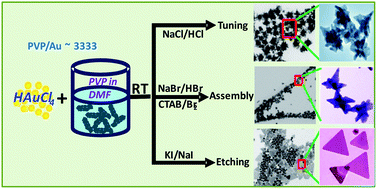
The simple addition of different halide ions to the precursor polymer–solvent solution for the synthesis of gold nanostars drastically changes their optical properties owing to the blue/red shifting of the longitudinal surface plasmon resonance (LSPR) bands as well as the emergence of new plasmon bands, aesthetically illustrating the simultaneous size/shape tuning enhanced with intriguing self organization, as confirmed from the TEM measurements. Such a synchronized morphology tuning has been very well understood in terms of the distinct reaction kinetics imparted by the different adsorption affinities of inorganic halide ions towards metal ions/surfaces. The systematic results of which are discussed rigorously in the present work in conjunction with the uncommon/unusual assemblies of anisotropic/elongated gold nanostructures, the first of its kind to the best of our knowledge, that are envisioned as ‘hot spots’ for exotic applications in surface enhanced Raman scattering (SERS) as well as plasmonic waveguiding.
The assembly of anisotropic metal nanoparticles offers a further control of their optical properties by significantly aligning the orientation of the nanoparticles in a desired/designed manner, the co-operative SPR excitations of which facilitate a high localization of electromagnetic energy suitable for potential applications in sensing and waveguiding for functional photonic devices.26–32 The corresponding organized self assemblies that result from the near field optical plasmonic coupling among neighboring individual particles has made it possible to expand the exotic application potentials of these nanoparticles.26–36 Ordered arrays of metal nanostructures also display significant electric field enhancement and consequently an improved sensitivity is observed in both LSPR and surface enhanced Raman scattering (SERS) based assays.29–33,37
Many efforts have recently been devoted to the wet-chemical synthesis of anisotropically branched metal nanoparticles through both seed mediated as well as seedless growth procedures.4,38–40 Gold nanostars8–10,13 have been of great interest in recent times for their excellent applications in nanoantennas as well as zeptomol-sensitive SERS based sensing,10,41,42 as these 3D complex multi-branched nanoparticles with sharp tips display extremely interesting plasmonic properties but require extensive optimization. The intrinsic properties of Au nanostars result from hybridization of plasmons focalized at the core and the tips of the nanoparticles. The core acts as an antenna producing electromagnetic field enhancements of the tip plasmons.8
These monodisperse gold nanostars are produced with(out) seed mediation by different research groups worldwide utilizing dimethylformamide and poly(vinylpyrroliodone) (PVP).8,40 In the seed mediated approach, the optical properties of gold nanostars can only be extended up to 800 nm8,43while in the single step seedless process it can be routinely tuned to 920 nm, as reported previously.40 Gaining insights into the respective growth mechanisms can help us to determine the optimal synthesis conditions for obtaining and designing more complex architectures of nanoparticles with tunable plasmonic properties.
In our present case, it has been observed that the introduction of halide ions (chlorine/bromine) into the DMF–PVP complex leads to the tuning/self assembly of these gold nanostars, whereas a drastically different morphology evolves when an iodide ion is added. Till now, halide ions were utilized only for the careful etching of the surface of preformed Au nanoparticles in order to get different morphology related optical responses.44–46 Only very few reports investigate the essential role of halide ions in the actual synthesis of anisotropic gold nanostructures. Mirkin's group47a has discussed the role of halide ions in the seed mediated synthesis of gold nanoparticles using CTA–X (X = halide), where CTA–Au-X complexes play an important role in dictating the shape evolution of nanoparticles. A recent review by Catherine J. Murphy47b discussed that halide ion containing surfactants (CTAB/CTAC) are well employed for the anisotropic growth of metal nanocrystals. They demonstrate that halide ions diligently adjust the reduction potential of gold ion species, passivate the gold nanoparticle surface and control the extent of silver under-potential deposition (if present in the system), that dictates the reaction kinetics (knowing the exact parameter is lacking in the reports), leading to the growth of different faceted nanostructures. None of the previous reports explicitly studied/mentioned the effect of halide ions in the absence of surfactants for the nucleation/growth of anisotropic metallic nanostructures. Herein, we present a systematic investigation on the influence of different halide ions (in situ) on the size, morphology and monodispersity of anisotropic/elongated Au nanostructures obtained in concentrated solutions of poly(vinylpyrrolidone) in N,N-dimethylformamide for the first time to best of our knowledge. The present work elucidates the fact that the introduction of halide ions to the DMF–PVP system leads to not only the selective tuning governed by the sequential change in the morphology, but also induces the tip to tip organization of these anisotropic gold nanostructures depending upon the strength of the halide ion interaction. Precise kinetic control represents a powerful route for the facile nucleation and controlled nanocrystal growth at the early stages of the colloidal synthesis procedures, essentially delineating better ways for not only producing near monodisperse anisotropic metal nanostructures, but also exemplifying their random/self organization. The emphasis on the various synthetic parameters responsible for the same forms the major theme of our present work, clearly underlining the fact that simple yet unconventional ideas are vital for the development and design of new types of nanostructures with sophisticated application potentials.
000, Aldrich) in DMF (Merck) is homogeneously mixed with an adequate amount of different halide ions (NaCl, NaBr, HBr, KI, CTAB, Br2) and after that tetracholoroauric acid (HAuCl4·3H2O, Aldrich) is added to the solution so as to make the molar ratio of PVP to metal (calculated in terms of polymer repeating unit or monomer chain length) ∼3333 and the whole solution is continuously stirred under normal room temperature conditions. The color of the solution starts changing from pale yellow to different colors, indicating the formation of gold nanostructures. Different halide ions at different concentrations are added in aliquots to the DMF–PVP complex and the rest of the reaction conditions are the same as mentioned above.
Optical absorption measurements were carried out in all our as-prepared nanoparticle solution samples in the wavelength range of 200–1100 nm using a Thermo Scientific absorption spectrophotometer. TEM samples were prepared by drying the fivefold centrifuged samples in ethanol at around 4500 rpm (to remove excess PVP) on carbon formvar coated copper grids and the images were acquired using an FE-Technai G2 system operated at an accelerating voltage of 300 kV. The hydrodynamic diameters of the as-prepared Au nanostructures were characterized using a particle sizing system NICOMP 380 ZLS (PSS, Santa Barbara, CA) at a measurement angle of 90º (Internal He-Ne laser, wavelength 633 nm) utilizing dynamic light scattering (DLS). All the measurements were done at room temperature unless otherwise specified.
Interestingly, the TEM images of the as-prepared, exceedingly reproducible and extremely stable gold nanostars reveal a complex multilayered core with a number of (non)planar single crystalline spikes radially branching out from the centre, resembling prominently a flower like structure, the size/shape of which has been normalized by the controlled addition of HCl without any external seed mediation. The evaluation of a plausible kinetics and growth mechanism has already been described extensively in our previous work.40 Higher volume/concentration of HCl essentially lead to a step-by-step dissociation of tips/edges from the star like Au nanostructures, gradually saturating towards the formation of spheroidal gold nanoparticles, strongly suggesting that an excess of HCl dramatically modifies the kinetics of the reaction steering towards a more conventional thermodynamic regime.
Convinced by the fact that the introduction of foreign agents in the precursor reaction medium substantially affects the size/shape of gold nanostars, we have carefully analyzed the effective role of each of the individual inorganic halide (chloride, bromide and iodide) ions upon addition to the DMF–PVP system in the following sections.
Moreover, it is interesting to note that with NaCl addition, an uneven nucleation of seed particles takes place as clearly depicted by the bimodal distribution in the TEM images (see Fig. 1(a–d), average diameter 90 and 60 nm, respectively). Preferential solvation of the Na+ ions by DMF takes place and chloride ions maintain the equilibrium concentration of AuCl4− in the solution (Le Chatlier principle), thereby drastically decreasing the nucleation/growth rate. It is necessary to mention here that either with the HCl or NaCl addition the inter-particle distance between the as-formed Au nanostructures invariably decreases, signaling the fact that inter-particle coupling enabled plasmon resonances predominate in these gold nanostructures.
It is thus clear that halide ions, in particular I− ions, exert a major influence over the evolution of the shape in gold nanocrystals. Among other halide ions, iodide ions have a strong affinity to chemisorb on gold surfaces and thus have the ability to induce surface reconstruction on the adsorbed faces. Higher concentrations of iodide ions restrain the growth of Au nanoparticles as no surface plasmon resonance is observed even after several months after the addition of KI ([KI] = 2 mM) (see Fig. S1†).
In terms of assimilating the extinction spectra for different HBr/NaBr concentrations, each representative spectra was deconvoluted utilizing Gaussian multi-peak fitting procedure, as shown in Fig. 5 and 7 with dashed lines. The main observation inferred is systematically explained as follows. Both the longitudinal LSPR mode (related to the tips) and transverse LSPR mode (corresponding to the central core) were blue-shifted along with a gradual decrease in the intensity of the longitudinal LSPR mode, signifying the effect of decreasing tip/spike length, their size and number, resulting in the overall change in morphology of the individual nanoparticles themselves. The anisotropic broadness of the individual plasmonic peaks essentially depicts their highly coupled nature, associated with the collective participation of individual gold nanoparticles in an ordered manner envisaged through in vitro PVP–bromine interaction in the surrounding medium.
Deconvolution of these individual asymmetrical plasmon peaks with different HBr/NaBr concentrations (shown in Fig. 5 and 7) qualitatively estimates the extent of the deviation from spherical symmetry of the as-formed gold nanostructures as well as their random self-organized configuration in an intriguing fashion is in complete collusion with the observed TEM images (Fig. 4 and 6). To our surprise, we saw that a 2D organization is preferred with HBr, while tip-to-tip or 1D assembly is preferred with NaBr addition, further accounting for the dynamic strength of the solvent DMF interaction with the cationic counterpart of the bromine ion in precisely engineering the unconventional anisotropic assembled configuration, even in the absence of other external energy resources.
The exclusive comparison of the optical absorption spectra of gold nanostructures formed with different NaBr concentrations (after 1 day and 8 months of preparation, see Fig. 8) illustrates conveniently the stability of the novel assembled gold nanostructures, which can be directly utilized for practical application purposes. The pH and refractive index stability of these as-formed assembled gold nanostructures were also conveniently demonstrated, as shown in Fig. S2 and S3,† establishing their robustness.
Overall, the halide ions present in the solution form the gold–chloro–X (X = halide) complex, thereby strongly affecting its reduction potential (in the decreasing order Au–Cl > Au–Br > Au–I) and binding strength (increasing as Cl− < Br− < I−), subsequently inhibiting the nucleation as well as the growth of gold nanoparticles by way of halide ion adsorption on the metal surface. From our present experimental results, it can be easily inferred that along with the polymer–halide ion interaction, the gold chloro complex facilitates the formation of 3D anisotropic nanostructures and the gold bromo complex initiates the nanoparticle network formation, while the gold iodo complex extends the formation of planar Au nanostructures. Since self-organization predominates with the addition of bromine ions, as confirmed from the variation in hydrodynamic diameter obtained through the dynamic light scattering (DLS) measurements shown in Fig. 9, effectively matching our TEM images (Fig. 6), we can assert the simple fact that the organized nanoparticle chain length is maximum at the optimal concentration of 0.4 mM NaBr, which randomizes for lower/higher concentrations of NaBr under the present experimental conditions, thereby encouraging us to investigate the suggestive/irreversible role of bromine ions in the assembly of metal nanostructures.
![]() | ||
| Fig. 9 (a) Normalized hydrodynamic diameter of the as-formed Au nanostructures measured by dynamic light scattering (DLS). (b) The variation of the hydrodynamic diameter illustrates the coupling strength between adjacent Au nanoparticles resulting in stronger/longer chain length (the maximum of which appears for an optimal concentration of 0.4 mM NaBr), in direct confirmation with our TEM images given in Fig. 6. | ||
Thus, control experiments were carried out by separately adding the well-known surfactant cetyltrimethylammonium bromide (CTAB), known for its long cationic chain suitably terminated with bromine ions, and molecular Br2 to the DMF–PVP complex, so as to test the individual roles of cations and halogen ions (as shown in Fig. S4 and S5†). As expected, assembled gold nanostructures obtained in both the cases emphasize the necessity of bromine ions in promoting the coupled organization of nanoparticles during the nucleation/growth stage itself. Instead, when we use bromine containing K2AuBr4 as the metal precursor we observe the persistence of the assembled gold nanostructures in a simple but efficient manner, as shown in Fig. S6† (more detailed work on the same is in progress), validating the certain formation of PVP–Au–bromo complexes (as schematically proposed in Scheme 1), which in conjunction with the DMF–PVP complex accentuates the organized chain-like formation of metal nanostructures. The effect of different molecular weights of PVP and gold concentrations on the optical spectra as well as on the assembly in the presence of NaBr is shown in Fig. S7 and S8.†
![]() | ||
| Scheme 1 showing the plausible PVP–Au-bromo complex interaction, leading to the formation of organized nanostructured networks. | ||
Till now, most of the available literature reports only the effect of halide ions on the post synthesized metal nanostructures. Recently, Liz-Marzán and his group48 have shown that by adding a small amount of CTAB to the gold nanostars colloidal solution reshaping takes place easily, as seen by the gradual conversion of 3D nanostar morphologies into quasi-spherical gold nanoparticles, which has been ascribed to the presence of both Br and the integrated chain length of CTAB, forcibly implying the idea that reshaping is not feasible in the presence of small inorganic molecules such as NaBr. In terms of verifying this nascent concept, we have added small amount of NaBr to the preformed colloidal Au nanostars and found that reshaping does indeed takes place (see Fig. S9†), but more slowly compared with that of CTAB, which prompted us to quantify the in situ effect of bromine entities in the growth/formation of metal nanostructures, in particular. Therefore, we examined the individual effects of three different bromine entities, namely NaBr, CTAB and Br2, in our synthesis protocol and their sharp contrasted results lead us to conclude that when brominated ions are used in situ, the self-organization (sharp tip-to-tip alignment) of metal nanostructures dominates (which correlates very well with our proposed Scheme 1 as well), and when used on the preformed nanoparticles aggressive reshaping takes place depending on their reactive strength. Further work of which is fast in progress and will be published elsewhere.
Furthermore, controlled inter-particle spacing in self-assembled metal nanostructures is achieved by encapsulating within organic shells of varying thicknesses, or by using stimuli-responsive polymer ligands, or by varying the type and location of ligands on the surface of the nanoparticles.49–51 This is also well correlated with the appearance of a new hump like feature in the near infra-red region (700–1100 nm) of the extinction spectra along with the existing transverse and longitudinal SPR peaks, indicating strong near-field plasmon coupling among the assembled anisotropic metal nanoparticles, that collectively behave as a continuous elongated quasi-1D nanostructure supporting multi-polar mode resonances in analogy with longer metal nanowire structures. Importantly, the perseverance of these spectral features emphasize the robustness of the plasmon coupling and its ability to tolerate defects within the sub-nm spaced assembly of nanoparticles, thereby providing a unique strategy for promoting a complex sub-wavelength optical phenomenon using bottom up design strategies.27,28,31,52
In our present work, we firmly believe that the surface chemisorbed PVP molecules not only dictate the individual size/shape of the as-formed anisotropic gold nanostructures but also effectively co-ordinate their in situ as well as intuitive programmed/directed organization in the presence of sufficient amount of NaBr/HBr, the mechanistic/topological aspects of which had not been verified or had been overlooked till now. It is further proposed that our as-prepared self-organized metal nanostructures can be directly utilized as plasmonic waveguides, particularly in view of the fact that the adjacent gold nanoparticles were mostly attached through their sharp tips, allowing them to transport electromagnetic energy over reasonably long distances far below the diffraction limit and hence minimizing the propagation loss to a large extent,28 highlighting the significance of our present bottom-up approach utilizing colloidal chemical synthesis procedures.
Even though PVP has already been extensively used both as reducing agent as well as steric stabilizer in the solution-phase synthesis of colloidal metal nanoparticles,53 its ability in giving rise to the non-equilibrium coupled integrative self-assembly to produce extended and multiple length scale nanostructured networks has been carefully identified and understood for the first time to the best of our knowledge. It is worth pursuing to ensure that the colossal breaking of the entangled nature of this universally soluble homogeneous polymer PVP in the presence of halide ions, especially the bromine ions, should essentially be the major factor in delineating the spatio-temporal organization of highly anisotropic metal nanostructures into long chain or any other patterned/templated shapes with ease even under normal conditions. Further work is in progress to tune this progressive self-assembly of these anisotropic gold nanostructures in synthetic patterns, as well as to understand the nature of the complex nucleation/growth mechanism.
Footnote |
| † Electronic supplementary information (ESI) available: UV-vis spectra and TEM images are illustrated in Fig. S1–S9. See DOI: 10.1039/c3ra43976c |
| This journal is © The Royal Society of Chemistry 2014 |