Thermochemical analysis on the growth of NiAl2O4 rods

Sang Sub Kim a, Gun-Joo Sun a, Hyoun Woo Kim *b, Yong Jung Kwon b and Ping Wu *c
aDepartment of Materials Science and Engineering, Inha University, Incheon 402-751, Republic of Korea
bDivision of Materials Science and Engineering, Hanyang University, Seoul 133-791, Republic of Korea. E-mail: hyounwoo@hanyang.ac.kr
cEntropic Interface Group, Singapore University of Technology & Design, Singapore 138682, Singapore. E-mail: wuping@sutd.edu.sg

Received 25th June 2013 , Accepted 14th November 2013

First published on 15th November 2013


Abstract

We have succeeded in growing cubic submicron-sized NiAl2O4 rods on sapphire substrates by means of heating a mixture of NiO and graphite powders. At 1600 °C, NiAl2O4 rods terminated by SiOx-containing nanoparticles were grown on the sapphire substrates. In contrast, NiO rods grew randomly at 1500 °C. We elucidated the growth steps of cubic NiAl2O4 submicron-sized rods on the basis of a thermochemical approach, revealing the critical role of liquid silica that blocks the continuous loss of Ni to the vapor phase for the successful growth of NiAl2O4 rods.

Introduction

Nickel aluminate (NiAl2O4) is a mixed-cation oxide with normal spinel structure in which Al occupies the octahedral and Ni the tetrahedral sites. Industrial applications of this material are mainly ascribed to its stable structure at high temperatures and its catalytic features,1 combined with a high surface area. In addition, NiAl2O4 is a promising candidate for use as anode material in aluminum electrolysis because of a unique combination of electrical conductivity and chemical diffusivity.2 It can also be used as core insulating material in power fusion reactors due to its radiation stability. Furthermore, it has potential for application as a refractory material in the ceramics industry due to its low density (3.58 g cm−3) and its stability in harsh environments.3 Also, it has been used as a humidity sensor with interesting results in terms of sensitivity, stability, and response time.4–6 Since the high surface area of NiAl2O4 is critical for industrial applications, including catalysis, the fabrication of NiAl2O4 nanoparticles has been intensively studied by means of a variety of methods, including sol–gel7 and sonochemical synthesis.8 In addition, nanoscale NiAl2O4 has been formed during NiAl (111) oxidation.9

One-dimensional (1D) structures have attracted great attention due to their peculiar physical properties and potential applications, thus focusing on investigations related to mesoscopic physics and the fabrication of nano-devices, respectively. Furthermore, the development of methods for synthesizing a wide variety of 1D structures made from novel materials has become increasingly important. Although 1D structures provide peculiar and interesting physical properties, to the best of our knowledge, no attempt has been reported on the preparation of 1D nano- or microrods of NiAl2O4. Their shape with a large surface-to-volume ratio indicates that they will exhibit useful physical and chemical properties. Accordingly, a variety of applications, including in electrodes, sensors, and insulators, is expected.

In the present paper, we report on the fabrication of 1D structures of NiAl2O4 at the submicron scale. This has been accomplished by heating a mixture of NiO and graphite powders. On the basis of a thermochemical analysis, we propose the growth mechanism of NiAl2O4. In particular, we revealed that liquid silica played a critical role in blocking the continuous loss of Ni to the vapor phase. Detailed experimental procedures are described in ESI. Previously, Sivakumar et al. synthesized NiFe2O4 nanorods by a polymer-assisted co-precipitation method using polyethylene oxide (PEO) as a capping and a polymer structure directing reagent.10 Herein, they revealed that the concentration of PEO/NiFe2O4 composite is controlling the formation, size, and shape of the nanorods. Also, Nanko et al. prepared NiAl2O4 nanorod arrays by the pack cementation process, in which Ni matrix is oxidized together with Al2O3 rods.11 In the present work, the well-known vapor–liquid–solid (VLS) mechanism was employed to obtain the 1D NiAl2O4 rods. While most previous VLS studies are associated with metal catalyst tips which should be removed for applications,12,13 we have produced the SiOx particles at the tips of the rods, which can be useful in a combination scheme.

Results and discussion

XRD patterns are included in ESI (Fig. S2) The diffraction peaks in XRD pattern of the product grown at 1500 °C can be indexed on the basis of two phases, namely, cubic NiO with lattice constants comparable to the reference values reported in the JCPDS 47-1049 card and cubic NiAl2O4 with normal spinel structure with lattice constants a = 8.048 Å (JCPDS: 10-0339). On the other hand, the product grown at 1600 °C is mainly comprised of cubic NiAl2O4 with a trace amount of the cubic NiO phase. SEM and TEM analyses were carried out for the rods grown at 1500 °C (Fig. S3). Both the TEM image and the SAED pattern indicate that the rods are mainly comprised of the NiO phase (Fig. S3), whereas the XRD investigation reveals the existence of a considerable amount of NiAl2O4 (Fig. S2). Further plan-view SEM observations exhibit the presence of film-like or cluster-like products, which are indicated by dotted areas in Fig. S4. Therefore, it is reasonable to conclude that rods of NiO grew on sapphire (0001) substrates with a buffer layer of NiAl2O4 at 1500 °C.

Fig. 1(a and b) shows SEM images of the product grown at 1600 °C. Fig. 1(a) exhibits that the 1D rods were grown with various angles on the substrate. The enlarged SEM image indicates that the rods have spherical nanoparticles at their tips (Fig. 1(b)). The low-magnification TEM image confirms that rounded nanoparticles are attached to the tip. Fig. 1(c–g) exhibits the elemental maps of Ni, Al, O, and Si. It is observed that the region in which the rods were grown is comprised of the elements Ni, Al, and O. The elements Si and O are preferentially located in the tip region. Fig. 1(h) and (i) show a SAED pattern and a lattice-resolved TEM image, respectively, from a surface region of the rods grown at 1600 °C. The SAED pattern was recorded perpendicular to the rod axis, which is parallel to the [01[1 with combining macron]] zone axis of cubic NiAl2O4. The well-defined SAED pattern clearly shows diffraction spots representing ([1 with combining macron]11), (111), and (200) lattice planes of the cubic NiAl2O4 structure. On the basis of the lattice-resolved TEM image, the interlayer distances were determined to be about 0.20 nm and 0.46 nm, corresponding to the spacings d200 and d110 of the cubic NiAl2O4 lattice.


image file: c3ra43196g-f1.tif
Fig. 1 (a and b) SEM image and (c) low-magnification TEM image of 1600 °C-grown rods. EDX elemental maps of (d) Ni, (e) Al, (f) O, and (g) Si elements. (h) SAED pattern and (i) lattice-resolved TEM image of 1600 °C-grown rods.

Based on the current investigations (XRD, SEM, and TEM) and literature reports,14–18 we performed an additional thermochemical analysis aiming at a better understanding about the growth mechanism of the 1D NiAl2O4 rods. De Roos et al.14 proposed that the nucleation of NiAl2O4 at the NiO–Al2O3 interface starts with Al3+ ions (penetrating along the grain boundaries of NiO) followed by counter-diffusion of Ni2+ ions, which is expected since Al3+ is smaller in size than Ni2+. The essential role of oxygen diffusion under various growth conditions of NiAl2O4 was studied by Zhong et al.15 and was further confirmed by Kotula et al.16 In addition, Loginova et al.17 pointed out that repeated cycles of oxygen exposure (a dynamic process) lead to nucleation of NiAl2O4. Recently, Chen et al.18 synthesized carbon nanofibers from CO2 by using a Ni–Al2O3 catalyst. It seems that the introduction of carbon into the NiO–Al2O3 system may lead to different products ranging from carbon nanofibers14 to spinel nanorods (in this work), depending on the thermochemical constrains imposed on the system. Therefore, it is important to understand the unique thermodynamic behavior of the C–SiO2–NiO–Al2O3 system. There are three phases involved in the spinel synthesis; gas (air and Ar), liquid (silica) and solid (C, SiO2, NiO, Al2O3, and NiAl2O4) material. We used a commercial thermochemistry simulation software, FactSage, for the following synthesis analysis performed at 1600 °C (amounts are given in moles):

I. Reactions between carbon and each of the three binary oxides

 
C + SiO2 = 0.66SiO2 + 0.33SiC + 0.69 gas (97.4% CO, 2.5% SiO)(1)

1/3 of solid SiO2 is reduced to 1/3 of solid SiC and a minor amount of SiO in the gas phase. As shown below, the formation of minor quantity of SiO in the gas phase is critical to the synthesis process.

 
C + Al2O3 = C + Al2O3(2)

No chemical reaction is expected between C and Al2O3.

 
C + NiO = Ni + gas (100% CO)(3)

NiO is reduced to Ni and the concomitantly formed gas phase consists of 100% CO. In other words, Ni is easily removed from the solid to the gas phase.

II. The partition of metals (Ni, Al, and Si) between the gas and the liquid (silica) phase determined by assuming that NiAl2O4 is the only solid phase, which is reasonable considering the trace amount of the cubic NiO phase.

 
C + SiO2 = 0.13SiO2 (liquid) + 1.78 gas (54% CO, 44% SiO, 2% SiC)(4)

We see that a sufficient amount of SiO is built up in the gas phase to supply Si for the formation of liquid SiO2.

 
C + NiO = 2 gas (50% Ni, 50% CO)(5)

No liquid phase is formed. All Ni2+ ions of NiO have been reduced to Ni° in the gas phase. Without additional protection, all Ni may be transferred to the gas phase prior to interacting with Al to form the spinel compound.

III. Reactions in the system of gas, liquid (silica slag), and solid (spinel, SiO2)

 
C + Al2O3 + NiO + SiO2 = 2.00 gas (47% Ni, 50% CO, 3% SiO) + 1.78 liquid (52.9% SiO2, 44.8% Al2O3, 2.3% NiO) + 0.156 spinel.(6)

The liquid phase is formed with a low solubility of NiO (47% in gas and 2.3% in liquid), therefore, we may use the liquid phase to block the loss of Ni from NiO to the gas phase. Here are two evidences. First, liquid silica is formed at the top of the NiAl2O4. In Fig. 1(g), Si element was observed mainly at the top of the rod. Based on the thermodynamics calculation shown in eqn (6), 94% and 6% of Si located at the top are in the liquid and gas phases, respectively, at 1600 °C. Therefore, at the top of the rod, this enriched Si is mainly in the liquid form of SiO2 at 1600 °C, which will separate the solid rod from the gas phase. Second, Ni has much lower solubility in liquid SiO2 than in gas SiO: based on the thermodynamics calculation shown in eqn (6), 94%, 4%, and 2% of all Ni are in the gas, liquid and solid phases, respectively, at 1600 °C. Therefore, less Ni will be lost into liquid SiO2 (4%) than into gas SiO (94%). The top liquid SiO2 layer cuts off the loss of Ni to the gas phase by blocking the direct contact of solid to gas phase. This will ensure sufficient supply of Ni for the formation of NiAl2O4. Based on the above thermochemical analysis, it is clear that the formation of the liquid silica phase is a critical step for the successful synthesis of NiAl2O4.

There are two well-accepted mechanisms for the growth of 1D nanostructures: the VLS and the vapor–solid (VS) mechanism. In the present growth process at 1600 °C, the existence of particles at the ends of the rods suggests that the growth mechanism is associated with the VLS process. The growth of NiAl2O4 rods at 1600 °C with nanoparticles attached to the end of the rods can be divided into several steps by taking the above thermochemical analysis into account. In the first step, a mixture of NiO and graphite powders was heated and evaporated according to eqn (5). We surmise that Si atoms within the liquid droplets originate from the chamber ambience, as shown by eqn (4). More detailed, we believe that the silicon contained in the liquid droplets originates from the surface of the quartz tube and/or from the silica component of the alumina boat.

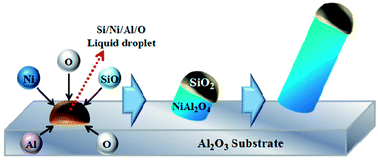
At a high temperature of 1600 °C, some Si atoms will evaporate from the quartz surface. This can be corroborated from the fact that the melting point of quartz is in the range of 1600–1800 °C (i.e., 1670 °C (β-tridymite); 1713 °C (β-cristobalite)). Also, it is possible that oxidation of Si occurs, consequently resulting in the formation of SiO gas19 (as indicated by eqn (4)). The thus formed volatile Si suboxide vapor could preferentially decompose at the surface of a liquid droplet. Ultimately, Si/Ni/Al/O liquid droplets are formed on top of the substrate (Fig. 2). From the NiAl2O4–SiO2 phase diagram shown in the ESI (Fig. S5),20 we suppose that there exists an eutectic-like reaction between NiAl2O4 and SiO2 at around 1495.5 °C. Accordingly, starting from Si/Ni/Al/O liquid droplets with a sufficient amount of Ni and Al, the liquid droplets become supersaturated when the temperature decreases and the relative amount of Ni and Al increases, as shown by eqn (6). In the second step, as droplets or nanoparticles acting as nucleation sites become supersaturated, such that the concentration of Ni and Al in the alloy droplets or nanoparticles exceeds the saturation threshold, the growth of NiAl2O4 rods is initiated as a result from the reaction between Ni, Al, and O (Fig. 2). Accordingly, the remaining alloy droplets will be comprised of SiO2. This is in agreement with the EDX results (Fig. 1), according to which the elements Si and O are preferentially located within the tip region.


image file: c3ra43196g-f2.tif
Fig. 2 Schematic illustration of the growth process at a substrate temperature of 1600 °C.

On the other hand, during the growth process at 1500 °C, which is only 4.5 °C higher than the eutectic-like reaction presented in Fig. S5, rods with particle-free ends were preferentially formed. It is likely that the liquid silica phase is not formed at 1500 °C, even though it is higher than 1495.5 °C, due to chemical kinetics constraints. Therefore, instead of a single liquid phase covering the top of the rods and preventing depletion of Ni to the gas phase (eqn (5)), a mixture of three solid phases (NiO, spinel, and cristobalite) may be formed, which is much less effective in insulating the top of the rods from the gas phase. This proposed mechanism is supported by the XRD and TEM data that suggest that the main constituent of the rods was cubic NiO, rather than cubic NiAl2O4. By increasing the temperature from 1500 to 1600 °C, the amount of the liquid silica phase will increase in a continuous manner. This tendency will be associated with the following two phenomena. First, with increasing the temperature, the amount of vapour Si atoms will be increased. Second, at a higher temperature, it will be easier to form Si/Ni/Al/O liquid on top of the substrate. Since the volatile Si suboxide vapor decomposes at the surface of a liquid droplet, the abundance of liquid droplet at a higher temperature will contribute to the increase of the amount of the liquid silica phase. In order to reveal the detailed structure/morphology of the products at temperatures between 1500 and 1600 °C, further systematic study is necessary.

A room-temperature PL spectrum of the rods grown at 1600 °C is shown in the ESI (Fig. S6). To reveal the origin of these bands, we have compared the PL spectra of the rods grown at 1600 °C and at 1500 °C (Fig. S6 and its inset). While the peak at 2.4 eV can be mainly attributed to the NiO phase, we suggest that the peak at 2.7 eV arises from the SiOx phase of the rod tips.

Conclusions

We have synthesized submicron-sized rods of NiAl2O4 at a temperature of 1600 °C on sapphire substrates. While the products synthesized at 1600 °C are mainly comprised of submicron-sized rods of NiAl2O4 with SiOx particles at the ends of the rods, the product grown at 1500 °C is formed by particle-free NiO submicron rods. Accordingly, it is revealed that the growth at 1600 °C is mainly controlled by a VLS mechanism in which NiAl2O4 rods are grown with remnant SiOx becoming tip particles. By thermochemical analysis, we revealed that diffusion kinetics plays a key role in the formation of the NiAl2O4 phase. The formation of a liquid phase on top of the rod may block the continuous depletion of Ni2+ into the gas phase and provide a steady supply of Ni to match the fast diffusion of Al3+ ions.

Acknowledgements

Dr Ping Wu's research is partially sponsored by the SUTD-ZJU grant (SUTD-ZJU/RES/01/2012) on chemical sensing and by Singapore MOE Tier 2 grant (MOE 2012-T2-1-097) on interface transport.

Notes and references

  1. A. Al-Ubaid and E. E. Wolf, Appl. Catal., 1988, 40, 73 CrossRef CAS.
  2. J. Shin, A. Goyal, K. More and S.-H. Wee, J. Cryst. Growth, 2008, 311, 210 CrossRef CAS PubMed.
  3. A. Laobuthee, S. Wongkasemjit, E. Traversa and R. M. Laine, J. Eur. Ceram. Soc., 2000, 20, 91 CrossRef CAS.
  4. G. Gusmano, G. Montesperelli, E. Traversa and G. Mattogno, J. Am. Ceram. Soc., 1993, 76, 743 CrossRef CAS.
  5. T. Seiyama, N. Yamazoe and H. Arai, Sens. Actuators, B, 1983, 4, 85 CAS.
  6. Y. Shimizu, H. Arai and T. Seiyama, Sens. Actuators, B, 1985, 7, 11 CAS.
  7. H. Cui, M. Zayat and D. Levy, J. Non-Cryst. Solids, 2005, 351, 2102 CrossRef CAS PubMed.
  8. P. Jeevanandam, Y. Koltypin and A. Gedanken, Mater. Sci. Eng., B, 2002, 90, 125 CrossRef.
  9. E. Loginova, F. Cosandey and T. E. Madey, Surf. Sci. Lett., 2007, 601, L11–L14 CrossRef CAS PubMed.
  10. P. Sivakumar, R. Ramesh, A. Ramanand, S. Ponnusamy and C. Muthamizhchelvan, J. Appl. Phys., 2013, 563, 6 CAS.
  11. M. Nanko, D. T. M. Do and T. Ishizaki, Curr. Appl. Phys., 2012, 12, S184 CrossRef PubMed.
  12. R. S. Wagner and W. C. Ellis, Appl. Phys. Lett., 1964, 4, 89 CrossRef CAS.
  13. A. M. Morales and C. M. Lieber, Science, 1998, 279, 208 CrossRef CAS.
  14. G. De Roos, J. M. Fluit, R. P. Velthuizen, J. H. W. De Wit and J. W. Geus, Surf. Interface Anal., 1983, 5, 119 CrossRef CAS.
  15. Q. Zhong and F. S. Ohuchi, J. Vac. Sci. Technol., A, 1990, 8, 2107 CAS.
  16. P. G. Kotula and C. B. Carter, J. Am. Ceram. Soc., 1998, 81, 2869 CrossRef CAS.
  17. E. Longinova, F. Cosandey and T. E. Madey, Surf. Sci., 2007, 601, L11 CrossRef PubMed.
  18. C. S. Chen, J. H. You and C. C. Lin, J. Phys. Chem. C, 2011, 115, 1464 CAS.
  19. D. Starodub, E. P. Gusev, E. Garfunkel and T. Gustafsson, Surf. Rev. Lett., 1999, 6, 45 CrossRef CAS.
  20. B. Phillips, J. J. Hutta and I. Warshaw, J. Am. Ceram. Soc., 1963, 46, 579 CrossRef CAS.

Footnote

Electronic supplementary information (ESI) available. See DOI: 10.1039/c3ra43196g

This journal is © The Royal Society of Chemistry 2014
Click here to see how this site uses Cookies. View our privacy policy here.