
Density functional calculations on the distribution of Ti in a Y zeolite and its influence on acidity

Na Wang, Minhua Zhang and Yingzhe Yu*
Key Laboratory for Green Chemical Technology of the Ministry of Education, Tianjin University Research and Development Center for Petrochemical Technology, Weijin road, Tianjin 300072, People's Republic of China. E-mail: belinda5084@163.com

Received 22nd May 2013 , Accepted 15th October 2013

First published on 21st October 2013


Abstract

The question of whether Ti replaces Al or Si in the framework of a Y zeolite is studied using a density function theory (DFT) calculation. The distribution properties of Ti in a zeolite are discussed by comparing substitution energies, they show that of the seventeen Si positions investigated the preferred substitution is the one where the Si atoms are located next to the Al, and that the Al is more easily replaced than Si. The framework of the Y zeolite shows a local expansion and deformation after the substitution. The deprotonation energy then reflects the change in Brönsted acidity, demonstrating that the replacement enhances the Brönsted acidity of the zeolite. Further, a detailed illustration of the relationship between the acidity of the zeolite and the location of the Ti is presented.

1. Introduction

Since its discovery, the TS-1 zeolite has attracted more and more attention due to its high reactivity under mild conditions, hydrophobicity and excellent stability.1–3 During the post-synthesis process, some of the framework atoms of the zeolite are substituted by Ti atoms,4,5 changing the physicochemical properties of the zeolite, especially the acidity.6 Therefore influencing the catalytic activity in zeolite-related reactions. The local chemical environments of the Ti atoms and their distribution in the framework of the zeolite should play an important role in influencing the catalytic properties.

In the well-prepared zeolite samples, the Ti atoms are found to be incorporated into the lattice in isolated sites and surrounded by four OSiO3 tetrahedra.7 Recently, the incorporation of Ti into a Y zeolite under acidic conditions by a post-synthesis method has been studied,8 and the results show that the Ti species in solution are incorporated into hydroxyl nests generated during the dealumination process in the zeolite framework. Furthermore, the catalytic performance of Ti incorporated into a Y zeolite for the epoxidation of cycloalkenes using aqueous hydrogen peroxide is better than that of a TS-1 zeolite. While the evidence for isomorphous substitution and the improvement of catalytic activity is convincing, the specific details of the siting position of Ti within the framework and the influence of the Ti siting on the properties of zeolites needs further in-depth study.

In zeolites with framework substitution, for example when Ti replaces Si or Al, questions surrounding the location of the substitution and the manner in which the siting affects the chemistry remain largely unanswered experimentally, although some computational approaches have addressed these questions.9,10 Density functional theory (DFT) can always provide information that is complementary to the multitude of experimental information, such as the distributions of Ti in CHA,11 Beta12 and MCM-41.13 However, there is little in the literature about the distribution of Ti in a Y zeolite. On the other hand, quantum chemical calculations have been frequently applied to the analysis and investigation of the acidity of zeolites.14 For example, the deprotonation energy15 represents the strength of a Brönsted acid. The lower the deprotonation energy, the better the ability of a material to provide a proton.

In the present work, we report the results of two sets of calculations by the DFT method. In the first, DFT calculations are used for a detailed study of the question of whether Ti replaces Al or Si in the framework of a Y zeolite by comparing the substitution energies, and the distribution of Ti in a Y zeolite is discussed. Following this, the change of Brönsted acidity is investigated by calculating the deprotonation energies. Finally, the relationship between the distribution of a Ti atom in a Y zeolite and the acidity is investigated.

2. Calculation details

2.1 Cluster models

In this work a 24T cluster model of a Y zeolite has been used to study the substitution of the Ti atom and the change of the acid strength. The 24T cluster represents parts of a supercage that is cut off from a Y zeolite configuration obtained from the Materials Studio library. In the cluster model, the dangling bonds of the Si atoms are terminated by OH and the O–H bonds are oriented along the bond direction towards what would otherwise have been the next Si atom.16 The terminal H atoms are fixed and other atoms are allowed to relax. The research of Lonsinger17 et al. shows that the effects of artificial termination do not propagate further than two bonds from the terminating proton. The geometric characterization of the optimized pure Si Y zeolite is shown in Table 1, where a comparison with the neutron diffraction results of a free-Al sample18 and a DFT calculation result19 are also included. Although our methodology yields large SiO bonds compared to experiments, the values are almost the same as other DFT calculation results. On the other hand, SiOSi and OSiO angles are calculated with great accuracy. It can be considered that the model that we chose could truly represent the realistic structure of a Y zeolite (Fig. 1).
Table 1 Structure data of the optimized 24T cluster model of a pure Si Y zeolitea
Labelsb T–Oc T–O19 T–O18
a Bond lengths are in Å, bond angles are in degrees.b O2, O3 and O4 are shown in Fig. 1.c Optimized values.
Si–O2 1.622 1.622 1.597
Si–O3 1.630 1.632 1.604
Si–O4 1.623 1.622 1.614

Labelsb T–O–Tc T–O–T19 T–O–T18
Si–O2–Si 150 149 149
Si–O3–Si 147 145 146
Si–O4–Si 143 142 141

Labelsb O–T–Oc O–T–O19 O–T–O18
O2–Si–O3 108 108 109
O2–Si–O4 109 109 109
O3–Si–O4 111 111 112


image file: c3ra42530d-f1.tif
Fig. 1 Cluster model location in the supercage of a Y zeolite (a), a pure Si Y zeolite (b) and the optimized 24T cluster model (c). Color code: Si (yellow), O (red), Al (pink), H (white).

A framework Si atom is replaced by an Al atom and the charge is compensated for by a proton, which provided the Brönsted acidity in the 24T cluster model. The calculations of the geometric structure show that the Al–O bond lengths are 1.776 Å, 2.063 Å, 1.791 Å, 1.737 Å respectively, and the Al–O bond connected to H is longer (2.063 Å) than the other three bonds, which agrees with the result of earlier theoretical and experimental studies,20 in that the Al–O distance associated with the acidic proton is significantly longer than the other Al–O distances, by up to 0.2 Å. Meanwhile, the value of the Al–O distance that is connected with the H is consistent with the DFT result of Katada et al.15 And the O–H distance (0.981 Å) agrees well with the observation of Kalita and co-workers.21 Therefore, 18 possible T sites including one Al site and seventeen Si sites are taken into considerations for the substitution.

2.2 DFT calculations

DFT calculations are performed by applying the Dmol3 program in the Materials Studio software package developed by Accelrys, as previously reported.22 Geometry optimization and energy calculations are performed using the double numerical with a polarization (DNP) basis set, BLYP exchange and correlation functional, which give more accurate results for zeolite calculations.23 The convergence criteria (energy, force, and displacement) are set to 2 × 10⁻⁵ Ha, 4 × 10⁻³ Ha Å−1, and 0.005 Å, respectively. No symmetry constraints are used for any of the cluster models in this study.

The substitution energy is used to measure the energy preference for the substitution by Ti at a certain T site. It is defined as the reaction energy of the virtual reaction, and it is calculated as follows:24

ESi/Ti = E(Si–zeolite) + ETiE(Ti–zeolite)ESi, EAl/Ti = E(Al–zeolite) + ETiE(Ti–zeolite)EAl

The smaller substitution energy means that the replacement of Si or Al by Ti is more likely to occur.

The Brönsted acidity strength of the zeolite is measured by the deprotonation energy (EDEP). It is defined for the reaction ZH → Z + H+, as follows:

EDEP = EZeo–OEZeo–OH

Models with high deprotonation energy are poor proton donors and have weak Brönsted acidity.

For convenience, all substitution energies and deprotonation energies are referred to by the corresponding energy, presented as a relative energy.

3. Results and discussion

3.1 Substitution of Si

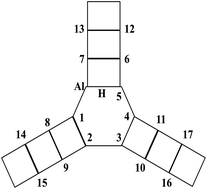
3.1.1 Configurations. There are seventeen possible positions where Ti can be substituted, these are shown in Fig. 2. The seventeen different configurations are optimized to investigate the structural change of the Y zeolite, and the Si/Ti–O bond lengths and Si/Ti–O–Si bond angles before and after the substitutions are shown in Table 2. The presented T–O bond lengths show that the distances between Ti and O increase by about 0.2 Å after the substitution. Also reported in Table 2 are the enlargements of the Ti–O–Si bond angles by up to 3°–7°, and only a small part among these bond angles varies within about 1°. It can be deduced from the changes of bond lengths and bond angles, that the Ti incorporation in the Y zeolite causes a local expansion and a deformation of the Y zeolite framework, which is related to the atomic radius of the Ti atom. Furthermore, the pore size of the zeolite decreases after the substitution, which corresponds with the findings of Yasunori's research.8 The changes in the structure of the channels will definitely influence the catalytic activity of the zeolite, especially for shape-selective reactions.
image file: c3ra42530d-f2.tif
Fig. 2 Substituted sites of Ti. The intersection of each line represents a T site. Every possible T site with a Ti substitution is numbered. The O atoms of the zeolite are not shown in this figure.
Table 2 Si/Ti–O bond lengths and Si/Ti–O–Si bond angles before and after the substitution as well as the relative ESi/Ti
T site Si–O bond length (Å) Si–O–Si bond angle (°) Ti–O bond length (Å) Ti–O–Si bond angle (°) Relative ESi/Ti (kJ mol−1)
1 1.691 113.3 1.831 116.2 0
1.647 108.5 1.877 112.2
1.679 108.8 1.881 112.7
1.674   1.847  
2 1.651 107.9 1.839 106.6 42.2
1.690 114.2 1.864 121.9
1.715 108.3 1.917 112.4
1.668   1.838  
3 1.689 112.6 1.888 118.1 94.1
1.683 108.8 1.866 108.2
1.683 112.4 1.874 117.9
1.664   1.834  
4 1.668 110.3 1.853 110.8 28.6
1.669 110.6 1.857 115.9
1.701 107.1 1.895 109.7
1.668   1.833  
5 1.648 107.8 1.829 113.1 9.24
1.669 116.9 1.843 116.9
1.748 104.4 1.969 109.8
1.652   1.825  
6 1.682 109.4 1.866 107.0 34.6
1.649 107.4 1.817 105.1
1.721 111.0 1.902 118.2
1.670   1.835  
7 1.698 106.6 1.901 108.6 18.9
1.693 113.6 1.872 120.9
1.644 107.9 1.825 106.0
1.686   1.843  
8 1.711 105.0 1.906 105.2 56.4
1.677 106.8 1.840 103.5
1.675 113.2 1.857 120.4
1.691   1.854  
9 1.719 113.9 1.913 121.3 67.7
1.670 109.2 1.843 110.0
1.704 108.3 1.891 106.2
1.683   1.848  
10 1.695 113.1 1.883 119.5 33.8
1.668 107.5 1.846 105.7
1.668 107.2 1.873 106.3
1.669   1.833  
11 1.693 113.5 1.886 122.7 21.9
1.663 108.7 1.836 109.3
1.682 106.6 1.876 104.1
1.667   1.838  
12 1.698 116.4 1.886 122.7 15.2
1.648 106.7 1.839 106.1
1.691 108.1 1.874 107.7
1.664   1.835  
13 1.692 114.7 1.878 122.9 22.2
1.658 107.9 1.842 104.9
1.679 107.4 1.868 106.4
1.662   1.835  
14 1.695 117.0 1.879 122.7 29.9
1.658 106.3 1.819 104.4
1.705 108.9 1.901 110.4
1.667   1.832  
15 1.717 120.3 1.910 125.9 76.1
1.652 108.9 1.833 107.7
1.732 103.4 1.909 102.7
1.674   1.827  
16 1.697 116.4 1.882 122.1 21.2
1.664 107.3 1.845 106.2
1.693 107.7 1.866 107.3
1.663   1.836  
17 1.696 115.5 1.892 123.0 23.7
1.662 106.8 1.832 105.4
1.687 106.8 1.870 106.1
1.665   1.832  


Also reported in Table 2 is the relative ESi/Ti, which takes the corresponding energy of 1 site as a benchmark to represent the difficulty of Si being replaced by Ti, and the relative ESi/Ti ranges from 0 kJ mol−1 to 94.1 kJ mol−1. The replacement is easiest at the 1, 5 and 7 sites with relative ESi/Ti of 0 kJ mol−1, 9.24 kJ mol−1 and 18.9 kJ mol−1 respectively, while the replacement is the hardest at the 3 site with a relative ESi/Ti of 94.1 kJ mol−1. According to the substitution sites shown in Fig. 2, it can be found that the 1, 5 and 7 sites lie in the position nearest to the Al in the six-membered ring of the Y zeolite, and the Al–O–Ti structure is formed. Correspondingly, the most unlikely replaceable position is the position diagonally away from the Al within the same six-membered ring. It can be concluded, on purely energetic grounds, that the probability of a different Si site substituted by a Ti is associated with the position of the Si in the framework of the Y zeolite, and the distributions of the Ti are obtained. That is, Ti is mainly located in positions neighboring Al in the six-membered ring of the Y zeolite, and it is unlikely for it to be distributed in the position diagonally away from Al in the same six-membered ring of the Y zeolite. Therefore, the Brönsted acidity generated from the proton could be influenced.

3.1.2 Acidity. The calculated relative deprotonation energies of the Y zeolite before and after the substitution are shown in Table 3, they take the corresponding energy of the Y zeolite as the benchmark (1244.09 kJ mol−1). All these clusters show a lower deprotonation energy compared with the original Y zeolite, which illustrates that the substitution of Si by Ti enhances the Brönsted acidity of the framework hydroxyl groups. And the relative EDEP of the Y zeolite with different distributions of Ti ranges from −0.75 kJ mol−1 to −19.9 kJ mol−1. Besides, the Mulliken charge of H increases after the isomorphous substitution, which is consistent with the change of the deprotonation energy that shows the enhanced Brönsted acidity. However, the replacement has a weak influence on the H–O bond length, which is over a narrow range from 0.980 Å to 0.983 Å, compared with the H–O bond length (0.981 Å) of the Y zeolite.
Table 3 The relative EDEP of the different T sites as well as the H–O bond lengths and the Mulliken charge of H
  Relative EDEP (kJ mol−1) H–O bond length (Å) Mulliken charge of H
Y zeolite 0 0.981 0.349
1 −16.6 0.982 0.365
2 −9.66 0.981 0.355
3 −8.44 0.980 0.352
4 −15.2 0.981 0.357
5 −19.4 0.981 0.360
6 −3.30 0.981 0.358
7 −19.9 0.982 0.362
8 −6.35 0.981 0.359
9 −4.26 0.981 0.361
10 −3.51 0.982 0.359
11 −13.4 0.983 0.361
12 −12.5 0.982 0.358
13 −8.07 0.982 0.361
14 −1.80 0.982 0.361
15 −0.75 0.982 0.359
16 −8.28 0.981 0.358
17 −8.49 0.981 0.359


3.2 Substitution of Al

3.2.1 Configuration. Because the number of framework Al atoms decreases during the substitution process, the replacement of Al by Ti is also discussed. After the substitution, the corresponding Ti–O distance is elongated by 0.2 Å to the original Al–O distance and reaches up to 1.923 Å, 2.246 Å, 1.948 Å and 1.900 Å, respectively. The calculated Al–O–Si bond angle increases from 102.0, 99.4 and 124.0 in the non-substituted zeolite to 103.2, 101.0 and 134.8 in the Ti-substituted zeolite. The changes of bond length and bond angle also indicate that Ti incorporation in to the Y zeolite causes a local expansion and a deformation of the Y zeolite framework.

The substitution energy is 83.3 kJ mol−1, whereas the smallest substitution energy in a Si site is 172.8 kJ mol−1 in 1 of the sites. The comparison of the different substitution energies suggests that it is easier to substitute Al than Si. Therefore, it is Al that is the first to be replaced by Ti during the experimental process, and thereby the configuration of the Brönsted acid sites is influenced. The position of the proton provided the Brönsted acidity of the zeolite without changing the structure of the Brönsted acid site, which changes from Al–OH to Ti–OH after the substitution.

3.2.2 Acidity. The deprotonation energy of the Ti substituted zeolite decreases to 1240.7 kJ mol−1, which is between the values of 1240.8 kcal mol−1 (replacement of Si in the 6 site) and 1241.0 kcal mol−1 (replacement of Si in the 10 site) compared with that (1244.1 kJ mol−1) of the Y zeolite, indicating that the Brönsted acidity of the substituted zeolite increases slightly. The influence of replacing Si on Brönsted acidity is greater than that of replacing Al by a comparison of the deprotonation energies.

4. Conclusion

In summary, the question of whether Ti replaces Al or Si in the framework of a Y zeolite, as well as the influence of the substitution on the acidity of the zeolite, is studied using DFT quantum chemical calculations. Si/Ti substitution energies reveal that the probability of substitution is associated with the Si position in the framework of the Y zeolite. And Ti atoms prefer to be located in the position neighboring Al, while the site diagonally away from the Al in the six-membered ring of the zeolite is the least favoured position for the substitution. Meanwhile, Al/Ti substitution is also discussed. By comparing the substitution energies, it is easier to replace Al than Si. According to the change of the bond length and bond angle after the substitution, the incorporation of Ti in the Y zeolite causes a local expansion and deformation of the framework, which may reduce the pore size of the zeolite. Deprotonation energies of different substituted zeolites demonstrate an enhancement in the Brönsted acidity, whereas the replacement of Al shows a weaker influence on the Brönsted acidity of the zeolite. The change in pore size and acidity of a Ti-incorporated Y zeolite will influence the catalytic activity of zeolite-related reactions, especially shape-selective reactions.

References

  1. D. Barbera, F. Cavani, T. D. Alessandro, G. Fornasari, S. Guidetti, A. Aloise, G. Giordano, M. Piumetti, B. Bonelli and C. Zanzottera, J. Catal., 2010, 275, 158–169 CrossRef CAS PubMed.
  2. V. Hulea and E. Dumitriu, Appl. Catal., A, 2004, 227(1–2), 99–106 CrossRef PubMed.
  3. N. Wilde, C. Worch, W. Suprun and R. Glaser, Microporous Mesoporous Mater., 2012, 164, 182–189 CrossRef CAS PubMed.
  4. M. Tamura, W. Chaikittisilp, T. Yokoi and T. Okubo, Microporous Mesoporous Mater., 2008, 112, 202–210 CrossRef CAS PubMed.
  5. V. R. Choudhary and S. K. Jana, Appl. Catal., A, 2002, 224, 51–62 CrossRef CAS.
  6. J. Su, G. Xiong, J. Zhou, W. Liu, D. Zhou, G. Wang, X. Wang and H. Guo, J. Catal., 2012, 288, 1–7 CrossRef CAS PubMed.
  7. A. Gamba, G. Tabacchi and E. Fois, J. Phys. Chem. A, 2009, 113, 15006–15015 CrossRef CAS PubMed.
  8. Y. Oumi, T. Manabe, H. Sasaki, T. Inuzuka and T. Sano, Appl. Catal., A, 2012, 388, 256–261 CrossRef PubMed.
  9. C. A. Hijar, R. M. Jacubinas, J. Eckert, N. J. Henson, P. J. Hay and K. C. Ott, J. Phys. Chem. B, 2000, 104, 12157–12164 CrossRef CAS.
  10. S. Yuan, H. Si, A. Fu, T. Chu, F. Tian, Y.-B. Duan and J. Wang, J. Phys. Chem. A, 2011, 115, 940–947 CrossRef CAS PubMed.
  11. A. Damin, S. Bordiga and A. Zecchina, J. Chem. Phys., 2003, 118(22), 10183–10194 CrossRef CAS PubMed.
  12. G. Sastre and A. Corma, Chem. Phys. Lett., 1999, 302, 447–453 CrossRef CAS.
  13. V. Hulea and E. Dumitriu, Appl. Catal., A, 2004, 277, 99–102 CrossRef CAS PubMed.
  14. T. Noda, K. Suzuki, N. Katada and M. Niwa, J. Catal., 2008, 259, 203–210 CrossRef CAS PubMed.
  15. N. Katada, K. Suzuki, T. Noda, G. Sastre and M. Niwa, J. Phys. Chem. C, 2009, 113, 19208–19217 CAS.
  16. A. Simperler, R. G. Bell, M. D. Foster, A. E. Gray, D. W. Lewis and M. W. Anderson, J. Phys. Chem. B, 2004, 108(22), 7152–7161 CrossRef CAS.
  17. S. R. Lonsinger, A. K. Chakraborty, D. N. Theodorou and A. T. Bell, Catal. Lett., 1991, 11, 209–217 CrossRef CAS.
  18. J. A. Hriljac, M. M. Eddy, A. K. Cheetham, J. A. Donohue and G. J. Ray, J. Solid State Chem., 1993, 106, 66 CrossRef CAS.
  19. S. German, K. Naonobu and K. J. Suzuki, J. Phys. Chem. C, 2008, 112, 19293 Search PubMed.
  20. N. E. Schultz, Y. Zhao and D. G. Truhlar, J. Phys. Chem. A, 2005, 109, 11127–11143 CrossRef CAS PubMed.
  21. U. Eichler, M. Brandle and J. Sauer, J. Phys. Chem. B, 1997, 101, 10035–10050 CrossRef CAS.
  22. B. J. Delley, Chem. Phys., 2000, 113, 7756–7766 CrossRef CAS PubMed.
  23. B. Kalita and R. C. Deka, J. Phys. Chem. C, 2009, 113, 16070–16076 CAS.
  24. R. Ch. Deka, V. A. Nasluzov, E. A. Ivanova Shor, A. M. Shor, G. N. Vayssilov and N. Rösch, J. Phys. Chem. B, 2005, 109, 24304–24310 CrossRef PubMed.

This journal is © The Royal Society of Chemistry 2014
Click here to see how this site uses Cookies. View our privacy policy here.