


 PLATFORM UPDATE:

Blue absorption and red emission of Bi2+ in solids: strongly spin–orbit coupled 6p levels in low symmetry fields†
Abstract
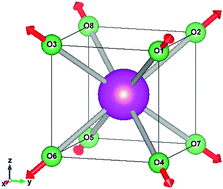
Wave function embedded cluster ab initio calculations on a (BiO8)14− cluster under the effects of a high symmetry Oh confinement potential are used to study the energies of the 2P1/2, 2P3/2(1), and 2P3/2(2) spin–orbit coupling levels of the 6s26p configuration of Bi2+ in Oh, D4h, D2h, D4, D2d, D2, S4, C4v, C4, C3v, C2v, C2, Cs, and C1 fields, together with the 2P1/2 → 2P3/2(1) and 2P1/2 → 2P3/2(2) absorption oscillator strengths and the 2P3/2(1) radiative lifetime. These levels are responsible for the blue absorptions and the red-orange emissions produced when Bi2+ is doped in borates, phosphates, sulphates, and other hosts. It is found that the splitting of 2P3/2 is mainly due to the tetragonal D4h and orthorhombic D2h components of the actual field. It is enhanced by Bi going towards two or four ligands. The intensities of the 2P1/2 → 2P3/2(1) and 2P1/2 → 2P3/2(2) absorptions are mostly induced by the Bi displacements and by tetragonal scalenoidal D2d fields. The most favorable fields for a large splitting of the 2P3/2 level that can drive a red shift of the 2P3/2(1) → 2P1/2 emission are the C2v and Cs fields resulting from the combination of D2h orthorhombic fields and Bi approaching two or four ligands on the main orthorhombic planes.
 Please wait while we load your content...


