
Rewarding excellence in biological chemistry
Nominations are now open for the sixth Malcolm Campbell Memorial Prize. This is presented by the RSC's Biological and Medicinal Chemistry Sector every other year to an individual or team based in UK industry or academia for significant recent contributions to biological chemistry. They might be working in discovery or process development, and nominees are welcome from medicinal, agrochemical or aromachemical research.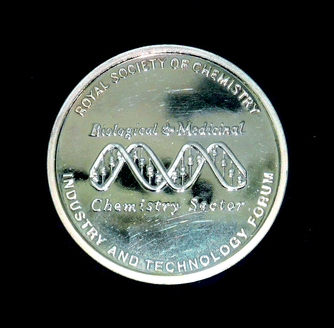
The award dates back to the 1980s, and was renamed in 2003 to commemorate Malcolm Campbell, who was a stalwart of the BMCS in the 1980s and 1990s. Born in Glasgow, Campbell studied chemistry at Glasgow University, followed by a PhD with Charles Brooks in the then-new field of gas chromatography-mass spectrometry. After a postdoc in the US on mechanistic organic chemistry with Jerry Berson at the University of Madison, Wisconsin, he returned to Scotland as a lecturer in organic chemistry at Heriot-Watt University.
As a small department, research funds were scarce, and he set about making links with pharmaceutical companies, notably Beecham, Organon and Pfizer. His research also headed down a pharmaceutical path, focusing on the chemistry of beta-lactam antibiotics such as penicillins and cephalosporins, and also steroidal amino alcohols.
His links with industry were strengthened by a six-month secondment at Organon in Newhouse in Scotland, followed by time spent at Pfizer in its research facility in Groton, Connecticut, US. This coincided with his appointment to the chair of organic chemistry at Bath, making him one of the youngest professors of chemistry in the UK. His time in Bath was productive – his chemistry focused on the synthesis of phosphorus-containing and other peptide mimics, shikimic acid, antibiotics and toxins. He spent two periods as head of the chemistry school in the 1980s and 1990s, leading it to a Grade 4 rating in the 1992 Research Assessment Exercise.
Campbell's links with the pharma industry continued, and he was much in demand as a consultant. His links with the RSC were significant – as well as time serving on the Council of the Perkin Division, he spent time on the Fine Chemicals and Medicinals Group Committee of the Industrial Division, and also the BMCS committee.
He was also heavily involved in the organisation of various medicinal chemistry conferences. For example, he chaired the organising committee of the RSC's medicinal chemistry conference in Cambridge in 1986, and chaired the organising committee for the European Federation for Medicinal Chemistry's 15th International Symposium on Medicinal Chemistry in Edinburgh until ill health forced him to relinquish the position at the 11th hour. He took early retirement, and moved to a croft in Lewis.
After his death in 2001, the BMCS committee was keen to recognise the huge influence Campbell had on medicinal chemistry in the UK, and with the permission of his widow Brenda the BMCS prize was renamed in his honour. Since then, the award has been presented in his memory every other year.
The first winners of the newly renamed prize, in 2003, were Malcolm Stevens, Andrew Westwell and Tracy Bradshaw from Cancer Research UK for the discovery of the anticancer drug candidate Phortress, and related work.1 This benzothiazole is a prodrug which is activated by an enzyme found in some forms of cancer. It is selectively taken up into sensitive cells, followed by arylhydrocarbon receptor binding and translocation into the nucleus. There, it induces the cytochrome P450 CYP1A1, and the drug is metabolised into an electrophilic reactive intermediate which forms extensive DNA adducts. This DNA damage results in the cell death via its own apoptotic machinery.
This process only occurs in specific cancer cell types, particularly breast and ovarian cancers, and unlike many drugs for these forms of cancer it is not dependent on the presence of the oestrogen receptor. This work followed on from a separate project which resulted in the cancer drug temozolomide, which was licensed to Schering-Plough, and has been sold to treat brain tumours since 1999.
In 2005, there were two separate winners. Pfizer's Tony Wood was rewarded as leader of the medicinal chemistry team at the Sandwich labs which developed the anti-AIDS drug maraviroc (Selzentry/Celsentri).2 The drug, which reached the market in 2007, is the first clinically validated host target agent for the treatment of HIV. The negative allosteric modulator acts at the CCR5 receptor, a coreceptor required for viral entry into cells in most HIV strains. The medicinal chemistry programme took just two-and-a-half years to complete, from the initial HTS hit to the identification of maraviroc.
A number of medchem challenges had to be overcome during this process, for example to remove unwanted off-target activities such as cytochrome P450 inhibition and HERG ion channel activity, while achieving the ADME properties that are required for a successful oral agent. This meant carefully balancing the hydrogen bonding potential of putative inhibitors to maintain permeability, while minimising HERG binding. The programme combined modern drug discovery technologies such as HTS, in silico modelling and parallel chemistry with more fundamental principles such as conformational analysis and bioisosterism to give a compound that was both clean and highly active.
The second 2005 winner, David O'Hagan of the University of St Andrews, was recognised for his work on fluorinating enzymes.3 The first fluorinase enzyme was identified in 2002 from the bacterium Streptomyces cattleya. Unusually, it is able to catalyse the formation of a carbon–fluorine bond in the presence of inorganic fluoride ions. Biosynthetic investigations showed that the enzyme combines S-adenosyl-L-methionine and fluoride ion to make 5′-fluoro-5′-deoxyadenosine. An HPLC assay was then developed to purify the enzyme based on this conversion. It has since been cloned and overexpressed for use as a biocatalyst.
Organofluorine compounds are important in pharmaceutical, agrochemical and fine chemicals applications, and the identification and purification of this enzyme enabled fluorinated compounds to be made biocatalytically for the first time. Previously, they had only been available by chemical synthesis, with many of the fluorinating agents being hazardous and tricky to handle. In addition, the enzyme can be used to catalyse the incorporation of 18F atoms during the synthesis of ligands that have applications in positron emission tomography.
The 2007 award went to a team from Organon in Newhouse for the development of sugammadex (Bridion).4 Jonathan Bennett, Anton Bom, Alan Muir, Ronald Palin, David Rees and Ming Zhang were all part of the group which developed this cyclodextrin-based compound which selectively binds skeletal muscle relaxants. These steroidal neuromuscular blocking drugs, such as rocuronium, are commonly used in clinical anaesthesia as they block the physiological effects of acetylcholine on striated muscle cells. Previous reversal agents modulated the effects of acetylcholine, but these commonly have side-effects such as bradycardia, arrhythmias and bronchoconstriction, and they cannot be used to reverse deep block.
Sugammadex acts in a completely different way – it chemically encapsulates the muscle relaxant, which encourages them to dissociate from their site of action and thus reverses the neuromuscular blockade. As it does not interact directly with cholinergic systems, it avoids the side-effects found with older agents. The medchem programme started with gamma-cyclodextrin. The depth of its lipophilic cavity was increased, and anionic functional groups added to the rim of the cavity. Sugammadex was the result, and it forms a very tight binding complex with rocuronium. It was approved in the EU in 2008.
In 2009, the prize was given to Lawrence Woo and Barry Potter of the University of Bath, along with Atul Purohit and Michael Reed of Imperial College London. The award was for the discovery of the first steroid sulfatase inhibitors which target hormone-dependent breast tumours.5 Many breast cancers are dependent on 17β-estradiol, and the hydrolysis of the conjugate estrone–3-O-sulfate to estrone by the enzyme steroid sulfatase is an important source of tumour oestrogen. The team used sulfate group surrogates in the search for highly potent active site-directive irreversible inhibitors of this enzyme, leading to the development of an aryl sulfamate pharmacophore. A spin-out company, Sterix, was set up to take non-steroidal candidates into clinical trials, which has since been taken over by Ipsen.
The first-in-class drug, STX64, reached Phase I trials in 2003. A second multi-targeted antitumour drug candidate, STX140, was based on similar structural concepts but was aimed at hormone-independent cancer, with potential against drug resistant tumours. The mechanism also has potential in other therapeutic areas – related steroidal sulfamate compounds have also been investigated in reproductive medicine.
The most recent winners, in 2011, came from the University of Liverpool. Paul O'Neill, Kevin Park and Stephen Ward won for their work on antimalarial drugs and the chemical biology of the malaria parasite Plasmodium falciparum.6 The EU-funded Antimal project, covering 35 institutions in Europe and Africa, was managed by Liverpool, and in the four years running up to the award it had progressed two novel molecules into human trials, with more coming up behind.
Several molecules from the Liverpool group show promise in malaria. The novel 4-aminoquinoline antimalarial NTB Isoquine progressed into Phase I trials in 2008 with GlaxoSmithKline and the Medicines for Malaria Venture, and preclinical development of the peroxide drug RKA 182 and the 4-aminoquinoline FAQ4 was put in place ahead of a potential move into clinical trials. The team has also been working on novel parasite targets, and identified a novel series of quinolones that are nanomolar inhibitors of the malarial enzyme PfNDH2.
| Previous winners of the BMCS award | |||
|---|---|---|---|
| 1984 | Michael Elliott | Rothamsted | Pyrethroids |
| 1985 | Barry Price | Glaxo | Medicinal chemistry |
| 1992 | George Gray | University of Hull | Liquid crystals |
| 1994 | Nigel Hughes | ICI | Colour chemistry |
| 1997 | Roger Newton | Maybridge | Popularisation of chemistry |
| 1998 | Paul Wyman & team | SmithKlineBeecham | 5-HT4 antagonists |
| 1999 | John Clough & team | Zeneca Agrochemicals | Azoxystrobin antifungals |
| 1999 | Stan Lee | Zeneca Pharma | Process chemistry |
| 2000 | Stephen Neidle | Institute of Cancer Research | Design of DNA binding agents |
| 2000 | Chris Swain & team | Merck Sharp & Dohme | NK1 antagonist research |
| 2001 | Colin Leech & team | GlaxoSmithKline | Lp-PLA2 inhibitor research |
Sarah Houlton is a freelance science journalist based in Boston, US.
References
- CRUK team: G. D. Brown, et al. , J. Med. Chem., 2002, 45, 5448 CrossRef CAS.
- Wood: A. Wood and D. Armour, Prog. Med. Chem., 2005, 43, 239 CrossRef CAS.
- O'Hagan: C. J. Dong, et al. , Nature, 2004, 427, 561 CrossRef CAS.
- Organon team: J. M. Adam, et al. , J. Med. Chem., 2002, 45, 1806 CrossRef CAS.
- Bath/IC team: S. Stanway, et al. , Clin. Cancer Res., 2006, 12, 1585 CrossRef CAS.
- Liverpool team: P. M. O'Neill, et al. , J. Med. Chem., 2009, 52, 1408 CrossRef CAS.
| This journal is © The Royal Society of Chemistry 2012 |