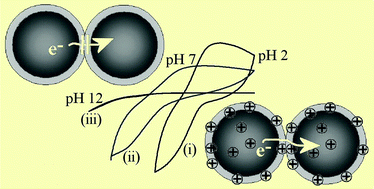
Carbon nanoparticles with phenylsulfonate negative surface functionality (Emperor 2000, Cabot Corp.) are coated with positive chitosan followed by hydrothermal carbonization to give highly pH-responsive core–shell nanocarbon composite materials. With optimised core–shell ratio (resulting in an average shell thickness of ca. 4 nm, estimated from SANS data) modified electrodes exhibit highly pH-sensitive resistance, capacitance, and Faradaic electron transfer responses (solution based, covalently bound, or hydrothermally embedded). A shell “double layer exclusion” mechanism is discussed to explain the observed pH switching effects. Based on this mechanism, a broader range of future applications of responsive core–shell nanoparticles are envisaged.