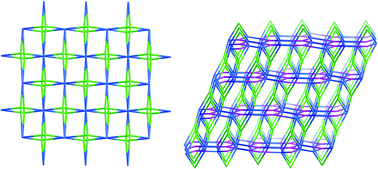
Solvothermal reactions of aromatic quaterphenyl-2,5,2′,5′-tetracarboxylic acid (H4qptc) ligand and transitional metal cations of MII (M = Co, Ni, Mn, Cu, Zn) in the presence of 1,10-phenanthroline (phen) afford five new coordination polymers (CPs), namely, {[M(H2qptc)(phen)(H2O)2]·2H2O}n (M = Co (1), Ni (2)), [Mn(qptc)0.5(phen)(H2O)]n (3), [Cu(qptc)0.5(phen)]n (4) and [Zn3(Hqptc)2(phen)2(H2O)2]n (5). Their structures have been determined by single-crystal X-ray diffraction analyses and further characterized by elemental analyses, IR spectra, powder X-ray diffraction (PXRD) and thermogravimetric (TG) analyses. Complexes 1 and 2 are isostructures and each displays a one-dimensional (1D) zigzag chain, which further forms a 2D supramolecular architecture via inter-chain π⋯π interactions. Complex 3 possesses a (3,6)-connected CdI2 layered architecture incorporating left- and right-handed helical chains. Complex 4 exhibits a 3D porous structure with rare (3,6)-connected ant topology. Complex 5 shows a 3D (3,4,5)-connected network with (42.6)2(43.62.8)(45.64.8)2 topology. The results show that the conformations and coordination modes of H2qptc2−/qptc4− ligand are crucial factors for the formation of the different structures. Moreover, the photoluminescence of 5 has been investigated.