
 Open Access Article
 This Open Access Article is licensed under a Creative Commons Attribution-Non Commercial 3.0 Unported Licence
Ir-catalysed formation of C−F bonds. From allylic alcohols to α-fluoroketones†
Nanna
Ahlsten
and
Belén
Martín-Matute
*
Department of Organic Chemistry, Arrhenius Laboratory, Stockholm University, SE 106 91 Stockholm, Sweden. E-mail: belen@organ.su.se; Fax: +46 (0)8 15 4908; Tel: +46 (0)8 16 2477
First published on 22nd June 2011
Abstract
A novel iridium-catalysed tandem isomerisation/C–F bond formation from allylic alcohols and Selectfluor® to prepare α-fluorinated ketones as single constitutional isomers is reported.
The introduction of fluorine into organic compounds has become a widely applied strategy to modulate the steric, electronic and lipophilic properties of a molecule. In this way, fluorine atoms can be used to modify the pharmacokinetic properties of pharmaceuticals.1 Electrophilic fluorination of carbonyl compounds,2–5 including asymmetric versions,2b–d,6 has emerged as a powerful tool for aliphatic C–F bond formation.7 Still, few methods for highly regioselective fluorination of unsymmetrical ketones have been reported, and sufficient steric differentiation at the α-carbons is usually a requirement for obtaining high selectivity. Alternatively, enones,8epoxides9 or other non-carbonyl precursors10,11 can be used to introduce a handle for regiocontrol.
Allylic alcohols can be isomerised into carbonyl compounds in the presence of a transition metal catalyst.12 The isomerisation may occur via formation of transition metal enolates,13 and, if electrophiles are present in the reaction media, α-functionalised carbonyl compounds are formed regiospecifically (Scheme 1). Although previously reported for aldehydes and imines,14,15 heteroatomic electrophiles have never been used in this fashion. To some extent, the reason for this has been the incompatibility of many transition metal complexes with strongly electrophilic reagents.
 | ||
| Scheme 1 Tandem isomerisation/α-functionalisation of allylic alcohols. | ||
Here, we present a novel one-pot method to synthesise α-fluoro ketones in a regiospecific manner by combining an iridium-catalysed isomerisation of allylic alcohols with an electrophilic fluorination.
Catalysts such as RhCl(PPh3)3, [Rh(COD)Cl]2, [Rh(COD)(MeCN)2]BF4, [η5-(Ph5C5)Ru(CO)2Cl] or Cp RuCl(PPh3)2 are known to isomerise allylic alcohols into ketones.14,16 Attempts to obtain fluorination by combining them with reagents such as N-fluorobenzenesulfonimide (NFSI) or Selectfluor® (SelectF) were unproductive due to deactivation of the catalyst. To overcome this, we evaluated complexes of a higher oxidation state, such as [RhCp*Cl2]2 and [IrCp*Cl2]2 (Table 1). When combined with NFSI, these two complexes catalysed the isomerisation/fluorination of 1-octen-3-ol (1a) in 43 and 70% yield, respectively (Table 1, entries 1 and 2). Unexpectedly, the product was a mixture of isomeric α-fluoroketones 2a and 2a′. In an attempt to explain the formation of 2a′, we performed a control experiment and confirmed that octan-3-one (3a) was unreactive under the reaction conditions used in Table 1, entry 2. Therefore, this fluorination (entry 2) did not proceed from base- (the reactions were run in the presence of Na2CO3) or Lewis acid-catalysed enolisation of 3a, but rather via an alternative (unselective) mechanism to that of Scheme 1.17 When SelectF was used as the fluorine source and water was used as a co-solvent, only the desired constitutional isomer (2a) was formed in 40% yield, together with 60% of non-fluorinated ketone (3a) (Table 1, entry 3). Under the same reaction conditions, NFSI or N-fluoropyridinium tetrafluoroborate (NFPY) failed to give any fluorinated products (Table 1, entries 4 and 5). Only monofluorinated products were obtained (i.e. no difluorinated ketones), under any of the reaction conditions.
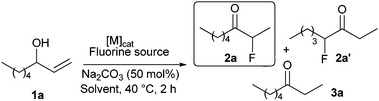
| Entry | [M] | F source | Solvent | Conv.b (%) | 2a/2a′/3ab (%) |
|---|---|---|---|---|---|
a Unless otherwise noted, the reactions were run with 2.5 mol% of metal dimer (5 mol% metal), allylic alcohol 1a (0.2 mmol), fluorine source (0.2 mmol) and Na2CO3 (0.1 mmol) in the solvent indicated (1 mL), and analysed after 2 h.
b Determined by 1H NMR with respect to consumption of 1a.
c After 18 h.
d 14% 1-octene-3-one formed.
e
THF/H2O 2![[thin space (1/6-em)]](https://www.rsc.org/images/entities/char_2009.gif) :1. :1.
|
|||||
| 1c | [RhCp*Cl2]2 | NFSI | THF | 47 | 28/15/4 |
| 2c | [IrCp*Cl2]2 | NFSI | THF | 100 | 52/18/16d |
| 3 | [IrCp*Cl2]2 | SelectF | THF/H2Oe | 100 | 40/—/60 |
| 4 | [IrCp*Cl2]2 | NFPY | THF/H2Oe | 100 | —/—/100 |
| 5 | [IrCp*Cl2]2 | NFSI | THF/H2Oe | — | —/—/— |
Since SelectF in THF/water mixtures successfully produced only one constitutional isomer of the product (i.e.2a′ was not formed), further screening on this system was performed (Table 2). The best results were obtained using a THF/water mixture of 5:1. Less water failed to dissolve SelectF, and more water increased by-product (3a) formation. The catalyst loading could be lowered to 1 mol% (Table 2, entry 1). At acidic pH, higher amounts of unwanted ketone 3a are obtained and the reaction is complete in a shorter time (15 min) (Table 2, entry 2). The best selectivities (2a/3a ratio) are obtained in the presence of Na2CO3 or at neutral conditions (using a phosphate buffer, pH 7) (Table 2, entries 1 and 3 vs. 2). Increasing the amount of SelectF had little effect on the product distribution (Table 2, entry 4). At higher temperatures than 30 °C, more of 3a was formed (Table 2, entry 5). Neither did the amount of 2a increase when the temperature was lowered to 10 °C, due to decreased solubility of SelectF (Table 2, entry 6). The fluorination did not proceed in the absence of the iridium catalyst. The reactions are operationally simple, run at, or close to room temperature, and under an atmosphere of air.
| Entry | Solvent | T/°C | Conv.b (%) | 2a/2a′/3ab (%) |
|---|---|---|---|---|
| a 1a (0.2 mmol) was added to a mixture of [IrCp*Cl2]2 (1 mol%) and SelectF (0.25 mmol) in the solvent mixture indicated (1 mL), and analysed after 1 h. b Determined by 1H NMR with respect to consumption of 1a. c With Na2CO3 (10 mol%). d At pH 3 after 15 min. e K/NaPO42−buffer (pH 7) was used. f With 2.5 equiv. SelectF. | ||||
| 1c |
THF/H2O (5:1) |
30 | 100 | 82/0/18 |
| 2d |
THF/H2O (5:1) |
30 | 100 | 67/0/33 |
| 3 |
THF/buffere (5:1) |
30 | 100 | 82/0/18 |
| 4f |
THF/buffere (5:1) |
30 | 100 | 84/0/16 |
| 5 |
THF/buffere (5:1) |
50 | 100 | 70/0/30 |
| 6 |
THF/buffere (5:1) |
10 | 100 | 82/0/18 |
We examined a variety of allylic alcohols (Table 3) and observed that for substrates requiring longer reaction times basic conditions promoted catalyst decomposition. Thus, we used a phosphate buffer (pH 7) or deionised water in combination with THF. All allylic alcohols tested (1a–h) afforded α-fluorinated ketones (2a–h) as single isomers. Non-fluorinated ketones (3a–3h) were formed as by-products (5–19%). Both terminal (Table 3, entries 1–4) and 1,2-disubstituted alkenes (Table 3, entries 5 and 6) afforded α-fluoroketones in good yields. Also 1g underwent isomerisation/fluorination to give 2g with a fluorine substituent on a tetrasubstituted carbon (Table 3, entry 7). Aromatic allylic alcohols (1h) can also be fluorinated using this procedure in high yields, and fluorination of the aromatic ring was not detected (Table 3, entry 8).
| Entry | Allylic alcohol | Product | Time/h | 2a–h g/3a–hb (%) |
|---|---|---|---|---|
|
a Unless otherwise noted, reactions were run with [IrCp*Cl2]2 (1 mol%), allylic alcohol 1a–h (1 mmol), SelectF (1.25 mmol) in THF (5 mL)/deionised H2O (1 mL) at 30 °C.
b Determined by 1H NMR with 1,4-dimethoxybenzene or fluorobenzene as internal standard. Isolated yields in parentheses.
c
Phosphate buffer pH 7.
d 2 equiv. SelectF.
e 3 mol% of [IrCp*Cl2]2.
f
THF/H2O = 10:1.
g Formed as single constitutional isomers.
|
||||
| 1c |

|

|
1 | 82/13 |
| 2c,d |

|

|
4 | 78/19 |
| 3 |

|

|
2 | 91 (77)/5 |
| 4 |

|

|
8 | 92 (74)/5 |
| 5 |

|

|
1 | 69/15 |
| 6d |

|

|
2 | 78 (67)/15 |
| 7e |

|

|
15 | 60/11 |
| 8d,f |

|

|
15 | 82 (67)/8 |
The C–F bond is formed exclusively at the alkenylic carbon of the starting allylic alcohol. To further support this, 1c (1 equiv.) was treated with [IrCp*Cl2]2 (1 mol%) and SelectF (4 equiv.) in the presence of 3-octanone (3a, 1 equiv.). After 2 h, 2c was the only fluorinated product produced (88%), and 3a remained unconverted (see ESI†). This demonstrates that the reaction occurs via an Ir-catalysed isomerisation/fluorination sequence from allylic alcohols and that non-fluorinated ketones are not reaction intermediates (i.e.Scheme 1).
When deuterated allylic alcohol 1f-d1 (96% D) was subjected to the reaction conditions, 2f-d1 (95% D) was formed via a 1,3-hydrogen (deuterium) shift, with the deuterium label exclusively at the benzylic position (Scheme 2A). The high conservation of deuterium in 2f-d1 (95% D) confirms that there is no hydride exchange with water and also excludes a mechanism via iridium dihydrides.14 The crossover experiment shown in Scheme 2B established that the 1,3-hydrogen shift occurs intramolecularly, since no traces of deuterium were detected upon analysis of 2i.18‡
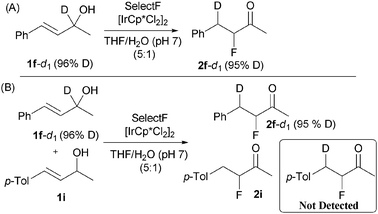 | ||
| Scheme 2 Deuterium labelling studies. | ||
We propose the mechanism outlined in Scheme 3. Step (i) involves an oxidation of the allylic alcohol to α,β-unsaturated ketone I with concomitant formation of an [Ir−H] species. Based on the deuterium labelling results, in step (ii) hydride addition to the double bond occurs before the unsaturated ketone leaves the coordination sphere of the metal centre forming intermediate II. The enol(ate) may bind to the Ir in a η1-mode through the oxygen atom (IIa) or through the methylenic carbon (IIc), or in a η3-mode as an oxaallyl (IIb).15b,19 In step (iii), the C–F bond is formed upon reaction with the electrophilic SelectF. Step (iii) can occur directly from II, or via formation of the free enol.§
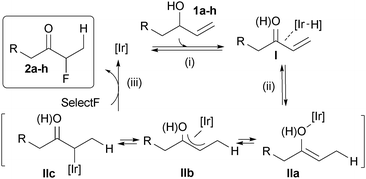 | ||
| Scheme 3 Proposed catalytic cycle. | ||
In conclusion, we have shown that α-fluorinated ketones can be prepared as single constitutional isomers by combining a tandem iridium-catalysed isomerisation of allylic alcohols with an electrophilic fluorination. The choice of the Ir complex was essential to successfully combine both steps. The reaction is easy to perform and is run under an atmosphere of air. To the best of our knowledge, this is the first report on the use of iridium catalysts to form C–F bonds,6 and it is also the first example on the construction of a C–heteroatom bond in the transition metal-catalysed coupled isomerisation/bond-forming reactions from allylic alcohols. The reaction works for substrates with different degrees of substitution and C–F bonds on a tetrasubstituted C can also be formed. We are currently investigating the participation of the Ir center in the C–F bond formation, and whether Ir–F species are involved in the mechanism.
Financial support from the Swedish Research council (vetenskapsrådet), the Knut and Alice Wallenberg Foundation and the Berzelii center EXSELENT is gratefully acknowledged.
Notes and references
- (a) K. Müller, C. Faeh and F. Diederich, Science, 2007, 317, 1881 CrossRef; (b) P. Jeschke, ChemBioChem, 2004, 5, 570 CrossRef CAS; (c) H.-J. Böhm, D. Banner, S. Bendels, M. Kansy, B. Kuhn, K. Müller, U. Obst-Sander and M. Stahl, ChemBioChem, 2004, 5, 637 CrossRef; (d) K. Mikami, Y. Itoh and M. Yamanaka, Chem. Rev., 2004, 104, 1 CrossRef CAS; (e) F. M. D. Ismail, J. Fluorine Chem., 2002, 118, 27 CrossRef CAS.
- (a) P. T. Nyffeler, S. G. Duron, M. D. Burkart, S. P. Vincent and C.-H. Wong, Angew. Chem., Int. Ed., 2005, 44, 192 CrossRef CAS; (b) D. Cahard, X. Xu, S. Couve-Bonnaire and X. Pannecoucke, Chem. Soc. Rev., 2010, 39, 558 RSC; (c) S. Lectard, Y. Hamashima and M. Sodeoka, Adv. Synth. Catal., 2010, 352, 2708 Search PubMed; (d) P. Kwiatkowski, T. D. Beeson, J. C. Conrad and D. W. C. MacMillan, J. Am. Chem. Soc., 2011, 133, 1738 Search PubMed.
- G. Verniest, E. Van Hende, R. Surmont and N. De Kimpe, Org. Lett., 2006, 8, 4767 Search PubMed.
- For reviews, see: (a) S. D. Taylor, C. C. Kotoris and G. Hum, Tetrahedron, 1999, 55, 12431 CrossRef CAS; (b) F. A. Davis and P. V. N. Kasu, Org. Prep. Proced. Int., 1999, 31, 125 Search PubMed; (c) J. A. Wilkinson, Chem. Rev., 1992, 92, 505 CrossRef CAS.
- (a) G. Stavber and S. Stavber, Adv. Synth. Catal., 2010, 352, 2838 Search PubMed; (b) G. Stavber, M. Zupan and S. Stavber, Synlett, 2009, 589 CrossRef CAS; (c) S. Stavber, M. Jereb and M. Zupan, Chem. Commun., 2000, 1323 RSC.
- For a combined Ir-catalysed isomerisation of primary allylic alcohols and enamine-catalysed fluorination, see: A. Quintard, A. Alexakis and C. Mazet, Angew. Chem., Int. Ed., 2011, 50, 2354 Search PubMed.
- For aromatic electrophilic fluorinations, see: T. W. Lyons and M. S. Sanford, Chem. Rev., 2010, 110, 1147 Search PubMed.
- Enones as latent enolates: (a) H.-Y. Jang and M. J. Krische, Acc. Chem. Res., 2004, 37, 653 CrossRef CAS; (b) M. Blackwell, D. J. Morrison and W. E. Piers, Tetrahedron, 2002, 58, 8247 CrossRef CAS , and references therein.
- W. Zhang and J. Hu, Adv. Synth. Catal., 2010, 352, 2799 Search PubMed.
- (a) W. Wang, J. Jasinski, G. B. Hammond and B. Xu, Angew. Chem., Int. Ed., 2010, 49, 7247 CrossRef CAS; (b) T. de Haro and C. Nevado, Adv. Synth. Catal., 2010, 352, 2767 Search PubMed.
- α-Fluoroketones can also be prepared by fluorination of silyl enol ethers: É. Bélanger, K. Cantin, O. Messe, M. Tremblay and J.-F. Paquin, J. Am. Chem. Soc., 2007, 129, 1034 Search PubMed.
- For reviews see: (a) R. Uma, C. Crévisy and R. Grée, Chem. Rev., 2003, 103, 27 CrossRef CAS; (b) R. C. van der Drift, E. Bouwman and E. Drent, J. Organomet. Chem., 2002, 650, 1 CrossRef CAS; (c) V. Cadierno, P. Crochet and J. Gimeno, Synlett, 2008, 1105 CAS.
- V. Cadierno, S. E. García-Garrido, J. Gimeno, A. Varela-Álvarez and J. A. Sordo, J. Am. Chem. Soc., 2006, 128, 1360 CrossRef CAS.
- (a) N. Ahlsten and B. Martín-Matute, Adv. Synth. Catal., 2009, 351, 2657 CrossRef CAS; (b) A. Bartoszewicz, M. Livendahl and B. Martín-Matute, Chem.–Eur. J., 2008, 14, 10547 CrossRef CAS.
- (a) A. Mizuno, H. Kusama and N. Iwasawa, Chem.–Eur. J., 2010, 16, 8248 Search PubMed; (b) D. Cuperly, J. Petrignet, C. Crévisy and R. Grée, Chem.–Eur. J., 2006, 12, 3261 CrossRef CAS; (c) X.-F. Yang, M. Wang, R. S. Varma and C.-J. Li, J. Mol. Catal. A: Chem., 2004, 214, 147 CrossRef CAS.
- (a) R. Uma, M. K. Davies, C. Crévisy and R. Grée, Eur. J. Org. Chem., 2001, 3141 CrossRef CAS; (b) N. Ahlsten, H. Lundberg and B. Martín-Matute, Green Chem., 2010, 12, 1628 RSC; (c) B. Martín-Matute, K. Bogár, M. Edin, F. B. Kaynak and J.-E. Bäckvall, Chem.–Eur. J., 2005, 11, 5832 CrossRef CAS; (d) B. M. Trost and R. J. Kulawiec, J. Am. Chem. Soc., 1993, 115, 2027 CrossRef CAS.
- Similar reactivity has been observed with Fe: (a) C. Crévisy, M. Wietrich, V. Le Boulaire, R. Uma and R. Grée, Tetrahedron Lett., 2001, 42, 395 CrossRef CAS; (b) V. Branchadell, C. Crévisy and R. Grée, Chem.–Eur. J., 2004, 10, 5795 Search PubMed.
- For an alternative allylic alcohol isomerisation mechanism catalysed by iridium hydrides, see: (a) L. Mantilli, D. Gérard, S. Torche, C. Besnard and C. Mazet, Angew. Chem., Int. Ed., 2009, 48, 5143 CrossRef CAS; (b) L. Mantilli and C. Mazet, Tetrahedron Lett., 2009, 50, 4141 CrossRef CAS.
- J. F. Hartwig, R. G. Bergman and R. A. Andersen, Organometallics, 1991, 10, 3326 CrossRef CAS.
- For metal-catalysed C–F bond formation using fluoride, see: (a) T. Wu, G. Yin and G. Liu, J. Am. Chem. Soc., 2009, 131, 16354 CrossRef CAS; (b) C. Hollingworth, A. Hazari, M. N. Hopkinson, M. Tredwell, E. Benedetto, M. Huiban, A. D. Gee, J. M. Brown and V. Gouverneur, Angew. Chem., Int. Ed., 2011, 50, 2613 Search PubMed.
Footnotes |
| † Electronic supplementary information (ESI) available: Experimental details and characterisation data of all compounds. See DOI: 10.1039/c1cc12653a |
| ‡ We have confirmed that 1f-d1 and 1i convert at similar rates. |
| § In a control experiment using KF (1 equiv.) instead of SelectF, we ruled out the formation of the C–F bond via nucleophilic attack of fluoride to the enolate intermediate II.20 |
| This journal is © The Royal Society of Chemistry 2011 |