
Towards European harmonised procedures for quantification of nutrient losses from diffuse sources—the EUROHARP project
B. Kronvanga, S. A. Borgvangb and L. J. Barkvedc
aNational Environmental Research Institute, Aarhus University, Silkeborg, Denmark
bBioforsk, Norwegian Institute for Agricultural and Environmental Research, Soil and Environment Division, Ås, Norway
cNorwegian Institute for Water Research (NIVA), Oslo, Norway
 B. Kronvang B. Kronvang | Brian Kronvang is Research Professor at the Department of Freshwater Ecology, National Environmental Research Institute, Aarhus University, Denmark. He has more than 20 years of research experience within a range of scientific fields covering monitoring, modelling and management of the loss, transport and fate of nitrogen, phosphorus, pesticides and sediments in catchments, climate change effects and effects of adapting mitigation measures such as river restorations and riparian buffers. |
 | ||
| Fig. 1 Bridging gaps between monitoring, modelling and management is vital for successful pressure-impact analysis and mitigation in river basins. | ||
In 1991, the EC adopted the Nitrates Directive.4 It is an environmental measure designed to reduce water pollution by nitrates from agricultural sources and to prevent such pollution occurring in the future. Furthermore, in 2000 the EC adopted the Water Framework Directive (WFD).5 This directive acts as an umbrella for a number of related directives, and its main goal is that all European water bodies should achieve “good ecological status” by 2015. The management of the diffuse nutrient sources within the context of the WFD and the Nitrates Directive faces two particular challenges: (i) Methods and approaches need to be sufficiently site-specific to achieve the best possible representation of the local and regional conditions; (ii) Methods and approaches should be harmonised to the widest possible extent throughout Europe.
The means of obtaining an improved ecological status involve general and targeted mitigation measures to be adopted in catchments.6 Instruments for such actions are the River Basin Management Plan (RBMP) of the WFD and the Action Program (AP) of the Nitrates Directive. Identifying cost-efficient measures to reduce diffuse losses to water bodies represents the core of the RBMP of the WFD and the AP of the Nitrates Directive. It is a prerequisite to ensure that the management plan has a sufficiently good scientific basis and that the documentation provided to present potential effects of different management scenarios is trustworthy. In this respect, models play a crucial role as they can assist catchment managers in simulating the outcome of management plans and furthermore give insight into the uncertainty involved. Models are, however, only really useful if their results may be trusted by managers, meaning that scientifically and economically sound decisions can be made based on the model results.
The EUROHARP project was a four-year EC funded integrative project on modelling of nutrient losses with focus on the interaction between modellers and catchment data holders; and to a lesser extent on end-users and socio-economic analysis. The scientific outcome of the EUROHARP project may thus assist in the implementation of the EC Directives in two ways: (i) It provides a resource base for choosing the right model at any one location and for any specific issue; (ii) the criteria for choosing a model could be adapted as part of the Directive implementation processes, thus harmonising implementation procedures throughout Europe.
The EUROHARP Toolbox synthesises the main outcome of the work carried out on model testing and applications in the 17 EUROHARP catchments and represents the main project deliverable (http://www.euroharp.org/toolbox) (Fig. 2). It aims at facilitating more efficient and harmonised approaches in terms of quantifying and managing nutrient losses from diffuse sources in the context of integrated water resource management. The nine scientific papers included in this themed issue of the Journal of Environmental Monitoring are another main achievement of the project. The papers are building blocks for bridging the gap between monitoring, modelling and management of water resources by means of integration of sciences and continuous dialogue between water managers and researchers:
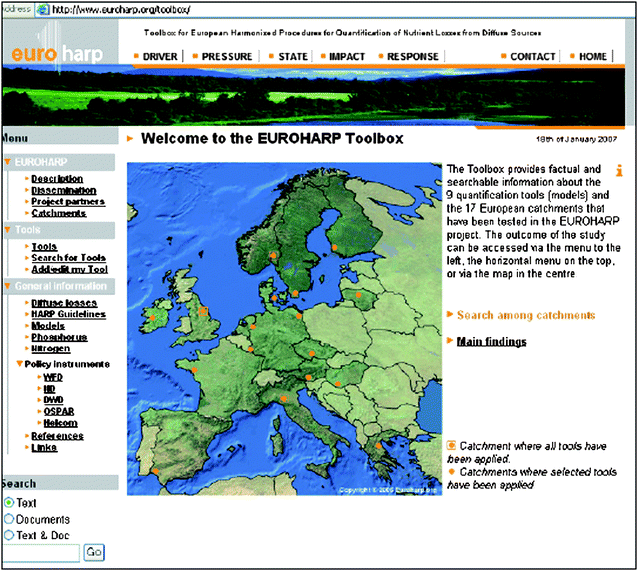 | ||
| Fig. 2 Snapshot of the EUROHARP Toolbox welcoming page with a suite of different entrances for supporting river basin managers and modellers. | ||
(1) The paper by Schoumans et al. (this issue; DOI: 10.1039/b823239c) describes the capabilities and suitabilities of the nine nutrient models involved in the EUROHARP project (Source Apportionment, REALTA, NOPOLU MONERIS, NLES-CAT, EveNFlow, TRK, SWAT and NL-CAT). The models differ profoundly in their complexity, level of process representation and data requirements. The models range from simple loading models and statistical models (SA, NOPOLU; REALTA, MONERIS, NLES-CAT) to conceptual and mechanistic models (EveNFlow, TRK, SWAT and NL-CAT).
(2) The paper by Bouraoui et al. (this issue; DOI: 10.1039/b822931g) includes a description of the 17 river basins used for modelling in the EUROHARP project concerning geographical conditions, climate, land use and land management, as well as hydro-geological perspectives. Furthermore, relationships between catchment characteristics and nutrient export are investigated.
(3) The paper by Silgram et al. (this issue; DOI: 10.1039/b823250d) includes a “blind test” of model performance for four sub-annual models (SWAT, TRK, EveNFlow and NL_CAT) for simulation of flow and nitrate concentrations in the three core catchments—Vansjø Hobøl, Norway, Ouse, UK and Enza River, Italy. The conclusion from the scientific “blind tests” of the four models was that catchment data owners and modellers must work more closely together given that the model output is clearly modeller-limited as well as model-limited.
(4) The paper by Schoumans et al. (this issue; DOI: 10.1039/b823240g) investigates the capability of eight nutrient models (MONERIS, SWAT, NL-CAT, TRK, EveNFlow, NLES-CAT, NOPOLU and REALTA) to predict annual flow and annual nitrogen and phosphorus concentrations and loads in three core catchments. Model performance was generally high for annual flow predictions, whereas only small differences were obtained for the validation statistics (root mean square error (RMSE)) for the ability of the models to predict annual nitrogen and phosphorus loads. The conclusion is that it is not possible to identify the “best model” for nutrient simulations.
(5) The paper by Silgram et al. (this issue; DOI: 10.1039/b901181a) investigates the models' abilities to predict nutrient concentrations and losses at sub-annual timesteps applying four models (SWAT, TRK, EveNFlow and NL-CAT) in three core catchments. Results demonstrate that model performance deemed satisfactory on an annual basis may conceal considerable divergence in performance when scrutinised on a weekly or monthly basis. The ability of models to predict seasonal variations in nutrient concentrations and loads are increasingly demanded as the ecological conditions of surface waters responses on a seasonal basis.
(6) The paper by Kronvang et al. (this issue; DOI: 10.1039/b900101h) tests the applicability of an ensemble of nutrient models for simulation of annual nutrient loads and nutrient load partitioning across 17 European catchments. The nutrient load partitioning shows a huge variation in the model simulated average annual nitrogen and phosphorus loss from agricultural land within the 17 catchments, ranging from nearly twofold for nitrogen loads and eightfold for phosphorus loads. The variation in simulated nitrogen and phosphorus partitioning could partly be ascribed to regional factors and the presence or absence of large lakes within the catchments.
(7) The paper by Hejzlar et al. (this issue; DOI: 10.1039/b901207a) investigates the modelled nutrient retention estimates in streams, lakes and reservoirs compared for four European catchments and applying six different models (Source Apportionment, MONERIS, EveNFlow, TRK, SWAT and NL-CAT). The outcome showed that retention values varied greatly with tendencies towards higher scatter for phosphorus than for nitrogen retention. The retention values and nutrient sources showed that the modelled nutrient export from diffuse sources was directly proportional to nutrient retention estimates in the catchments, implying that nutrient retention calculation is highly important for the quantification of nutrient losses from diffuse sources. Realistic modelling of nutrient exports from diffuse sources at catchment scale is very difficult without monitoring data on nutrient transport and retention.
(8) The paper by Vagstad et al. (this issue; DOI: 10.1039/b823112e) presents a comparative study of modelled changes in nutrient losses from two European catchments caused by modifications in agricultural practices. Seven models were calibrated and applied for the same scenarios in the Enza catchment, Italy and the Zelivka catchment, Czech Republic. The scenario results reveals a variation in predicted effects of the different management scenarios showing again that it is important that care is taken by modellers and involved decision makers throughout the entire modelling process.
(9) The paper by Deelstra et al. (this issue; DOI: 10.1039/b900769p) examines the influence of winter conditions for the modelling of flow and nutrient losses utilising data from nested agricultural catchments in Lithuania, Sweden, Finland and Norway. Runoff, nutrient losses and weather data was analysed and the results revealed that even under conditions with below-zero soil temperatures, considerable amounts of nutrients are lost to surface waters. The study highlights the requirements put to models when simulating nutrient losses in cold climates.
We would like to dedicate this themed issue in the memory of our dear colleague Horst Behrendt from the Leibniz Institute of Freshwater Ecology and Inland Fisheries (IGB), Berlin, Germany who died in December 2008. Horst Behrendt dedicated his scientific work to the understanding and modelling of nutrient emissions and retention in surface waters and he is the father of the well-known MONERIS (MOdelling Nutrient Emissions in RIver Systems) model which he applied all over the world, and also in the EUROHARP project.
References
- B. Kronvang, N. Vagstad, H. Behrendt, J. Bøgestrand and S. E. Larsen, Soil Use Manage., 2007, 23, 104–11 CrossRef.
- B. Kronvang, H. E. Andersen, C. Børgesen, T. Dalgaard, S. E. Larsen, J. Bøgestrand and G. Blicher-Mathiasen, Environ. Sci. Policy, 2008, 11, 144–152 CrossRef.
- Towards European Harmonised Procedures for Quantification of Nutrient Losses from Diffuse Sources—the EUROHARP Summary Report, 2007, EUROHARP report 22-2007, NIVA report SNO 5420-2007, ed. S. A. Borgvang and L. J. Barkved, Oslo, Norway, 61 pp Search PubMed.
- European Council, Directive 2000/60/EC of the European Parliament and of the Council of 23 October 2000, EC Official Journal, (OJ l 327), 72 pp Search PubMed.
- European Council, Council Directive of 12 December 1991 concerning the protection of waters against pollution caused by nitrates from agricultural sources (91/676/EEC), 1991 Search PubMed.
- B. Kronvang, M. Bechmann, H. Lundekvam, H. Behrendt, G. Rubæk, O. F. Schoumans, N. Syversen, H. E. Andersen and C. C. Hoffmann, J. Environ. Qual., 2005, 34, 2129–2144 CrossRef CAS.
| This journal is © The Royal Society of Chemistry 2009 |