


 PLATFORM UPDATE:


Viruses as supramolecular self-assemblies: modelling of capsid formation and genome packaging
Abstract
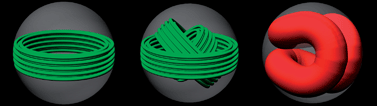
Viruses are considered the simplest form of live. A virus is basically composed of genomic material surrounded by a protecting capsid. Today, full molecular details of many viruses are known, and several subclasses can be discerned. In this review, we present recent advances made over the past few years obtained from theoretical considerations and model simulations to improve our understanding on two vital aspects of the physics of viruses: viz.
 Please wait while we load your content...


