
Theme issue: biology in the service of materials
The use of synthetic materials for the control and sensing of biological systems is a common goal in materials science. This street is not one way, however. The remarkable diversity of structures and processes found in Nature provide new toolkits for the creation of functional materials. Moreover, these biosystems provide inspiration for the design and creation of biomimetic materials, devices, and catalysts. Given the strong bidirectional synergy between biology and materials, I was quite taken by the tongue-in-cheek suggestion for a feature issue on “Biology in the Service of Materials” suggested by Yuval Ofir, a postdoctoral researcher in my group. Building on this suggestion, we have assembled this theme issue, encompassing a diverse array of topics that exemplify the role of biology as both muse and muscle in materials chemistry.Proteins are inherently nanoscopic entities that can be obtained from both natural sources and via biotechnology, making them both versatile and “green”. Cage structures formed via protein self-assembly are common motifs found in viruses and a number of other protein-based systems. Viral cages, or capsids, can be readily obtained in a wide variety of shapes and sizes from plant viruses. The use of viral capsids for the creation of nanomaterials is introduced in two feature articles. Bogdan Dragnea presents an in-depth discussion of the use of viral capsids to package and transport non-genomic materials, while David Evans focuses on the use of these systems as templates for new nanomaterials. New research on the use of viral capsids for the creation of size-controlled titania nanoparticles is presented by Trevor Douglas and Mark Young (Fig. 1a)
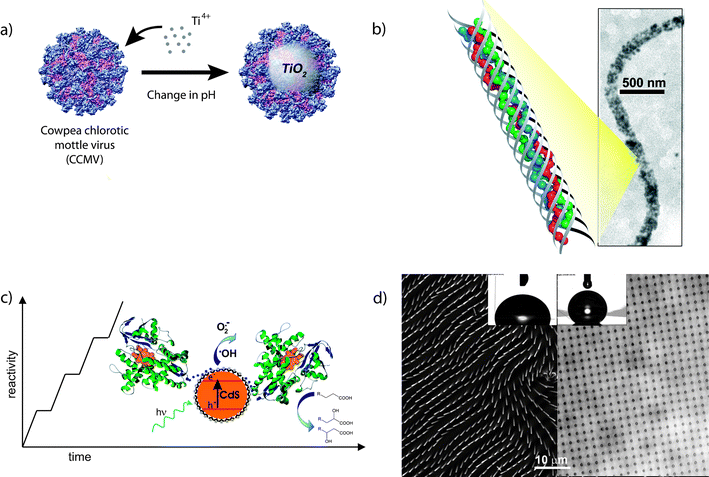 | ||
| Fig. 1 a) The use of cowpea chlorotic mottle virus by Douglas as a “template” for titania nanoparticles. b) Creation of metallic nanowires using peptide templates by Morin and Song. c) Catalysis using protein-quantum dot conjugates by Niemeyer. d) Surfaces featuring responsive wettability using nanostructured hydrogels developed by Aizenberg. Images provided by the authors. | ||
Protein cages such as ferritin, are likewise useful tools for the creation of nanostructures. Ichiro Yamashita provides an introduction to the use of ferritin and other protein cages for the creation of nanostructures, demonstrating the use of these cage structures as both templates for the creation of nanoparticles and as building blocks for the creation of self-assembled materials and devices. Ichiro Yamashita (along with Takao Aoyagi) also presents new research in a paper describing the layer-by-layer (LbL) assembly of these systems using polyelectrolytes.
Proteins and peptides serve a key role as templates for the creation of hard materials such as bone, teeth, and shells through biomineralization processes. Silke Behrens provides an introduction to the use of proteins and peptides for the creation of inorganic nanomaterials in a feature article. In the papers section, Fu-Zhai Cui describes new studies on the interplay between protein structure and the biomineralization of calcium phosphate, while Kenneth Sandhage demonstrates the use of phage display to identify peptides for the controlled formation of titania. The flip side of the coin, namely the inorganic precursors for biomineralization, is likewise represented. An introduction to the role of calcium phosphate nanoparticles in biomineralization is provided in a feature article by Ruikang Tang. The use of these sorts of particles for the creation of nanocapsules via LbL processes is presented in a paper by Matthias Epple, while the field of LbL-based nanocapsules in general is presented by Changyou Gao. Finally, it would be difficult to discuss the field of biomineralization without covering actual biomaterials. Meir Barak uses optical metrology as a tool to explore the biomechanics of skeletal systems, focusing on the relationship between load and bone deformation.
Needless to say, peptide and protein structures can be used for far more than biomineralization. The application of peptides to create functional materials is presented in two papers. Lewis Rothberg, Mary Galvin and Kristi Kiick focus on the creation and electronic behavior of peptide-conjugated polymer scaffolds, while Song Jin and Ronald Raines describe the use of peptide superstructures as templates for the creation of metallic nanowires (Fig. 1b). The broader topic of protein self-assembly is covered both in a highlight by Takafumi Ueno and a feature article by Yu Huang.
As mentioned above, biology is about processes as well as structure. Christof Niemeyer presents a paper on the use of cytochrome P450–cadmium sulfide quantum dots as photocatalysts, exploiting the synergy between the photochemistry of the quantum dot and the controlled reactivity of the protein partner (Fig. 1c). Function of a very different sort is described in a paper by Alexander Sidorenko and Joanna Aizenberg on the use of hydrogel “muscles” as responsive controls for the wettability of nanostructured surfaces (Fig. 1d).
The papers compiled in this issue provide a sampling of how biosystems can be used for the creation of new materials and processes. Clearly, though, we are just beginning to explore the incredible diversity of Nature. As our understanding of biology improves, we can expect the realization (for good, one hopes) of systems that currently exist only in the realm of science fiction.
 | ||
| Plate1 Vincent M. Rotello, Guest Editor | ||
| This journal is © The Royal Society of Chemistry 2008 |