
Hot off the Press
In the Hot off the Press section of Molecular BioSystems members of the Editorial Board and their research groups highlight recent literature for the benefit of the community. This month the highlighted topics include uncommon roles of HDAC1 in steroid receptor-mediated transcriptions, a novel post-translational protein modification mediated by nitrated fatty acids and targeting retroviral zinc finger–DNA interactions.
Nitroalkylation: A novel post-translational protein modification mediated by nitrated fatty acids
Recent evidence has emerged to demonstrate the presence and physiological relevance of nitrated polyunsaturated fatty acids. These compounds, often referred to as ‘nitroalkenes’, are present at concentrations greater than 1 µM in membrane extracts of human blood. The electrophilic nature of these nitroalkenes renders them susceptible to Michael addition reactions in the presence of nucleophiles. A recent publication by Batthyany et al., provides evidence for the covalent modification of nucleophilic residues on proteins by nitrated fatty acids and speculates on the role of this reversible protein modification in regulating enzyme function, cell signaling and protein trafficking (Fig. 1).Nitro-oleic and nitro-linoleic acids comprise the most abundant of these nitroalkenes. In this study, in vitro analysis demonstrated that these nitrated fatty acids form covalent adducts with glutathione as well as a model protein, glyceraldehyde-3-phosphate dehydrogenase (GAPDH). Through the application of a variety of mass spectrometric techniques, the nitroalkene group was shown to be appended to nucleophilic cysteine and histidine residues on GAPDH, including modification of a critical catalytic cysteine residue (Cys-149) that inhibited enzyme function. Inactivation of the enzyme by nitroalkenes occurred significantly faster than similar inactivation reactions with known oxidative modifiers such as hydrogen peroxide and peroxynitrite. Additionally, the inhibitory effects of nitroalkylation were readily reversed by low levels of dithiothreitol and glutathione, suggesting the reversible nature of this protein modification. The effect of the nitroalkene modification on protein localization was investigated by the degree of association of GAPDH with sedimented liposomes. These sedimentation studies demonstrated that nitroalkene modification of GAPDH promotes localization to membranes. Finally, essential in vivo studies revealed the physiological presence of this novel protein modification in healthy human red blood cell extracts. Mass spectrometric analysis established that the catalytic cysteine of GAPDH was covalently modified by nitro-oleic acid in vivo and modified protein was present in human blood at detectable levels.
Using GAPDH as a model protein, this study has illustrated the dual effect of nitroalkylation: protein translocation to the membrane coupled with inhibition of catalytic activity. Further studies will shed light on the role of this novel protein modification in regulating the localization and function of proteins in response to changes in cellular redox state.
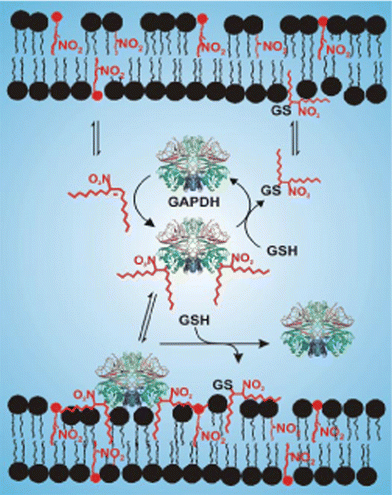 | ||
| Fig. 1 Nitroalkene-mediated post-translational modification of GAPDH and other proteins will influence protein structure, function, and subcellular distribution in a GSH-reversible manner. The modified sites of the protein were randomly assigned. Reproduced from J. Biol. Chem., 2006, 281(29), 20450–20463. Copyright © 2006 The American Society for Biochemistry and Molecular Biology. | ||
C. Batthyany, F. J. Schopfer, P. R. S. Baker, R. Durán, L. M. S. Baker, Y. Huang, C. Cerveñansky, B. P. Branchaud, B. A. Freeman, J. Biol. Chem., 2006, 281(29), 20450–20463.
Reviewed by: Eranthie Weerapana, The Scripps Research Institute, California, USAUncommon roles of HDAC1 in steroid receptor-mediated transcriptions
Histone modifications play critical roles in eukaryotic gene regulation. Among them, histone acetylation by histone acetyltransferases (HATs) and deacetylation by histone deacetylases (HDACs) were first described about a decade ago and since then an explosion of research on their roles in gene regulation has ensued. It is well accepted now that HATs are normally associated with transcriptional activation, whereas HDACs are mostly involved in transcriptional suppression. However, as always, there are exceptions to the general rules. In a recent report by the Hager group, it was shown that HDAC1 serves as a coactivator for the glucocorticoid receptor (GR) and the acetylation of HDAC1 leads to progressive repression of GR-mediated transcription.The authors previously observed a rapid increase followed by an equally rapid decrease in RNA Pol II engagement on the GR-responsive elements upon dexamethasone treatment. In this paper, they observed a protein acetylation event occurring precisely along the time course of the Pol II disengagement and the transcriptional repression. The protein was identified as HDAC1 through proteomic characterization and a series of in vitro and in vivo tests revealed that acetylation of HDAC1 inhibits its deacetylation activity. Suppression of HDAC1 by siRNA drastically decreases the maximum induction level of the GR-mediated transcription, supporting that HDAC1 is a coactivator in this transcriptional event.
The results suggested that unmodified HDAC1 plays critical roles in the initial transcriptional activation, possibly through active deacetylation of an unknown protein targeting at the promoter region. Upon accumulation of HAT activity in the GR complex, HDAC1 becomes acetylated and is no longer able to hold the unknown target in its deacetylated form, resulting in the progressive repression of transcription. Taken together, these new findings revealed that HDACs, as well as HATs, are capable of carrying out functions apart from what people commonly perceived, and histones are not the only substrates for these enzymes. This implied an existence of an “acetylation–deacetylation” cascade, just as the well-established “kinase–phosphatase” cascade, for critical cellular signal transduction.
Y. Qiu, Y. Zhao, M. Becker, S. John, B. S. Parekh, S. Huang, A. Hendarwanto, E. D. Martinez, Y. Chen, H. Lu, N. L. Adkins, D. A. Stavreva, M. Wiench, P. T. Georgel, R. L. Schiltz and G. L. Hager. Mol. Cell, 2006, 22, 669–679.
Reviewed by: Peng Yu, University of Texas Southwestern Medical Center, Dallas, USA.Targeting retroviral Zn finger–DNA interactions: A small-molecule approach using the electrophilic nature of trans-platinum-nucleobase compounds
This paper describes a novel approach to the chemical inhibition of zinc finger transcription factor–DNA or –RNA interactions. Protein–nucleic acid complexes have proven to be very tough targets for chemical antagonists in general. This is because the protein–DNA/RNA interface is usually large and involves many ionic interactions. In this case, Farrell and co-workers eschew the standard approach of designing a compound that will bind non-covalently to either the protein or nucleic acid better than the binding partner. Instead, they employ an ingenious inorganic chemistry-based approach in which a trans-Pt nucleobase complex “steals” two coordinating thiolates from the zinc and ejects it from the zinc finger (Fig. 2). This has the effect of changing the structure of the protein such that it can no longer bind tightly to its nucleic acid partner. They demonstrate the efficacy of this novel strategy on the HIV Ncp7 DNA-binding protein, which contains a “Cys3His” class zinc finger.![Schematic Mechanism of Action. (A) Proposed concept mechanism of zinc ejection from F2 involving an initial recognition process through non-covalent interactions and a further covalent interaction that eventually disrupts the secondary structure in the protein. (B) A chemical mechanism for zinc ejection using platinum-nucleobase electrophiles. The specific nature of the coordination site for the [Pt(py)2] unit remains to be determined. Reprinted from Chemistry & Biology, 13(5), Atilio I. Anzellotti, Qin Liu, Marieke J. Bloemink, J. Neel Scarsdale and Nicholas Farrell, Targeting Retroviral Zn Finger–DNA Interactions: A Small-Molecule Approach Using the Electrophilic Nature of trans-Platinum-Nucleobase Compounds, pp. 539–548, Copyright © 2006, with permission from Elsevier.](/image/article/2006/MB/b610215h/b610215h-f2.gif) | ||
| Fig. 2 Schematic Mechanism of Action. (A) Proposed concept mechanism of zinc ejection from F2 involving an initial recognition process through non-covalent interactions and a further covalent interaction that eventually disrupts the secondary structure in the protein. (B) A chemical mechanism for zinc ejection using platinum-nucleobase electrophiles. The specific nature of the coordination site for the [Pt(py)2] unit remains to be determined. Reprinted from Chemistry & Biology, 13(5), Atilio I. Anzellotti, Qin Liu, Marieke J. Bloemink, J. Neel Scarsdale and Nicholas Farrell, Targeting Retroviral Zn Finger–DNA Interactions: A Small-Molecule Approach Using the Electrophilic Nature of trans-Platinum-Nucleobase Compounds, pp. 539–548, Copyright © 2006, with permission from Elsevier. | ||
Atilio I. Anzellotti, Qin Liu, Marieke J. Bloemink, J. Neel Scarsdale, and Nicholas Farrell, Chem. Biol., 2006, 13, 539–548.
Reviewed by: Thomas Kodadek, University of Texas Southwestern Medical Center, Dallas, USA| This journal is © The Royal Society of Chemistry 2006 |