
Editorial: A new scope for publishing in JAAS
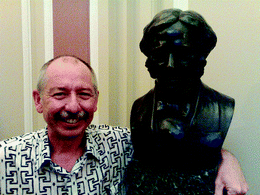 | ||
| Plate1 Norbert Jakubowski with Michael Faraday! | ||
JAAS is celebrating 21 years of publishing this year. It is still a young journal compared, for instance, with its sister journal The Analyst, but after 20 years this young journal has already grown up. Looking back at the roots of the journal we can identify its strengths. The strengths of JAAS are not only expressed by the current impact factor of 3.64, but also by the loyalty of the readers and authors. Anniversaries are always a good opportunity to analyse current situations and to make plans for the future, helping us (the Editorial and Advisory Board) to develop new directions and perspectives for the journal.
Since the launch of the journal, 65 review articles have been published in JAAS. Half of these have been published in the last 5 years, demonstrating that reviews are playing an important new role in our journal. These review articles include Critical Reviews, Tutorial Reviews and Perspectives. The increasing importance of the review articles was highlighted at a meeting of the Editorial Board last year, and as a result a new position of Reviews Editor was created on the Editorial Board from January 2006—that’s me!
In the last Editorial Detlef Günther,1 who has now recovered from the excitement of the football World Cup, analysed the trend of different research topics published in JAAS and discussed how they had developed over the last 20 years. He mentioned that more than 3700 manuscripts had been published so far in JAAS and investigated which thematic areas they covered. The intention of this Editorial is similar in that my arguments are also based on journal statistics, but I am not focusing on research areas rather on the article types published in this journal.
What is the current situation with article types published in JAAS? Every reader and author of the journal already knows that the most popular and well accepted types of articles in JAAS are, of course, the conventional Paper and the Technical Note, both directly related to the novel research of one or more investigators. But did you also know that over the years JAAS has published more than 29 Editorials (all of which can be read free of charge on the journal website), 25 Communications, 59 Critical and Tutorial Reviews, 6 Perspectives and 120 Atomic Spectrometry Updates (ASUs)?
In this Editorial I intend to promote a new diversity in the types of articles published in JAAS. As Reviews Editor I will, of course, focus mainly on review articles, as I would like to provide some information on these articles with the intention of attracting new authors to write reviews.
A Communication is a very fast type of a publication in JAAS. As you can see from the numbers above it is a very rare form of publication, and it is not often enough used as a medium to report on urgent, high impact, preliminary results in this journal. Communications are given priority treatment in JAAS, they are fast-tracked through the publication process and appear prominently at the front of the journal. The key idea of a Communication is to present innovative concepts with important analytical implications. An example is a Communication from Helle Rüsz Hansen (by the way, she received the Hilger Atomic Spectroscopy Award 2006 at the last BNASS in Glasgow for her work) and Spiros A. Pergantis, published in the August issue of JAAS.2 The article was published less than 2 months after submission, was identified as a Hot Article by the referees and was, in the month of publication, one of the top ten most accessed articles in JAAS. This really demonstrates that it is the novelty of the scientific work, not the type or form of the article, that is important for the reader of a paper. I can only encourage authors to present even more innovative concepts using this article type to guarantee fast publication!
Moving onto Review articles, these are essential for a journal as they are often among the most read and cited papers published. For instance, in the compilation given by David Koppenaal in the Editorial of the March issue,3 among the top 3 in the list of the top 20 most cited manuscripts of JAAS there are 2 review articles, one from Bendicho and de Loos-Vollebregt4 and the other from Evans and Giglio.5
What changes will I be making in my new role as Reviews Editor? First of all, the Reviews content will be becoming more critical and this holds true for all types of reviews. For instance, Critical Reviews are definitive, comprehensive reviews that also provide a personal but critical evaluation of the chosen topic area. Authors are asked to be selective in their choice of material, whilst still covering the important work in the area. They discuss the various trends seen and also indicate possible future developments. Relevant fundamentals as well as the most important and novel applications are included.
Second, some thematic key areas have been defined by the Editorial Board, which will have the highest priority for sending out invitations. For these key areas a number of Critical Reviews have already been invited, covering all areas of analytical methods in atomic spectroscopy (absorption, emission, fluorescence and mass spectrometry) including sampling strategies, sample preparation and sample introduction, hyphenation and speciation. It is planned that over the years a thematic network will be established which will comprehensively cover all the different topics and aspects of analytical atomic spectroscopy in the most recent and updated form, covering fundamentals as well as applications, and which will be presented by well accepted experts. These reviews will be snapshots of the most novel research areas in analytical and atomic spectroscopy and will cover those topics which are of interest to our readers. Compared with the static form of information presented in a text-book, reviews are dynamic. They will reflect the hot topics and the trends, and they will change topics when our research work starts to change in its direction.
Third, the authors and the readers can now become more active as we are still looking for review articles. Readers can take the initiative and propose topics for which they are seeking a review. Authors are encouraged to contribute, but asked to contact the Reviews Editor in advance, sending a short outline of their planned review, including information on the co-authors and providing a time schedule. The outline will be sent to two referees (mainly members of the Editorial and Advisory boards), who will evaluate if the proposed review is in the scope of JAAS, does not intrude on the topics of other invited articles and is of interest to our readership. I can be contacted directly by e-mail, through the Editorial office, or alternatively approached at one of the coming conferences.
I will try to cover as many as possible actual and relevant topics, but I still need feedback from authors and readers as well, in particular, with Tutorial Reviews and Perspectives that will become important features in the future.
Tutorial Reviews are written from a personal point of view, and are ideally the first review in a new significant area, bringing together the results of various primary publications. These should not be a comprehensive review of the literature: however, due credit should be given to other workers in the field. Articles will cover only the most interesting developments in that specific subject area. Tutorial Reviews are designed to interest a large number of readers and are written at a level that can be understood by an advanced undergraduate student. Their aim is to inform researchers and students alike of the most recent developments in the area, which are not yet available in text books. For this specific type of review I am still looking for volunteers! Please have in mind that the future analyst is only as good as our education and teaching was and we (the senior scientists) have the duty to make atomic spectroscopy and analytical chemistry even more attractive for the next generation, which consist of the young investigators of today! Young investigators already play an important role in JAAS, for instance the second Young Analytical Scientists special issue will form the November issue of JAAS. Once again the quality of the work presented is very high. Young analytical scientists can play an even more important role in JAAS in the future because they are, in particular, invited to write Tutorial Reviews as many of them already work in the new and emerging fields of analytical spectroscopy, where Tutorial Reviews are urgently needed. So, if you are a young (or a young feeling) author, working in a new and up-coming field of analytical atomic spectroscopy, then you should not hesitate to contact me as soon as possible.
Perspectives offer authors the highest individuality of all the article types published in JAAS. These short papers discuss recent relevant literature and for that reason they are considered as Review articles. However, they do not only discuss research results, they also have a philosophical function, discussing either a particular aspect of analytical spectroscopy, or a topic of relevance or potential relevance to the analytical community. Perspectives are used to initiate discussions or even open new research topics, which for a long time have fallen into oblivion or which can already be seen on the horizon and which are becoming now of actual and increasing interest. So, if you are a highly individual author who would like to write a Perspective article please let me know!
Since the launch of JAAS more than 120 Atomic Spectrometry Updates (ASUs) have been published. These annual reviews cover the most relevant topics for the journal on atomic spectroscopy. Six popular ASUs are published each year which critically review the most significant research in the field of analytical atomic spectroscopy from recently published literature of the last 12–18 months.
They currently cover the following topics.
• Environmental analysis.
• Chemical and biological materials, food and beverages.
• Advances in atomic emission, absorption and fluorescence spectrometry, and related techniques.
• Atomic mass spectrometry.
• X-ray fluorescence spectroscopy.
• Industrial analysis: metals, chemicals and advanced materials.
Historically, these annual reviews started as Annual Reports on Analytical Atomic Spectroscopy (ARAAS). They were implemented in a new bimonthly format of ASUs in JAAS when the journal was launched in 1986. See Steve Hill’s Editorial in issue 6 of JAAS for more information.6 The ASUs have their own ASU Editorial Board with a representative on the JAAS Editorial Board (currently this is Andrew Taylor, see his Editorial in issue 4 of JAAS7). As a reader of JAAS, I find the ASUs to be interesting reviews and an excellent source of information and literature in all areas of analytical atomic spectroscopy. They give a fast overview and are good appetizers for a more detailed literature study. Consequently they are a very important part of the journal.
Finally you might ask: why is Norbert telling me about this well known stuff and why has he not added any comments about soccer to his Editorial? Over the last 20 years, JAAS has evolved to its present form. The journal is getting more colourful, and not only on the front cover: it now provides more information about all areas in chemistry. The journal offers much more than the publication of Full Papers and Technical Notes. It is a new diversity of article types which I want to propagate and which I will strongly support in the newly established role of the Reviews Editor. Authors are encouraged to discover the full potential and capabilities offered by this journal.
Finally, coming back to the anniversary, the Editorial Board wants to thank all readers, authors and all other contributors, who have not yet been mentioned, for their loyalty and their support. It sounds simple, but the most important thing for this journal and its future is YOU—the author and the reader—you make the journal alive!
Comments are welcome!
Norbert Jakubowski
References
- D. Günther, J. Anal. At. Spectrom., 2006, 21, 728–730 RSC.
- H. R. Hansen and S. A. Pergantis, J. Anal. At. Spectrom., 2006, 21, 731–733 RSC.
- D. Koppenaal, J. Anal. At. Spectrom., 2006, 21, 259–262 RSC.
- C. Bendicho and M. T. C. de Loos-Vollebregt, J. Anal. At. Spectrom., 1991, 6, 353–374 RSC.
- E. H. Evans and J. J. Giglio, J. Anal. At. Spectrom., 1993, 8, 1–18 RSC.
- S. Hill, J. Anal. At. Spectrom., 2006, 21, 555 RSC.
- A. Taylor, J. Anal. At. Spectrom., 2006, 21, 381–383 RSC.
| This journal is © The Royal Society of Chemistry 2006 |