
Fast temporal fluctuations in single-molecule junctions
Rolf
Ochs
a,
Daniel
Secker
ac,
Mark
Elbing
a,
Marcel
Mayor
*ab and
Heiko B.
Weber
*ac
aForschungszentrum Karlsruhe, Institut für Nanotechnologie, Postfach 3640, D-76021, Karlsruhe, Germany
bUniversity of Basel, Department of Chemistry, St. Johannsring 19, CH-4056, Switzerland. E-mail: marcel.mayor@unibas.ch
cUniversität Erlangen-Nürnberg, Staudtstr. 7, D-91058, Erlangen, Germany. E-mail: heiko.weber@physik.uni-erlangen.de
First published on 7th September 2005
Abstract
The noise within the electrical current through single-molecule junctions is studied at cryogenic temperature. The organic sample molecules were contacted with the mechanically controlled break-junction technique. The noise spectra refer to a system where only few Lorentzian fluctuators occur in the conductance. The frequency dependence shows qualitative variations from sample to sample.
1. Introduction
We have seen in the past decades a breathtaking development of continuous shrinking of the device feature size in the semiconductor technology. This process is still going on, but will soon be slowed down by some fundamental limitations when the size of the active devices reaches the molecular scale. Then, presumably, similar reproducibility will not be in reach and the investment for new fabrication facilities will be enormous. Therefore, it makes sense to try out new concepts for future nanoelectronics and see how far one can drive alternative technologies. Among the different concepts proposed, molecular electronics provides a unique richness of conceivable functionalities, which is given by the enormous number of possible molecules. As first demonstrators, diodes1 and negative differential resistance devices2 have been fabricated on the base of molecular monolayers. Further, devices that switch their resistance as a consequence of voltage pulses have been shown,3–5 which may be employed for both data storage and logic devices. In a research-oriented effort, we are interested in the investigation of charge transport across single-molecule junctions, which is in many respects a simpler system than a molecular film device. We have developed a technique that was able to demonstrate that indeed single molecules could be contacted, and further showed how the electronic properties can purposefully be controlled by a proper choice and synthesis of organic molecules.6–9 However, some limitations of single-molecule junctions became also evident: the electronic properties displayed sample-to-sample fluctuations, which are not surprising when the single-molecule level is reached. They reflect the uncontrolled local environment of the molecular structure and also structural disorder in the gold tips, which cannot be controlled reproducibly. Similar scattering of results have been reported for transistor geometries, based on a single molecule as the active channel.10–12In addition to sample-to-sample fluctuations, changes of the electronic current–voltage characteristics as a function of time are quite probable, which correspond to the rearrangement of the local environment of the actively conducting molecular bridge, or to a change in the microscopics of the contact bond.6,13,14 If they are sufficiently slow so they can be independently observed, such abrupt changes are often termed switching and the corresponding two-level conductance signal as a function of time is frequently called telegraph noise, both being ubiquitous phenomena in solid state physics.15,16 Such effects were, for example, reported in STM experiments, where the tip was placed on top of a molecule (or few molecules) and the tunneling current was continuously switching between two or three different conductance states.17 They are usually attributed to single bonds, atoms or groups of atoms which tunnel or move (over a low activation barrier) between two nearly degenerate spatial configurations. Further sources of noise are (i) the thermal Johnson–Nyquist noise, which corresponds to fluctuations in the quantum mechanical occupation of electron states, (ii) shot noise, which has its origin in the discrete nature of charge carriers, and (iii) electronic noise of the detection circuit. Whereas (i) and (iii) play a role in our measurements and are appropriately subtracted, (ii) comes only into play at higher frequencies and is disregarded.
In this paper, we report on frequency-dependent measurements of the conductance in a frequency range of 100 Hz to 100 kHz. The data show a power-law decrease of noise towards high frequencies, which can be related to fluctuating degrees of freedom of the microscopic configuration in the junction. Interestingly, we observe again sample-to-sample fluctuations not only in the amplitude, but also in the exponent of the power law. Possible mechanisms are discussed.
2. Experimental
2.1. Molecules
Prototypical candidates for the investigation of temporal fluctuations in a single-molecule junction are the molecular rods 1 and 2, which are displayed in Fig. 1. Their rigid rod-like structure together with their terminal acetyl protected sulfur groups make them well suited for single-molecule investigations in a mechanically controlled break junction. For a defined voltage drop within the molecular structure, the molecular rods are separated into two π-systems by considerable torsion angles in their central biphenyl units induced by steric repulsion of two methyl groups in ortho position of their biphenylic C–C bonds. Thereby the overlap of the π-orbitals is decreased resulting also in a reduced electronic coupling between both adjacent phenyl-rings in the biphenyl core. To investigate potential effects of the electronic properties of the rod on the temporal fluctuations, the molecular rod 2 was further functionalised with four fluorine atoms on each terminal phenyl subunit. It is noteworthy that these fluorine atoms alter the electronic properties considerably by their strong negative inductive effect and their moderate positive mesomeric effect, while the structural features of the rod 2 remain basically unchanged compared to 1. Both molecular rods have been designed and synthesized as control samples of experiments investigating an asymmetric rod as a single molecule rectifier.9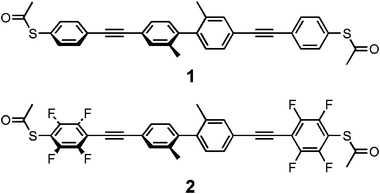 | ||
| Fig. 1 The molecular rods 1 and 2, both consisting of two separated phenyl–ethynyl–phenyl π-systems. Effective electronic barriers are created in both molecular rods by considerable torsion angles between both phenyl rings of their central biphenyl-subunits. While structural features remain equal, electronic properties of 2 are considerably varied compared to 1 by fluorine substituents. | ||
2.2. Formation of a gold–molecule–gold contact
The electronic measurements are carried out with the established mechanically controlled break-junction technique.18–20 A thin gold wire is lithographically structured on a flexible substrate such as phosphorus bronze with an insulating layer of polyimide. At its narrowest constriction, the wire features a width of approximately 50–80 nm which is underetched in an oxygen plasma. The result is a freestanding, suspended gold bridge. The substrate is mounted in a three-point bending mechanism and the gold wire is subsequently stretched until it is broken, yielding a pair of opposing electrodes with a spacing that can be varied with an accuracy on the order of 10−10 m, when atomic rearrangements are disregarded.The open electrode pair is immersed in a droplet of a tetrahydrofurane (THF) solution containing the organic molecules under investigation. The solvent evaporates rapidly and a covalent sulfur–gold bond is formed (Fig. 2).
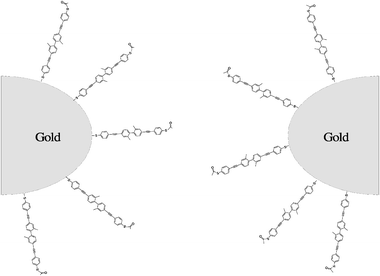 | ||
| Fig. 2 Schematic view of the gold electrodes and some molecules on the surface. A gold–sulfur bond is established by cleaving of an acetyl protection group. | ||
The entire setup is mounted in a vacuum chamber which is equipped with a 4He continuous flow cryostat that allows for cooling down the sample to around 20 K. In a simple two-wire configuration the conductance is monitored and several current–voltage characteristics are recorded. At a pressure of approximately 2 × 10⁻⁸ mbar the electrode distance is reduced until the first molecule reaches the opposite electrode and the second sulfur–gold bond is established bridging the gap. While closing the electrode gap further, additional molecules are contacted. Then, the contact is reopened, i.e. the electrode distance is increased again. Just before the conductance suddenly drops to zero, the I–V-curves are very stable and reproducible. At this point, stable single- or few-molecule contacts are established. This has already been demonstrated in a previous paper employing molecules 1 and 2 (Fig. 1) in comparison with a third molecule9 and with other molecular rods consisting of comparable subunits in ref. 6. The stability of such a junction is attributed to a fixed molecule–gold contact realisation.
2.3. Noise detection
As in any measurement of electric conductance, the current is not constant in time but exhibits stochastic fluctuations around a mean value. When all external contributions, such as e.g. radiation, are eliminated by screening, the remaining fluctuations are referred to as noise. The corresponding physical quantity (at constant voltage) is the autocorrelation function of the current KII(t) and accordingly its Fourier transform, the spectral density SII(f):15,21| KII(t) = 〈ΔI(t′)ΔI(t′ + t)〉 |
The following experimental setup is used to measure SII(f). A shunt resistance RS is inserted into the circuit for the current measurement, converting the current into a voltage signal. It is chosen such that the voltage is high enough to be measured with sufficient accuracy while the current measurement is not influenced significantly. For the molecules studied here which have resistances in the 100 MΩ range, RS = 100 kΩ proves to be a good trade-off.
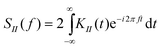
Before the voltage signal is detected by a spectrum analyzer, electronic amplification is required. In order to avoid the the first amplification step adding more noise than the intrinsic signal, we have chosen two low-noise preamplifiers in parallel. The spectrum analyzer (Agilent 89410A), equipped with two input channels, calculates the cross-correlation of these two signals. By this procedure the uncorrelated noise of the amplifiers is eliminated and the correlated noise of the signal at RS remains. Technically, the analyzer calculates first the Fourier transform of the correlation function and then the cross spectrum. The final result is the frequency-dependent noise density SII(f).
All spectra shown below are calibrated and corrected by the frequency dependence of the transmission line. For this purpose, the signal of a white noise source, i.e. a noise source with a constant frequency dependence, is sent through the setup. The measured spectrum is not frequency-independent and is used to calibrate the noise measurements.
3. Noise-generating mechanisms
The mechanisms of noise generation can be distinguished by two different phenomena: the spectral density SII(f) can either depend on the frequency, or not.3.1. Lorentz oscillator
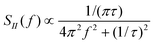
The frequency-dependent noise is the so-called flicker noise, often referred to as 1/f-noise. In contrast to the frequency-independent noise (described below) there is no physical theory that describes the flicker noise in a global way. It occurs though in all electronic devices, resistances, semiconductor devices, and so on. There are several processes that can be responsible for this noise: fluctuating particle numbers, e.g. generation–recombination processes in a p–n transition,22 varying mobility of charge carriers,23 or fluctuating impurities.24,25Their common properties are fluctuations of the resistance and, as a consequence at constant voltage, current noise. In this case the following is valid:
| KII(t) = 〈ΔI(t′)ΔI(t′ + t)〉 ∝ I2 |
| SII (f) ∝ I2 |
This shows that the noise density of a single fluctuator is for f ≫ 1/τ proportional to f−2.
For a finite number of fluctuators, one may assume that their activation energies Wn have a certain distribution. This, however, will result in a broad distribution of time constants τ, following the relationship 1/τ ∝ exp(−βW). Already for few fluctuators the summation leads approximately to SII ∝ f−1 (Fig. 3). For a continuously and uniformly distributed Wn, the integration leads equivalently to SII ∝ f−1, which is the textbook result for a large ensemble.15
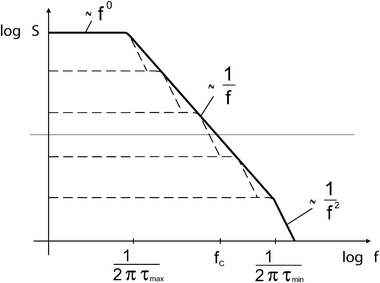 | ||
| Fig. 3 Schematic view of the superposition of several Lorentz fluctuators. The 1/f2-dependence of the noise of a single process with time-constant τ leads effectively to a 1/f-dependence of the superposition.15 | ||
3.2. Thermal noise and shot noise
There are two further sources of noise, where the spectral density is independent of the frequency.First, there is so-called thermal noise, also known as Johnson–Nyquist noise. It already occurs at equilibrium, i.e. when no current flows. This noise results from fluctuations in the quantum mechanical occupation of electronic states and, as a consequence, from the temperature-dependent statistical distribution of the kinetic energy of the electrons. It leads to a variance of the current despite the fact that the mean value of the current is zero. The resulting spectral density of the auto-correlation is constant for the frequencies relevant in our experiments. This is the well known Johnson–Nyquist theorem:

| SII(f) = 2eI |
4. Results
4.1. Noise spectra and current-dependence
The measurements on the immobilised molecules 1 and 2 in a MCB are performed in the following way: a voltage sweep is applied between the contacts and the current is measured. In parallel, at each measuring point a complete noise spectrum is recorded by the spectrum analyzer. So, altogether, we gain both the frequency dependence of the noise density SII(f) and its current dependence SII(I).As we are not interested in the thermal noise which is neither frequency- nor current-dependent, the measured value at I = 0 is subtracted. Additionally, we get rid of undesired external perturbations by that scaling. As already mentioned in Section 2.3 the data are calibrated with the response to a white noise source signal.
Figs. 4 and 5 show the noise spectra of two measurements at a current of I = 5 nA in the frequency range [1 kHz,100 kHz], recorded at T ≈ 30 K. One immediately sees that beyond ∼5 kHz the noise level is decreasing, which looks very similar to flicker noise. The linearity in the double-logarithmic plot indicates a power-law behaviour SII (f) ∝ fξ. The lines correspond to exponents of ξ = −1 for Fig. 4, whereas for another junction (Fig. 5) ξ = −2 is better applicable.
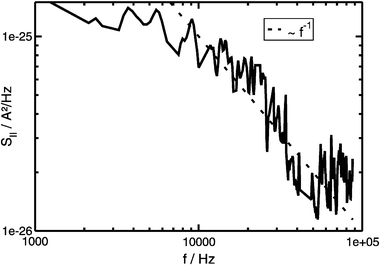 | ||
| Fig. 4 Noise density SII(f) of a gold–molecule–gold contact (molecule 2) measured at T ≈ 30 K and I = 5 nA. The frequency dependence shows a power-law behaviour approximately SII ∝ f−1 at higher frequencies. Similar results are obtained with molecule 1. | ||
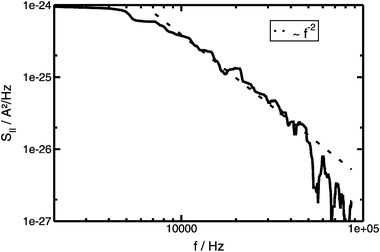 | ||
| Fig. 5 Noise density SII(f) of a gold–molecule–gold contact (molecule 1) measured at T ≈ 30 K and I = 5 nA. The frequency dependence shows a power-law behaviour approximately SII ∝ f−2 at higher frequencies. Similar results are obtained with molecule 2. | ||
According to the previous explanations, these values correspond to the expectations for a finite number of Lorentz oscillators and a single Lorentz oscillator for the different samples, respectively.
A closer look at the current dependence of the noise density shown in Fig. 6. At a fixed frequency of 5 kHz SII shows a nearly quadratic dependence of I. Hence, the noise is generated by resistance fluctuations of the junction.
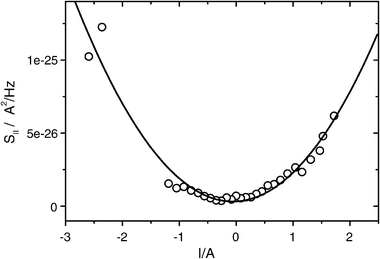 | ||
| Fig. 6 Noise density SII(I) of a gold–molecule–gold contact (molecule 2) measured at T ≈ 30 K and f = 5 kHz. The fitted curve represents a quadratic regression of the data (circles). Similar results are obtained with molecule 1. | ||
The shot noise at a current of I = 5 nA has its upper limit at the Poisson value SII = 2eI = 1.6 × 10⁻²⁷ A2/Hz. In our frequency range the noise density is much larger and the shot noise can be neglected.†
4.2. Sample-to-sample variations
For the conductance measurements obtained with our technique, we observe sample-to-sample fluctuations in the stable I–V characteristics, which we attribute to be caused by an uncontrolled, disordered local environment of the sample molecule.6,9 Here, the noise measurements show power-law behaviour of SII(f) which matches well to the limiting cases ξ = −1 and ξ = −2. Further data not presented here show effective exponents between these two values. Hence, we find again sample-to-sample variations, which occur here as different frequency dependencies. Again, we attribute this to local variations of the environment of the bridging molecule, in paricular different numbers of fluctuators which cause the noise as it is described by the Lorentz-oscillator model in section 3.1.But what are the elementary processes which cause such resistance fluctuations?
First, the molecule itself could flicker. Both molecular rods consist of four phenyl subunits which are linked with each other by C–C bonds or by ethynyl linkers. The electronic transparency is assumed to depend sensitively on the overlap of adjacent systems.29 While the rotation of the central C–C bond is limited by the steric demands of two methyl groups, the axial rotation along the ethynyl C![[triple bond, length as m-dash]](https://www.rsc.org/images/entities/char_e002.gif) C triple bond is not hindered. Axial rotations of the subunits of the molecular rod may be a source of resistance fluctuations, which may be excited by the flow of current in addition to thermal excitation. It should be stressed that molecular rotations typically lie in frequency ranges far beyond the upper frequency limit of our experiments. However, in a packed environment with other molecules which come close to the bridging molecule, all degrees of freedom could eventually be slowed down considerably. The fact that differences in the fluctuations between both molecules 1 and 2 have not been observed in these investigations rather points to processes independent from the electronic structure of the molecule.
C triple bond is not hindered. Axial rotations of the subunits of the molecular rod may be a source of resistance fluctuations, which may be excited by the flow of current in addition to thermal excitation. It should be stressed that molecular rotations typically lie in frequency ranges far beyond the upper frequency limit of our experiments. However, in a packed environment with other molecules which come close to the bridging molecule, all degrees of freedom could eventually be slowed down considerably. The fact that differences in the fluctuations between both molecules 1 and 2 have not been observed in these investigations rather points to processes independent from the electronic structure of the molecule.
Another possible fluctuator could be the gold–molecule contact. Whereas it is presumably not fully released (then the gold electrode tips would immediately be destabilised and retracted), it could be that there are fluctuations between two (or more) metastable configurations. A similar mechanism has been proposed to explain telegraph-like fluctuations in STM experiments.30
Further, the resistance is influenced by the atoms which form the gold tip. Due to the covalent bond between the molecule and the leads, the gold atoms are a part of the contact’s wave function. Instabilities which happen in the electrode tips, or, more likely, at its surface could serve as Lorentz fluctuators. In addition, the molecule is sensitive to the local environment. Other molecules or ions which come close to the bridging molecule can electrostatically polarise the molecule’s backbone and affect the conductance.
To summarise, not only fluctuations within the molecule, but also in its local environment can affect the conductance of the junction. Hence the noise is a probe for the fast dynamics of the contact molecule and/or its local environment. Due to the fact that many mechanisms could create such noise, combined with the fact that the interaction volume is tiny (few nanometers around the molecular bridge), the observation of a small and varying number of fluctuators is not surprising.
Because the Lorentz oscillators are presumably driven by thermal activation, a continuous temperature dependence would be desirable. This, however, is difficult to achieve, because a variation of the temperature is connected to rearrangements in the contact, driven by the thermal expansion of the electrodes. We have performed few measurements at higher temperatures, which clearly show that the noise level increases substantially (by roughly one order of magnitude at T = 150 K). This fits well to the observation that conductance peaks which are rather sharp at cryogenic temperatures appear strongly blurred at room temperature.20,7 Such inhomogeneous broadening of the peaks corresponds to an averaging over many configurations, when many more degrees of freedom are activated at elevated temperatures.
5. Outlook
These phenomena are rather general in our experiments and are not specially related to molecules 1 or 2. For example, we have seen qualitatively similar behaviour for a molecule without the central tilted unit, I–V characteristics of which have been reported in.7 This underscores the notion that the environment could play an important role. For molecules with a switching functionality, which will play a key role for molecular electronic devices, this probe of the fast dynamics could be suitable to detect precursor instabilities before and after switching occurs. But also for stiff molecules, flicker noise is a probe which unambiguously shows that the local environment of a single molecule contact is of critical importance. If there was only one molecule spanned between two stiff and stable electrodes, we would not detect flicker noise. Hence, this observation confirms a picture that has been previously developed:6,20 there is a disordered environment of the bridge molecule, which results in both static sample-to-sample fluctuations in the current–voltage characteristics6 as well as dynamical flicker noise.Acknowledgements
We thank for helpful discussions with Michelle Di Leo, Jan Würfel, Joachim Reichert, Matthias Hettler, Peter Hänggi, Detlef Beckmann, Daniel van der Veer, Ralph Krupke and Hilbert von Löhneysen. Financial support from the Volkswagen foundation and from the network project MOLMEM of the German Ministry of Education and Research (BMBF-FZK 13 N 8360) is gratefully acknowledged.References
- R. M. Metzger, Acc. Chem. Res., 1999, 52, 950–957 CrossRef.
- J. Chen, M. A. Reed, A. M. Rawlett and J. M. Tour, Science, 1999, 286, 1550–1552 CrossRef CAS.
- M. A. Reed, J. Chen, A. M. Rawlett, D. W. Price and J. M. Tour, Appl. Phys. Lett., 2001, 78, 3735 CrossRef CAS.
- Y. Luo, C. P. Collier, J. O. Jeppesen, K. A. Nielsen, E. Delonno, G. Ho, J. Perkins, H. -R. Tseng, T. Yamamoto, J. F. Stoddart and J. R. Heath, ChemPhysChem, 2002, 3, 519 CrossRef CAS.
- C. N. Lau, D. R. Stewart, R. S. Williams and M. Bockrath, Nano Lett., 2004, 4(4), 569–572 CrossRef CAS.
- J. Reichert, R. Ochs, D. Beckmann, H. Weber, M. Mayor and H. v. Löhneysen, Phys. Rev. Lett., 2002, 88, 176804 CrossRef CAS.
- M. Mayor, H. B. Weber, J. Reichert, M. Elbing, C. v. Hänisch, D. Beckmann and M. Fischer, Angew. Chem. Int. Ed., 2003, 42, 5834 CrossRef CAS.
- M. Mayor, C. v. Hänisch, H. B. Weber, J. Reichert, D. Beckmann and M. Fischer, Angew. Chem. Int. Ed., 2002, 41, 1183 CrossRef CAS.
- M. Elbing, R. Ochs, M. Köntopp, M. Fischer, C. von Hänisch, F. Weigend, F. Evers, H. B. Weber and M. Mayor, Proc. Natl. Acad. Sci., USA, 2005, 102, 8815 CrossRef CAS.
- J. Park, A. N. Pasupathy, J. I. Goldsmith, C. Chang, Y. Yaish, J. R. Petta, M. Rinkoski, J. P. Sethna, H. D. Abruña, P. L. McEuen and D. C. Ralph, Nature, 2002, 417, 722 CrossRef CAS.
- S. Kubatkin, A. Danilov, M. Hjort, J. Cornil, J.-L. Brédas, N. Stuhr-Hansen, P. Hedegård and T. Bjørnholm, Nature, 2003, 425, 698 CrossRef CAS.
- W. Liang, M. P. Shores, M. Bockrath, J. R. Long and H. Park, Nature, 2002, 417, 725 CrossRef CAS.
- F. Zahid, A. W. Ghosh, M. Paulsson, E. Polizzi and S. Datta, Phys. Rev. B, 2004, 70, 245317 CrossRef.
- S. N. Yaliraki, M. Kemp and M. A. Ratner, J. Am. Chem. Soc., 1999, 121, 3428 CrossRef CAS.
- R. Müller, Rauschen, Springer-Verlag, Berlin, 1990 Search PubMed.
- S. Brouër, G. Weiss and H. B. Weber, Europhys. Lett., 2001, 54, 654–660 CrossRef CAS.
- Z. J. Donhauser, B. A. Mantooth, K. F. Kelly, L. A. Bumm, J. D. Monnell, J. J. Stapleton, D. W. Price, A. M. Rawlett, D. L. Allara, J. M. Tour and P. S. Weiss, Science, 2001, 292(5525), 2303–2307 CrossRef CAS.
- J. M. van Ruitenbeek, A. Alvarez, I. Pineyro, C. Grahmann, P. Joyez, M. H. Devoret, D. Esteve and C. Urbina, Rev. Sci. Instrum., 1996, 67, 108–111 CrossRef CAS.
- N. Agraït, A. L. Yeyati and J. M. van Ruitenbeek, Phys. Rep., 2003, 377(2–3), 81–279 CrossRef CAS.
- J. Reichert, H. B. Weber, M. Mayor and H. von Löhneysen, Appl. Phys. Lett., 2003, 82, 4137–4139 CrossRef CAS.
- A. Blum, Elektronisches Rauschen, Teubner, Stuttgart, 1996 Search PubMed.
- A. L. McWorther, in Semiconductor Surface Physics, ed. R. H. Kingston, University Press, Philadelphia, 1957 Search PubMed.
- F. N. Hooge, Physica B, 1990, 162, 344 CrossRef.
- J. L. Black, Low-Energy Excitations in Metallic Glasses, Springer-Verlag, Berlin, 1981 Search PubMed.
- S. Kogan, Electronic Noise and Fluctuations in Solids, University Press, Cambridge, 1996 Search PubMed.
- Y. Imry, Introduction to Mesoscopic Physics, Oxford University Press, New York, 1997 Search PubMed.
- C. Schönenberger and S. Oberholzer, Proc. SPIE, 2004, 5469, 233–243.
- Y. M. Blanter and M. Büttiker, Phys. Rep., 2000, 336, 15.
- J. Chen and M. Reed, Chem. Phys., 2002, 281, 127–145 CrossRef CAS.
- Z. J. Donhauser and P. S. Weiss, unpublished.
Footnote |
| † In order to characterize shot noise, the measurements would have to be performed up to higher frequencies to make the shot noise contribution visible. This is indeed very challenging due to RC-depression of the transmission at higher frequencies. |
| This journal is © The Royal Society of Chemistry 2006 |