
Profile
Abstract
Journal of Materials Chemistry profiles the new members of the Editorial Boards, Takuzo Aida, Eugenio Coronado, Dirk M. Guldi, Chad A. Mirkin and Jaume Veciana.
Takuzo Aida (Regional Associate Editor for Japan, Materials Editorial Board) was born in 1956. He received a BS degree in physical chemistry from Yokohama National University in 1979, and then studied under the direction of Professor Shohei Inoue at the University of Tokyo, obtaining a PhD in polymer chemistry in 1984. He then began an academic career at the University of Tokyo, and was involved, until 1994, in the development of precision macromolecular synthesis using metalloporphyrin complexes. In 1996, he was promoted to Full Professor of the Department of Chemistry and Biotechnology, Graduate School of Engineering, the University of Tokyo. His research interests include controlled macromolecular synthesis with mesoporous inorganic materials, photo and supramolecular chemistry of dendritic macromolecules, mesoscopic materials sciences, and bio-related molecular recognition and catalyses. In 1996, he was appointed as a researcher in the JST PRESTO Programme “Fields and Reactions”. Since 2000 he has been the Project Leader of the JST ERATO Programme “Nanospace”.
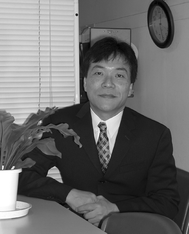 | ||
| Plate1 Takuzo Aida | ||
Eugenio Coronado (Materials Editorial Board) has been Full Professor of Inorganic Chemistry at the University of Valencia since 1993, and Director of the Institute of Molecular Science at the University since its foundation in 2000. His research interests focus on the chemistry and physics of functional molecular materials in general, with a particular emphasis on their magnetic, electrical, and optical properties. In the last few years his main effort has been devoted to the search of hybrid molecular materials with multifunctional properties. He obtained a BS degree in chemistry (1981) and a PhD degree in inorganic chemistry (1985) from the University of Valencia, followed by a PhD degree in physics (1990) from the University Louis Pasteur of Strasbourg. He was the recipient of the 1998 “Rey Juan Carlos I” National Prize for Scientific and Technical Research, and of the 2003 “Rey Jaime I” Prize of Research in New Technologies.
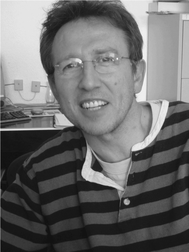 | ||
| Plate2 Eugenio Coronado | ||
Dirk M. Guldi (International Advisory Editorial Board) graduated from the University of Cologne, Germany, in 1988, from where he received his PhD in 1990. In 1992, after a postdoctoral appointment at the National Institute of Standards and Technology, he took a research position at the Hahn–Meitner Institute, Berlin. After a brief stay as a Feodor–Lynen Stipend (Alexander von Humboldt Foundation) at Syracuse University he joined the faculty of the Notre Dame Radiation Laboratory in 1995, where he was promoted to Associate Scientist in 1996. In 1999 he completed his Habilitation at the University of Leipzig, Germany. He was awarded the Heisenberg Prize in 1999, the Grammaticakis-Neumann Prize in 2000, a Japan Society for the Promotion of Science Fellowship in 2003; and the JPP-Award in 2004 from the Society of Porphyrins and Phthalocyanines. His primary research interests are in the areas of new multifunctional carbon-based nanostructures within the context of light-induced charge separation and solar-energy conversion.
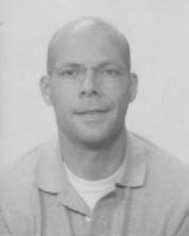 | ||
| Plate3 Dirk M. Guldi | ||
Chad A. Mirkin (International Advisory Editorial Board ) is the George B. Rathmann Professor of Chemistry and the Director of the Institute for Nanotechnology and Center for Nanofabrication and Molecular Self-Assembly at Northwestern University. Professor Mirkin is a world renown chemist, known for his development of nanoparticle-based biodetection schemes and his invention of dip-pen nanolithography. He is the author of over 180 manuscripts and is one of the most influential figures in the emerging area of nanotechnology. He is the founder of two companies, Nanosphere and NanoInk, which commercialize nanotechnology applications in the life science and semiconductor industries. Dr Mirkin holds a BS degree from Dickinson College (1986), a PhD degree in chemistry, from Penn State University (1989), and held a NSF Postdoctoral Fellowship position at Massachusetts Institute of Technology before becoming a Chemistry Professor at Northwestern University in 1991.
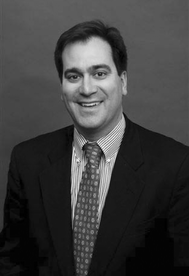 | ||
| Plate4 Chad A. Mirkin | ||
Jaume Veciana (International Advisory Editorial Board) obtained his PhD from the University of Barcelona, Spain, in 1977 working in physical organic chemistry with Manuel Ballester. He was appointed Colaborador Científico of the CSIC in 1979. He was a Postdoctoral fellow from 1982–1983 at The Johns Hopkins University, MD (USA), with Dwaine O. Cowan, working on molecular conductors and organic metals. In 1991 he moved to the Institut de Ciència de Materials de Barcelona (CSIC) where he was promoted to Full Professor in 1996. He has been co-author of over 250 journal articles and book chapters and has edited and co-edited two books and received the Solvay Award in 2001 for his research in chemistry. His research interests focus on molecular functional materials and molecular nanoscience, in particular in the fields of molecular magnetism, electron-transfer phenomena and processing of molecular compounds using supercritical fluids.
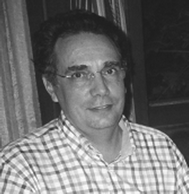 | ||
| Plate5 Jaume Veciana | ||
| This journal is © The Royal Society of Chemistry 2004 |