
CrystEngComm: Providing the best editorial service for the crystal engineering community
CrystEngComm continues to offer the best publishing service for the crystal engineering community. As crystal engineering is attracting an increasing amount of interest worldwide, so is the journal, and the articles published in CrystEngComm in 2003 illustrate the true international nature of crystal engineering. In 2003, CrystEngComm published articles from 22 countries, with 9% of articles from the Americas, 43% from Europe, 29% from Asia and 19% from the rest of the world. Contributions to the journal are coming from what were traditionally separate fields of chemistry: organic chemistry, inorganic chemistry, theoretical chemistry, crystallography, materials science and the biological interface.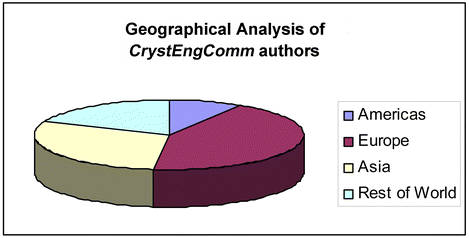
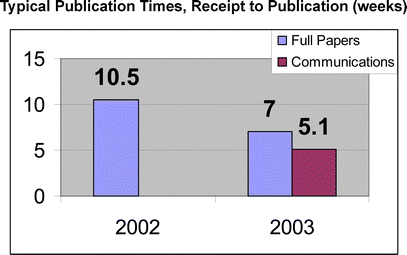
CrystEngComm has always offered our crystal engineering community first-class editorial services. Electronic submissions of articles minimises authors’ efforts to submit articles for publication. Free colour reproduction in figures is guaranteed, to the benefit of both authors and readers. CrystEngComm also offers very fast publication times. In 2003, the typical time from receipt to publication for a CrystEngComm full paper was 7 weeks (50 days), a reduction in publication times from 74 days in 2002, while the receipttopublication time for a Communication in 2003 was just over 5 weeks (36 days).
In 2003, CrystEngComm was selected as the journal of choice for publishing not only the keynote speaker lectures, in the form of Highlights, but also many of the relevant papers from the first in a series of EuroConferences on Molecular Crystal Engineering. The first meeting was held in Maratea, Italy, and the second of this series will take place in Finland in 2005. A logical connection exists between the Maratea meeting and the forthcoming meeting in Nottingham [ CrystEngComm Discussion 2 (CECD2), see below] and the preceding CrystEngComm Discussion 1, held during 2002, and this connection highlights, beyond the statistics of paper submissions, how strongly CrystEngComm is rooted in the crystal engineering community and continues to grow with it. While these conferences are based in Europe, the fact that more than 50% of the papers published last year in CrystEngComm come from the rest of the world, qualifies the international dimension of CrystEngComm: not only a traditional journal for publication of excellent scientific results but also a forum for debate (for example, viaCrystEngComm Letters) and interdisciplinary cross-fertilization.
In 2004, CrystEngComm will continue providing important services for the community. An example of this will be the second CrystEngComm Discussion meeting to be held in Nottingham, UK, on September 8–10, which will bring together researchers from all areas of crystal engineering. This Discussion meeting builds on the success of the first CrystEngComm Discussion meeting (CECD1), held in Bristol, UK, in 2002. Keynote speakers have already been finalised. Highlights from these authors together with articles from the other speakers will be published in CrystEngComm in October. Further information is available from ( http://www.rsc.org/lap/confs/cecd2004.htm). The deadline for receipt of proposed abstracts for contributed papers is approaching (31st January 2004), so don't delay. If you would like your paper to be considered for inclusion in the meeting programme, send us your abstract!
The Discussion meeting will feature four areas of considerable interest to the future development of crystal engineering. (i) Intermolecular interactions: evaluation and application to crystal design (keynote speaker: Sally Price, University College London, UK) is expected to attract contributions involving both experimental and theoretical studies. (ii) Networks: design and applications (keynote speaker: Mike Ward, University of Minnesota, USA) will cover networks based upon non-covalent interactions such as hydrogen bonds and coordination networks. (iii) Hydrothermal syntheses, zeotypes and covalent networks (keynote speaker: Ken Poeppelmeier, Northwestern University, USA) will examine the important contribution of hydrothermal (or, more generally, solvothermal) methods to crystal synthesis and permit exploring the important links between designed molecular network solids and covalent networks that are the domain of materials chemistry. (iv) Polymorphism, crystal transformation and reactivity (keynote speaker: Peter Erk, BASF, Germany) will provide an opportunity to discuss the important issues associated with solid state transformations in crystals and the ever important issue of polymorphism from an academic and industrial perspective.
We thank Professor Guy Orpen (Bristol, UK), who retired from the Editorial Board of CrystEngComm in 2003 for his contributions to the journal since its inception. We welcome Professor Juerg Hulliger (Bern, Switzerland) to the Editorial Board and look forward to working with him on the future development of the journal. We also welcome Professors Christoph Janiak (Freiburg, Germany), Roger Bishop (New South Wales, Australia) and Kari Rissanen (Jyvaskyla, Finland) as members of our International Advisory Board, and thank Professor Eugenio Coronado who retired from the Advisory Board in 2003. We also welcomed two new people to the CrystEngComm Cambridge Editorial Office: Dr Claire Darby (Deputy Editor) and Miss Emma Gilson (Publishing Assistant).
Finally, but by no means least, we also thank everyone who has assisted as a referee for the journal in 2003, and so helped maintain the high standards of the journal, and we thank all the CrystEngComm authors, whose published work has helped to make the journal what it is today.
We do hope that you will join us in Nottingham for the CECD2 meeting, and that you continue to take advantage of the excellent services that CrystEngComm offers its authors and readers. Most importantly, we wish you the best for 2004!
Dario Braga, Scientific Editor
Lee Brammer, Chair, Editorial Board
Jamie Humphrey, Managing Editor
| This journal is © The Royal Society of Chemistry 2004 |