
Dalton Transactions: A celebration year
Abstract
Professors David Cole-Hamilton, Scientific Editor, and John Arnold, Associate Editor for the Americas, highlight some of Dalton Transactions' latest achievements and innovations, and the benefits of publishing with the Editorial Office in Berkeley. This year the Journal celebrates the 200th anniversary of John Dalton's investigations which led to the determination of atomic weights.
Welcome to 2003, which is an especially exciting year for Dalton Transactions because we celebrate the 200th Anniversary of the pioneering work of John Dalton (see below). This year, we say goodbye to Peter Bruce, who has been an especially active and productive member of the Editorial Board. Peter has worked very hard to raise the profile of Dalton Transactions within the Solid State Chemistry community and will continue to work with the journal, along with Richard Catlow, in the organisation of a Dalton Discussion on the Ionic and Electronic Properties of Solids, to be held in St. Andrews in July, 2004. We thank Peter most warmly for all he has done so far. We also welcome two new members of the Board; the first is Mike Ward, who replaces Peter. Mike is a coordination chemist with interests in secondary interactions and their importance in electron transfer, switching, etc. He has been a highly enthusiastic supporter of Dalton Transactions and we very much look forward to his time on the Board. The other new member of the Dalton Editorial Board is Roberta Sessoli from Florence. Roberta further enhances the geographical distribution of Board members, as well as bringing expertise in cluster synthesis and properties. She has a particular interest in magnetism and its possible use for information storage at the molecular level. As indicated in an earlier Editorial (Issue 17, 2002), John Arnold has replaced Malcolm Chisholm as the Associate Editor for the Americas. I am really pleased with the way John has immediately taken hold of the reins in the American Office. He has hit the ground running and most of the rest of this Editorial is from him.
John Arnold the new Associate Editor for the Americas writes
First, let me begin by wishing readers of Dalton Transactions around the world a Happy New Year. This is an auspicious year for chemistry as a whole—and for the journal in particular—as it marks the 200th Anniversary of John Dalton's atomic theory, which brought chemistry out of the alchemical era and into the form we recognize today. To celebrate this great anniversary of one of the giants of inorganic chemistry, after whom this journal is named, we shall be publishing a series of Dalton Celebration Perspectives from leading scientists around the world. The first of these appears in this issue and is a wonderful account of carbon nanotubes by C. N. R. Rao. Others will follow, including a very important contribution by Mike Lappert. This biographical Perspective article will highlight John Dalton's seminal work in Inorganic Chemistry and will be published on 6th September, the 200th anniversary of the entry in Dalton's notebook, which records the first list of atomic weights. Readers may also note that the name of the journal has changed this year, from the somewhat anachronistic title Journal of the Chemical Society, Dalton Transactions to the simpler contracted version Dalton Transactions.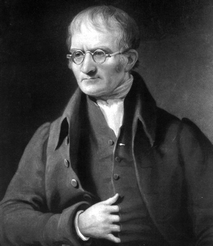 | ||
| Plate3 John Dalton(Reproduced courtesy of the Library and Information Centre, Royal Society of Chemistry) | ||
Now, some well-deserved thanks. In September of last year, I took over the reins as Associate Editor for the Americas from Professor Malcolm Chisholm, who had held the position since 1998. Following in the footsteps of Malcolm is both an honor and a tremendous challenge: under his tenure, and with the administrative help of Cyndy Chisholm, authorship from the Americas prospered, helping to make Dalton Transactions one of the most international of the major publications in inorganic chemistry. His excellent service to the journal is warmly appreciated by all concerned. Malcolm's one remaining task as Associate Editor will be to organize a Dalton symposium at the 2004 Fall ACS National meeting in Philadelphia to help celebrate John Dalton's contributions to chemistry.
As I learn the ropes here in Berkeley, I am fortunate to be able to rely on the expert assistance of the staff in the Cambridge (UK) office and the members of the Dalton Editorial Board. Dr Graham McCann, Managing Editor has been an invaluable resource in getting me started and has been quick to respond to e-mail messages from me at the odd hours resulting from the eight-hour time difference between us. Thus far, I'm happy to report, it has had little impact on our ability to communicate and to get the work of the journal completed effectively. I'm also grateful to Dr Claire White, Deputy Editor; Dr Ian Farrell, Assistant Editor and Emma Gilson, the Publishing Assistant for all their help in responding to my questions in a timely fashion and for their professionalism in dealing with the multitude of communications necessary to process manuscripts efficiently. Emma has recently joined the Editorial Team to replace Carol Megginson following her move to the Benevolent Fund Office, while Ian Farrell has recently been promoted to Deputy Editor of The Analyst. Two new Assistant Editors, Helen Fletcher and Beverley Williams, have recently been appointed and Sula Armstrong completes the team, moving from ChemComm for four months. We thank Carol and Ian for all the hard work they have put into Dalton Transactions and wish them well in their new positions. We also wish all new members of the team great success and happiness in their time with Dalton Transactions.
Next, I'd like to bring your attention some issues of particular relevance to authors in the Americas, and especially to readers who may be considering publishing in Dalton Transactions.
Our highest impact factor ever
As you can see in the graph, our impact factor has risen substantially over the last few years as a result of the publication of high quality, well-edited papers from the best authors across the globe. Dalton Transactions stands as the highest-ranked European journal of inorganic chemistry and is comparable to the best journals publishing in the same field in the United States. The Editorial Board is committed to increasing the quality of work in Dalton Transactions and it is worthy of note that rejection rates are running at high levels—ca. 45% for full papers and ca. 55% for communications—consistent with this goal.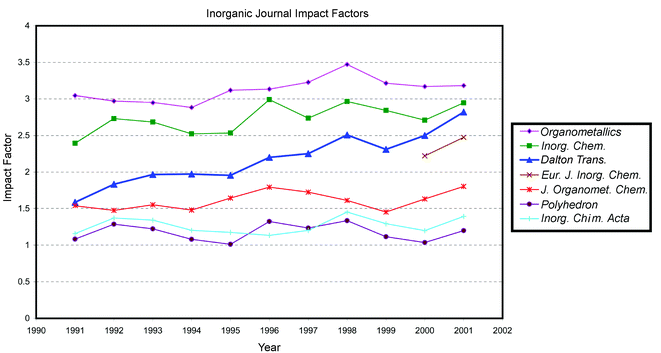
Electronic submissions, fair reviewing and rapid publication
I'm pleased to see that most authors in the Americas are taking advantage of the benefits offered by electronic submission of manuscripts. I am very much in favor of this method as an author myself, but even more so from my new perspective as Associate Editor. I heartily encourage all authors to consider electronic submission, especially those of you who may perhaps have thought about it—or even attempted it—in the past, but were put off because of cumbersome technology and uncertainties regarding file formats, etc.My office can handle direct e-mail submissions of entire manuscripts, including figures and CIF files, or you may prefer to submit directly to the RSC's web server, whereupon your submission will be instantly forwarded to Berkeley for handling. Most papers submitted electronically are sent out for review—by colleagues in the Americas—within two days via e-mail.
As an author, the main benefits to you are (i) cost savings (no multiple copies, no mailing charges), and (ii) short publication times: we receive your manuscript on the same day and can generally have it back from the reviewers in 2–4 weeks, often less. Please rest assured, nonetheless, that traditional paper submissions are still very welcome and reviewers who prefer hardcopies of manuscripts will be supplied with them on request.
Dalton communications
I especially encourage authors to submit their work in the form of a communication whenever they have exciting preliminary results that are amenable to publication in condensed format. Our average publication time for communications is very fast—only 10 days from acceptance and 40 days from receipt, a number that is decreasing rapidly as electronic submissions increase.Crystallographic review
The RSC's in-house Crystallographic Data Editor, Dr Kirsty Anderson (PhD with Guy Orpen), along with Professor George Ferguson advise the editors on matters relating to crystallographic material submitted to all the RSC's journals. For the author, this ensures that your crystallographic data is evaluated efficiently, fairly, and to a high, consistent standard.Biological inorganic chemistry
Authors working at the boundary of inorganic chemistry and biology are an important part of our community and Dalton Transactions is committed to developing the publication of articles in this area. A recent decision by the RSC to create a web based “virtual journal” (http://www.rsc.org/chembiol) bringing together all biology related articles in RSC publications was implemented last year as part of a joint venture between RSC Publishing and the Chemical Biology Forum. The intention is to provide a valuable resource for the chemical biology community, a major component of which will be the virtual journal. This will of course include the papers concerning Bioinorganic Chemistry and Inorganic Biochemistry found in Dalton Transactions. So, by publishing your bio-related work in Dalton Transactions, it will be easily accessible to both the Inorganic Chemistry and Chemical Biology communities.
Your cover art and free use of color
If you have a particularly appealing graphic that highlights your work and that you think may be suitable for the cover of Dalton Transactions, please feel free to bring this to the attention of the editors. On a related note, the complexity of modern chemistry is often best communicated in the form of color graphics, and the RSC is happy to provide this service free of charge to authors and the readership when an appropriate case—i.e. one based on more effective communication of scientific information—can be made.Journals grant for international authors
Authors of articles in RSC journals are eligible to apply for a ‘Journals Grant for International Authors’. The grants are intended to fund visits to other countries to (i) collaborate in research; (ii) to exchange research ideas and results and; (iii) to give or receive special expertise and training. Further details and an application form are available from our web site http://www.rsc.org/is/journals/authrefs/jgrant1.htmDiscover CrystEngComm in Dalton Transactions
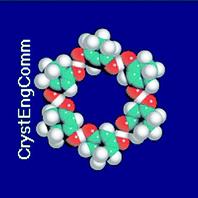
CrystEngComm (see http://www.rsc.org/crystengcomm/) is an electronic only journal dedicated to publishing full papers and communications describing innovative research covering all aspects of crystal engineering. The e-only nature of the journal allows research to be presented in ways that are not possible in printed journals, with authors encouraged to use color, movies and animated graphics. As the Dalton Transactions readership may find this both interesting and useful, details of recently published articles will be included regularly throughout the year, the first of these article listings is included in this issue.On behalf of the Dalton Editorial Board, we welcome suggestions from the community for further enhancement of the journal. Please feel free to contact me or other members of the Dalton Editorial Board, the International Advisory Editorial Board or staff in the Editorial Office in Cambridge with your comments and advice. Your views are welcomed on matters of policy or individual papers alike.
Finally, I'd like to thank all our authors and reviewers for their time and effort in helping to make Dalton Transactions such a vibrant and important resource for the international chemical community.
With best wishes for a prosperous 2003.
John Arnold
Associate Editor for the Americas
Berkeley, USA
Thank you, John, for a really stirring rallying call for the journal.The last 12 months have been particularly busy for the Production department working on Dalton Transactions. A reflection of this is that more pages have been published this year than in any year since 1997. It is thanks to the hard work and dedication of the Technical Editors that times to publication have remained very impressive; times for acceptance to publication have been only ten days for communications and 40 days for full papers, but noteworthy times of five and seven days, respectively, have been achieved during the year.
To finish, let me add my thanks to John's for the tremendous work done by the Editorial team in Cambridge, but also to all of you, readers and writers alike. Dalton Transactions has become one of the world's leading journals thanks to you. With your continued support and help, I am convinced that we can make it even better. We look forward to a very exciting year, thinking especially of the wonderful contribution to life in general and to Chemistry in particular that John Dalton made 200 years ago.
David Cole-Hamilton
Scientific Editor
St. Andrews, UK
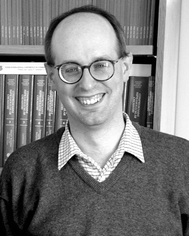
Dalton Transactions profiles new members of the Editorial BoardMike WardMike Ward was born in 1964. After a BA and PhD from Cambridge, where he worked with Professor Ed Constable making some of the first examples of double helical complexes, he did post-doctoral work in the group of Professor Jean-Pierre Sauvage in Strasbourg before joining the School of Chemistry in Bristol as a new lecturer in 1990. His research interests cover all aspects of coordination chemistry, in particular the syntheses of polynuclear complexes, by either traditional or self-assembly methods, and the study of their physical properties (electrochemical, magnetic, optical, and photophysical). He was awarded the Royal Society of Chemistry's Corday Morgan medal for 1999, and the Sir Edward Frankland fellowship for 2000–2001, and is now a Professor of Inorganic Chemistry at Bristol.
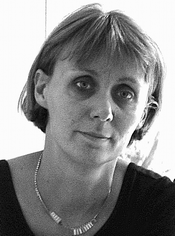
Roberta SessoliRoberta Sessoli, born in 1963, graduated in chemistry at the University of Florence in 1987 and received a PhD in 1992 under the supervision of Professor D. Gatteschi. She is now an Associate Professor at the Faculty of Pharmacy at the University of Florence. Her major scientific interest is the investigation of molecular magnets and particularly molecular clusters. Her contribution to the discovery of the unusual dynamics of the magnetisation in these systems has been awarded with the 2002 Agilent Technologies Europhysics Prize.
| ||||||||||||
| This journal is © The Royal Society of Chemistry 2003 |