
2003 Editorial
Abstract
Professor Dario Braga, Scientific Editor, and Jamie Humphrey, Managing Editor of CrystEngComm, review the many successes and developments of the past year, and illustrate the commitment that CrystEngComm has to developing its already important role of international forum for the crystal engineering communities.
Happy New Year!
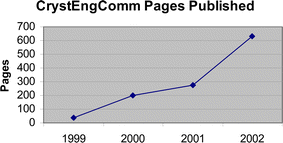
The beginning of a new year is always a good time to reflect on the successes of the previous year, and consider the (hopeful) successes of the year ahead. 2002 was a very good year for the field of crystal engineering and CrystEngComm. In 2002, the journal published over 640 pages with 108 articles, including 12 Highlights. 19% of the published manuscripts were submitted from the Americas, 15% from Australia/Oceania, 22% from Asia and 49% from Europe, representing papers submitted from 21 countries. CrystEngComm is clearly fulfilling its role as the international forum for the publication of papers of interest to the crystal engineering research communities. We also saw enormous growth in the number of articles and pages published in the journal. In fact, the number of published articles in 2002 increased by 98% compared with the number published in 2001, while the number of pages published increased by a staggering 130%!
Authors publishing in CrystEngComm have benefited from excellent publication times (the typical time from receipt to publication is less than 50 days), free use of colour, and an efficient, easy to use, web-based e-submissions service. Authors can also, of course, publish multimedia components to enhance their articles, and in 2002, 80% of papers were published with multimedia enhancements.
2002 also saw some exciting developments, which included the introduction of reference linking. Readers can now follow links in the references of online articles to the cited articles. This reference linking facility now includes free access to the Chemical Abstracts Service abstract for the reference via ChemPort (http://www.chemport.org), and links to the full text of the reference, where available online, on the publisher's server (a subscription or pay-per-view may be required to access the article). We also introduced pdf proofs for authors, allowing authors to comment on the presentation of their articles in the published pdf version of their articles. Authors also receive a pdf reprint of their article, which has advantages over printed reprints: electronic pdfs can be filed electronically, and so not take up valuable filing space in offices, and, of course, with electronic reprints, copies can be printed off on demand.
The latter half of 2002 saw the launch of two new article types for CrystEngComm: Letters and Communications. Letters provide a medium for the expression of scientific opinions and views normally concerning (but not limited to) material published in CrystEngComm or other RSC journals. The first CrystEngComm Letter published was ‘Bond free’, by Gautam R. Desiraju (CrystEngComm, 2002, 4, 499). CrystEngComm Communications are preliminary accounts of original and significant work of such importance or novelty that rapid publication is justified.
In 2002, we published 12 CrystEngComm Highlights, including those by Fumio Toda, Angelo Gavezzotti, Omar Yaghi, Phillip Coppens and Roger Davey, that were presented during the CrystEngComm Discussion meeting, and we have further Highlights planned for 2003, including one on the subject of superprotonic conductivity by Sossina Haile and those by Lia Addadi, Luigi Nassimbeni, Gerd Kaupp, Martin Schröder and others that will be presented during the Euroconference on Molecular Crystal Engineering that will take place in Maratea, Italy in June 2003. A full list of published Highlights is available viawww.rsc.org/is/journals/current/crystengcomm/cechighlights.htm.
2002 was a good year for crystal engineering, as witnessed by the CrystEngComm Discussion meeting was held in June, and the papers from this excellent meeting published in July (see www.rsc.org/is/journals/current/crystengcomm/discussion.htm) give a timely overview of the current status of crystal engineering. It is clear that in some areas, the field has reached a certain maturity, while in other areas, there are still many exciting discoveries to be made. Crystal engineering can be expected to develop – inter alia – towards:
- solid state reactivity, increasing our knowledge of solid state supramolecular topology to help with the design of new processes where molecular crystals are reacted with gases or solids;the design and evaluation of collective crystal properties obtained by convoluting the properties of the individual building blocks (molecule, ions, preformed supermolecules, etc.) with the periodicity of the crystal – these properties will be not only physical (magnetism, conductivity and superconductivity, optics and non-linear optics) but also mechanical and biological (biomimetics);the systematic approach to molecular crystal polymorphism and investigations of the factors controlling nucleation, growth and whether solvates are formed;the construction of functional materials, such as nano- and meso-porous systems able to reversibly absorb and release molecules, solid state reservoirs, solid state sensors for detecting, trapping and signalling the presence of environmentally unfriendly molecules, nano-computing, etc.;the improvement of the instruments for theoretical crystal structure generation and for theoretical evaluation of intermolecular bonding and of bulk properties.
As all readers of CrystEngComm will know, since 2000, until December 2002, CrystEngComm published articles have been available free for four months from publication. We are pleased to confirm that this ‘rolling’ free access continues in 2003, with all published articles free for two weeks following publication. This continuation of the free access to published articles ensures the widest accessibility of published work, to the benefit of the crystal engineering communities. Since 2000, CrystEngComm has been included in Chemistry Citation Index, Science Citation Index Expanded, Web of Science, Research Alert, Chemical Abstracts Service and the Cambridge Structural Database, ensuring that articles published in CrystEngComm are visible to a wide community. To increase the visibility of the journal further, in 2003, the contents of the journal will be published regularly in the RSC's journal, Dalton Transactions. The first of these ‘contents lists’ appeared in Issue 1, 2003.
We thank Professors Mike Ward, Joel Bernstein and Fraser Stoddart, who retired from the International Advisory Editorial Board in 2002. We also welcomed new members of the Editorial Board in 2002: Dr Neil Champness and Professor Phillip Coppens. Both have already made an enthusiastic start to their involvement with the journal. We also welcomed new members of the International Advisory Editorial Board: Professors Israel Goldberg (Israel), Kenneth Harris (UK), Bart Kahr (USA), John MacDonald (USA), Len MacGillivray (USA), Tobin Marks (USA), Juan Novoa (Spain), Davide Proserpio (Italy) and Jon Steed (UK). We also welcome Professor Lee Brammer (Sheffield, UK), who takes on the Chair of the CrystEngComm Editorial Board from January 2003. We very much look forward to working with Lee on the continual development of CrystEngComm to ensure that it continues to fulfil its role as the international journal for the crystal engineering communities.
CrystEngComm has grown considerably since its launch in 1999, and we have great confidence that 2003 will be an even better year for the journal, with your help and support. Those who have already published in the journal, and experienced the excellent service that we offer our authors, please continue to do so! For those who have not yet published in CrystEngComm, why not experience first hand the rapid handling of your article, take advantage of the free use of colour, and join the many people who have already published in CrystEngComm?
We look forward to receiving your articles for publication in the journal, and wish you a peaceful, prosperous and successful 2003.
Professor Dario Braga, Scientific Editor
Dr Jamie Humphrey, Managing Editor
| This journal is © The Royal Society of Chemistry 2003 |