


 PLATFORM UPDATE:


Research progress in double perovskite oxide half-metals for magnetic storage technology
 *bc
*bc
Abstract
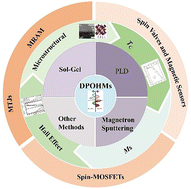
With the development of spintronics and magnetic storage technologies towards ultra-high density, ultra-low power consumption, and ultra-fast response, double perovskite oxide half-metals (DPOHMs) have become core candidate materials to break through the performance bottlenecks of traditional magnetic storage devices due to their tunable crystal structure, high Curie temperature (Tc), nearly 100% spin polarization (SP), and excellent chemical stability. Here, we systematically review the research progress in DPOHMs used for magnetic storage devices, which covers crystal structure regulation, microstructural characterization, physical property characterization methods, theoretical calculation models, and their applications in magnetic storage devices. Firstly, synthesis methods (sol–gel methods, pulsed laser deposition, magnetron sputtering, etc.) and structural characterization of DPOHMs are described, and the effects of A-/B-site element doping and oxygen vacancy regulation on the crystal ordering degree and half-metallic properties are analyzed. Then, the correlation between microstructures and material properties is critically discussed. In addition, theoretical investigations into the physical origins of the half-metallicity of DPOHMs by first-principles calculations (density functional theory (DFT) plus the U method (DFT+U)) are critically reviewed, especially the theoretical simulations of band structures, density of states, magnetic exchange interactions, and defect effects. Finally, the promising applications of DPOHMs in magnetic tunnel junctions, spin valves, and spin field-effect transistors are systematically summarized, and the current challenges and future prospects of DPOHMs in the field of magnetic storage are discussed.
- This article is part of the themed collection: Journal of Materials Chemistry C Recent Review Articles
 Please wait while we load your content...


