


 PLATFORM UPDATE:


Multi-state emission of TICT luminophores
 †a
Agnieszka
Czapik,
†b
Marzena
Banasiewicz,
c
Klaudia
Chuchracka,
b
Marcin
Kwit,
b
Agnieszka
Szumna
*a
and
Paweł
Skowronek
*b
†a
Agnieszka
Czapik,
†b
Marzena
Banasiewicz,
c
Klaudia
Chuchracka,
b
Marcin
Kwit,
b
Agnieszka
Szumna
*a
and
Paweł
Skowronek
*b
Abstract
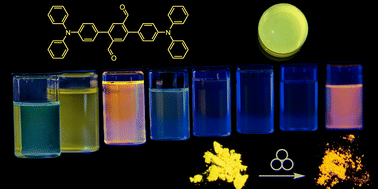
In this work, we address the challenge of designing versatile luminophores that maintain their emissive properties across various phases, including solutions and solid states (dual-state emission, DSE). We report the synthesis and detailed characterization of a series of Twisted Intramolecular Charge Transfer (TICT)-type luminophores with D–A–D molecular geometries composed of triphenylamine (TPA) or dimethylphenylamine fragments as donors (D) and aromatic ortho-substituted aldehydes as acceptors (A). In solutions, they exhibit polarity-dependent solvatochromism, with emissions spanning 500–600 nm. Importantly, their luminescence persists even in restrictive environments, such as crystalline, aggregated states, mechanically treated solids, and solid polymer matrices (PMMA). This durable condensed-phase luminescence results from their non-planar structure, particularly the ortho-substituted acceptor and propeller-shaped donor components, which effectively hinder stacking interactions linked to aggregation-induced quenching (AIQ), leaning more toward characteristics similar to aggregation-induced emission (AIE). Crystallographic data and theoretical calculations confirm the presence of twisted biaryl D–A fragments with D–A angles of 41–45°, a structural feature vital for preventing efficient solid-state stacking. Additionally, we find that these luminophores can undergo further twisting, showing a mechanochemically induced batochromic shift in luminescence (mechanochromism). The most sterically hindered compound consistently exhibits higher photoluminescent quantum yields under various conditions. Our results, supported by structural analysis, suggest that multi-state luminescence is a common trait among D–A–D-type twisted molecules and has significant potential for future development.
 Please wait while we load your content...


