


 PLATFORM UPDATE:


In situ investigation of Li permeation through grain boundaries in garnet-based solid electrolytes
 *d
*d
Abstract
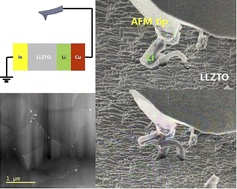
Garnet-type solid electrolytes, such as Li7La3Zr2O12 (LLZO), are promising candidates for next-generation solid-state batteries due to their high ionic conductivity, mechanical stability, and excellent compatibility with lithium metal anodes. However, a major safety concern remains: internal short-circuits caused by lithium dendrite penetration, a mechanism that is not yet fully understood. To address this, we employed a suite of in situ techniques—including conductive atomic force microscopy (C-AFM), scanning electron microscopy (SEM), and scanning transmission electron microscopy (STEM) to directly observe the mechanism of lithium plating and propagation in Ta-doped Li6.5La3Zr1.5Ta0.5O12 (LLZTO) solid electrolytes. Our findings reveal that non-uniform current distribution within the LLZTO is the primary driver for lithium dendrite formation. We observed that lithium crystals initially nucleate and grow as discrete islands along the grain boundaries where current is concentrated. These isolated crystals subsequently merge, forming continuous dendritic pathways that lead to short-circuiting. The growth of these lithium crystals was further confirmed by in situ electron beam induced current (EBIC) experiments. Based on these insights, we developed a novel C-AFM-based technique to artificially induce lithium dendrite growth from the LLZTO surface, which serves as a powerful diagnostic tool for identifying regions of non-uniform current flow. This work elucidates the fundamental mechanism of lithium dendrite formation and provides a valuable method for assessing the safety and performance of solid-state electrolytes.
 Please wait while we load your content...


