


 PLATFORM UPDATE:


Revealing the pseudocapacitance charge storage mechanism of sulfur-doped carbon supercapacitors in non-aqueous electrolyte through in situ EPR
 c
and
Anke
Krueger
*a
c
and
Anke
Krueger
*a
Abstract
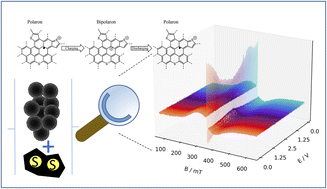
Sulfur-doped carbon has emerged as a promising material for high-performance supercapacitors, yet its charge storage mechanism in non-aqueous electrolytes remains poorly understood. In this study, we provide an experimentally supported mechanism, that the pseudocapacitive behaviour of S-doped carbon is governed by a reversible polaron-to-bipolaron transition, facilitated by thiophenic sulfur sites. In situ electron paramagnetic resonance (EPR) spectroscopy is consistent with the presence of pre-existing polarons, which undergo oxidation to bipolarons during charging and revert to polarons during discharge, establishing a clear correlation between spin chemistry and charge storage. Electrochemical characterization, including cyclic voltammetry, Trasatti, and Dunn analysis, reveals that up to 81% of the total capacitance originates from faradaic contributions, which is due to the presence of sulfur-doped carbon. Comparison with mesoporous onion-like carbon (OLC), whose capacitance arises from a purely electric double-layer (EDL), further supports this conclusion. These findings provide the first description of a proposed pseudocapacitive charge storage mechanism in sulfur-doped carbon within organic electrolytes, that is supported by comprehensive experiments. This result lays the foundation for future optimized sulfur-doped electrode materials.
- This article is part of the themed collection: Supercapacitors for a sustainable energy future
 Please wait while we load your content...


