


 PLATFORM UPDATE:


Simulation of weak polyelectrolyte brushes: the effects of ionizable monomer fraction and monovalent salt

Abstract
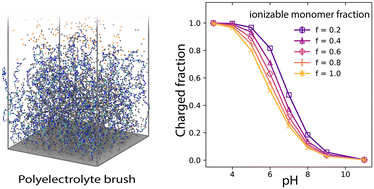
We perform simulations using the grand reaction method (GRM) to investigate the effects of pH, monovalent salt concentration, and ionizable monomer fraction f on the swelling of weak polyelectrolyte brushes (PEBs) consisting of polymer chains with random sequences of neutral and weakly basic monomers. The brush height responses of the model PEBs obtained by incrementally increasing or decreasing pH are found to be indistinguishable. This behavior sharply contrasts with the pronounced hysteresis observed in some experiments, indicating that these measurements probe long-lived metastable states. Upon increasing salt concentration, the model PEBs exhibit a crossover from the osmotic brush regime to the salted brush regime, as predicted by mean-field theory. However, as observed in experiments, the scaling exponents in both regimes depend sensitively on f and pH and are found to be generally smaller in magnitude than predicted. Nonetheless, we demonstrate that the expected scaling behavior can be approximately recovered under specific conditions. These results support the growing body of work elucidating the complex behaviors of stimuli-responsive polymer brushes and highlight outstanding challenges in reconciling findings from experimental, simulation, and theoretical studies.
- This article is part of the themed collection: Soft Matter Open Access Spotlight 2026
 Please wait while we load your content...


