


 PLATFORM UPDATE:


Multicomponent synthesis of 2H-chromene-fused-thiazolo-triazole derivatives via cascade Michael addition/cyclization reaction: anticancer, antibacterial and computational evaluations

Abstract
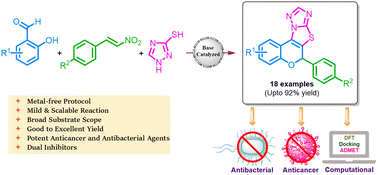
We report an efficient approach for the synthesis of a series of 2H-chromene-fused-thiazolo-triazole derivatives. This method enables the synthesis of the desired compounds through a multicomponent cascade of C–N and C–S bond formation. The synthesized compounds were thoroughly characterized by 1H NMR, 13C NMR, HRMS, and single-crystal XRD. The anticancer results showed that in the MCF-7 cell line, all tested compounds exhibited better activity than the other two cancer cell lines (MDA-MB-231 and A549). Compounds 4f, 4h and 4i showed significant cytotoxicity against the MCF-7 cell line compared to Doxorubicin. Additionally, in vitro antibacterial activities were evaluated against E. coli (PDB ID: 3G7E) and S. aureus (PDB ID: 3G7B), where compounds 4a, 4e, and 4i showed the highest potency compared to Gentamicin. Molecular docking studies further supported these findings, indicating the strong binding affinities of the active compounds towards the selected protein targets. FMO analysis based on global reactivity parameters indicated that compounds 4a, 4e, 4f, 4h and 4i exhibited high stability. Additionally, MEP plots revealed that these compounds exhibited a strong electrophilic reaction potential. In addition, ADMET predictions indicated favorable physicochemical and pharmacokinetic properties of these potent compounds. Overall, compounds 4a, 4e, 4f, 4h and 4i were identified as promising dual anticancer and antibacterial inhibitors for future drug discovery.
 Please wait while we load your content...


