


 PLATFORM UPDATE:


Refractometric and conductivity based water cut measurement techniques for stable emulsions

Abstract
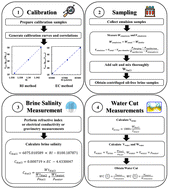
The production stream from thermal recovery processes for heavy oil and bitumen, such as steam-assisted gravity drainage, contains highly stable emulsions. The precise measurement of water cut in produced stable emulsions is essential for making informed economic and management decisions, yet it remains a complex challenge. This study introduces novel measurement techniques by applying Boyle's law in combination with RI or EC to measure water cut in stable emulsions. To accurately measure the volume of the aqueous phase in a stable emulsion, a known amount of salt, such as NaCl, is added. The salinity of the extracted brine is then assessed using RI or EC. By correlating the added NaCl weight with the measured salinity, the water volume in the emulsion—and consequently, the water cut—can be precisely determined without separating water from the oleic phase. With accurate measurements of the total volume of the emulsion and the volume of the aqueous phase in the emulsion, the water cut and volume of the oleic phase can be determined precisely. The developed measurement techniques were first validated using known emulsion samples and then applied to measure the water cut in unknown stable emulsion samples from an ES-SAGD experiment. The results showed excellent agreement with those obtained using the centrifuge method.
 Please wait while we load your content...


