


 PLATFORM UPDATE:


Nature of ammonia storage sites in H-SSZ-13 and Cu-SSZ-13
 *ab
Yingxin
Feng,
ac
Henrik
Grönbeck,
ac
Magnus
Skoglundh
ab
and
Hanna
Härelind
*ab
*ab
Yingxin
Feng,
ac
Henrik
Grönbeck,
ac
Magnus
Skoglundh
ab
and
Hanna
Härelind
*ab
Abstract
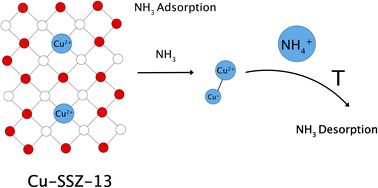
In this study, the nature of ammonia storage sites in H-SSZ-13 and Cu-SSZ-13 with different Si/Al and Cu/Al molar ratios is characterized by NH3 sorption experiments using in situ DRIFT spectroscopy, and by NH3-TPD flow reactor experiments. In addition, the binding energy and vibrational properties of different surface species are obtained by DFT calculations to aid the interpretation of the experimental results. The NH3 sorption DRIFTS experiments over Cu-free samples show that NH3, NH4+ and NH4+·NH3 ions form during the adsorption of NH3 over the Brønsted acid sites at 70 °C. DRIFT results show that peaks at around 3735 and 3650 cm−1 become increasingly more negative with increasing Cu loading, which is likely related to solvation of Cu by NH3. DFT calculations show two possible ammonia-solvated Cu species, i.e. CuI(NH3)2 and CuII(NH3)3OH. By comparing the simulated and measured IR spectra, we conclude that the experiments match the simulated infrared spectra of CuII(OH)(NH3)3, CuI(NH3)2, NH4+ and NH4+·NH3. Both DRIFTS experiments and calculations show that the amounts of CuI(NH3)2 and CuII(OH)(NH3)3 increase with decreasing Si/Al molar ratio and increasing Cu loading. Furthermore, the TPD results show that the NH4+·NH3 peak decomposes at relatively low temperatures, i.e. in the low-temperature region. The remaining NH4+ species is stable until decomposition in the high-temperature region.
 Please wait while we load your content...


