


 PLATFORM UPDATE:


Design and evaluation of a thiazoline-appended imidazole based fluorescent turn on chemosensor for Hg2+ ion detection: spectroscopic characterization and solid state film applications

Abstract
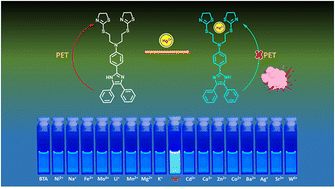
Mercury contamination presents a significant environmental and biological hazard, necessitating the development of reliable and sensitive fluorescent probes for the detection and removal of mercury ions. In this study, a novel fluorogenic chemosensor (BTA) incorporating a sulfur- and nitrogen-donor analogue of 4-(bis(2-((4,5-dihydrothiazol-2-yl)thio)ethyl)amino)benzaldehyde, has been synthesized for the selective detection of Hg2+ ions. BTA exhibits excellent chemo-selectivity and high sensitivity towards Hg2+ ions in a binary mixture of acetonitrile–water medium (CH3CN : H2O) (6 : 4, v/v), showing a distinct red shift (∼15 nm) in absorption spectrum and a pronounced fluorescence “turn-on” response. The detection limit was determined to be 114.7 nM, confirming its superior analytical performance. Detailed spectroscopic investigations, including Job's plot, proton NMR titration, HR-MS, FT-IR, and DFT calculations, confirm a 1 : 1 binding stoichiometry between BTA and Hg2+. The probe displays a prompt emission response, excellent reversibility, and strong anti-interference capability. Moreover, a Boolean logic gate (AND) was developed using the emission response of BTA to achieve selective detection of Hg2+ ions. Furthermore, a BTA infused PVA solid-state fluorescent film (BTA/PVA) was developed, enabling efficient recognition of deadly Hg2+ under practical conditions.
 Please wait while we load your content...


