


 PLATFORM UPDATE:


Enhancing the energy storage capacity of a symmetric supercapacitor employing α-Cu2P2O7 produced by a template-based co-precipitation approach

Abstract
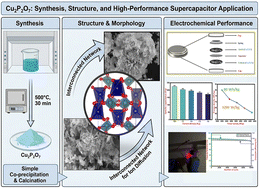
Pyrophosphates have acquired considerable attention as a potential electrode material in energy storage devices owing to their strong covalent P–O bonds, which ensure structural stability, high electrochemical activity, and efficient ion migration. In this contribution, we synthesized copper pyrophosphate (Cu2P2O7) by using a simple co-precipitation method followed by calcination at 500 °C for 30 minutes. The monoclinic structure of the material with space group C12/c1 was confirmed by powder X-ray diffraction. The Cu2P2O7 bonds were confirmed using Raman spectroscopy, while Fourier transform infrared spectroscopy confirmed the bending vibration of P–O–P and P–O bonds. X-ray Photoelectron Spectroscopy validates the +2-oxidation state of copper and the +5-oxidation state of phosphorus. Field emission scanning electron microscope revealed that the interconnected porous morphology with a rough surface of the material provides abundant active sites for ion movements and facilitates electrolyte penetration. The symmetric supercapacitor device of Cu2P2O7 possesses an excellent specific capacity of 225 F g−1 with a power density and energy density of 3200 W kg−1 and 80 Wh/kg at a current density of 1 A g−1, respectively. The symmetric device retains about 90% of its initial capacity after 10 000 cycles at a current density of 1.5 A g−1. The symmetric device is capable to illuminate a single 3 V red light emitting diode continuously for 1 minute and 27 seconds. The electrochemical findings endorse the viability of Cu2P2O7 as a suitable electrode material for long-term energy storage applications.
 Please wait while we load your content...


