


 PLATFORM UPDATE:


Dual functionality of tungsten oxide-doped magnesium oxide nanoparticles for organic dye adsorption and antimicrobial activity
 c
Elbadawy A.
Kamoun
*g
and
c
Elbadawy A.
Kamoun
*g
and
Abstract
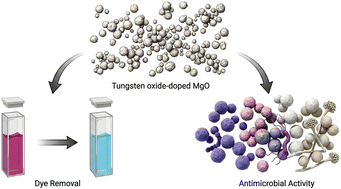
The basic fuchsin dye is well known for its long-term stability, potential ecological toxicity in aquatic environments, and genotoxic, neurotoxic, and carcinogenic effects in humans. This study introduces novel tungsten oxide-doped MgO (TW) adsorbent NPs fabricated by applying the sol–gel/auto-combustion method. TW nanoparticles were analyzed using XRD, confirming their cubic structure. Functional groups were examined and verified by FTIR spectroscopy. SEM investigation revealed the quasi-spherical surface morphology of the prepared TW. The optical properties of pure MgO TW0 (4.66 eV) and 10% tungsten oxide-doped MgO TW4 (4.15 eV) were determined using ultraviolet diffuse reflectance spectroscopy (UV-DRS), and BET surface area analysis and electrochemical impedance spectroscopy (EIS) were performed. The effects of variables, such as dose, pH, initial concentration, and contact time on adsorption, were studied, with strong correlation coefficients. TW4 NPs demonstrated great selectivity for BF, providing a maximum capacity of 324.64 mg g−1 at pH 7 in BF dye (0.04 g L−1) for 35 minutes. The Freundlich adsorption isotherm closely matched the experimental data. Kinetic modeling was studied for BF adsorption using both pseudo-first-order and pseudo-second-order models. The antimicrobial activity of TW NPs was assessed against various human pathogens, including Gram-positive and Gram-negative bacteria and fungal cells. Overall, TW NPs exhibited excellent antimicrobial activity against all tested Gram-negative bacteria, demonstrating their potential as promising nanomaterials for various environmental and medical applications.
 Please wait while we load your content...


