


 PLATFORM UPDATE:


Synergetic mono- and bimetallic tungstate–biochar composites for efficient adsorptive removal of aniline blue from simulated wastewater: reusability, multivariate analysis, and greenness assessment

Abstract
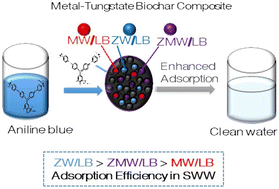
The removal of synthetic dyes from industrial wastewater remains a significant environmental challenge due to their high chemical stability and resistance to biodegradation. This study presents a comparative evaluation of three tungstate-modified loquat biochar composites ZnWO4/loquat biochar (ZW/LB), MnWO4/loquat biochar (MW/LB), and bimetallic Zn–Mn–WO4/loquat biochar (ZMW/LB) for the adsorption of aniline blue under both deionized water and simulated wastewater conditions, highlighting the influence of ionic competition on mono- and bimetallic systems. Comprehensive characterization using XRD, FTIR, FESEM, BET, EDX, and ICP-OES confirmed the successful formation of crystalline tungstate phases and mesoporous structures with enhanced surface properties. Batch adsorption experiments were conducted to investigate the effects of pH, contact time, initial dye concentration, temperature, and adsorbent dosage. The adsorption process was well described by pseudo-second-order kinetics and predominantly followed Langmuir-type behavior; however, it is more accurately attributed to a combination of electrostatic interactions, surface complexation, and diffusion processes. Among the synthesized materials, ZMW/LB achieved the highest removal efficiency in deionized water (89.16 ± 0.73%), while ZW/LB exhibited superior performance in simulated wastewater (89.33 ± 1.93%), indicating enhanced resistance to ionic interference. MW/LB showed comparatively lower adsorption efficiency but more stable performance under varying conditions. Reusability studies confirmed high structural stability, with removal efficiencies remaining above 95% after five cycles. Multivariate analysis revealed that textural properties account for 76.24% of adsorption performance, highlighting the dominant role of pore structure and surface area. Mass balance analysis demonstrated that Zn-containing composites require lower adsorbent dosages, confirming improved material efficiency. Furthermore, combined environmental evaluation using Eco-Scale, AGREE, GAPI, and simplified life cycle analysis indicated that ZW/LB exhibits the lowest environmental footprint when normalized to adsorption performance. Overall, the developed tungstate–biochar composites, particularly ZW/LB, show strong potential as efficient, reusable, and environmentally sustainable adsorbents for dye removal in complex wastewater systems.
 Please wait while we load your content...


