


 PLATFORM UPDATE:


Green spectrofluorimetric determination of clemastine using nitrogen and phosphorus Co-doped carbon quantum dots with face-centered design optimization and sustainability assessment
 *a
Omkulthom
Al kamaly
b
and
*a
Omkulthom
Al kamaly
b
and
Abstract
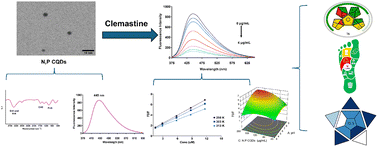
A novel, environmentally sustainable spectrofluorimetric method was developed for the determination of clemastine fumarate in pharmaceutical formulations and biological matrices using nitrogen and phosphorus co-doped carbon quantum dots (N,P-CQDs) as fluorescent nanoprobes. The N,P-CQDs were synthesized via rapid microwave-assisted carbonization of citric acid, urea, and phosphoric acid, yielding uniform nanoparticles (3.2 ± 0.9 nm) with high quantum yield (47.2 ± 2.3%) and strong blue emission at 445 nm. Face-centered central composite design was employed to optimize analytical parameters, achieving optimal conditions at pH 8.7, a buffer volume of 1.5 mL, an N,P-CQD concentration of 175 µg mL−1, and an incubation time of 3 minutes. Mechanistic studies confirmed static fluorescence quenching through ground–state complex formation driven by electrostatic interactions between protonated clemastine and deprotonated carboxyl groups on the nanoprobe surface. The validated method exhibited excellent linearity (0.1–4.0 µg mL−1, r2 = 0.9997), high sensitivity (LOD = 0.03 µg mL−1), satisfactory accuracy (100.41 ± 1.12%), and high precision (RSD < 2%). Successful application in synthetic pharmaceutical tablets and spiked human plasma samples demonstrated practical applicability, with statistical equivalence to reported HPLC methods. Comprehensive green chemistry assessment using MOGAPI (76), CaFRI (78), BAGI (72.5), and RGB12 (whiteness = 84.3) confirmed outstanding environmental sustainability and balanced analytical performance. The proposed method offers a rapid, cost-effective, and environmentally friendly alternative to conventional chromatographic techniques for clemastine quality control and bioanalytical applications.
 Please wait while we load your content...


