


 PLATFORM UPDATE:


Computational exploration of hydrogen storage potential in Mg2LiXH6 (X = Ti, V) hydrides via DFT and AIMD simulations

Abstract
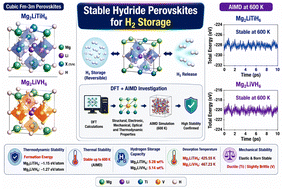
Perovskite-based materials offer considerable potential for efficient, stable, and environmentally sustainable hydrogen storage technologies. In this study, an inclusive density functional theory (DFT) investigation was conducted to evaluate the structural, mechanical, electronic, optical, and thermodynamic features of Mg2LiXH6 (X = Ti, V) double perovskite hydrides. Both compounds adopt a stable cubic Fm-3m symmetry supported by favorable tolerance factors (0.87 for Ti and 0.92 for V) and negative formation energies (−1.15 and −1.27 eV per atom), confirming their thermodynamic stability. Both compounds exhibit thermal stability at 600 K without significant structural distortion, as confirmed by ab initio molecular dynamics (AIMD) simulations. Dynamic stability was evaluated using phonon dispersion calculations, which showed no imaginary frequencies, confirming that the system remains stable at 0 K. Mechanical analysis confirms elastic and Born stability, with Poisson's ratios of 0.31 (Mg2LiTiH6) and 0.24 (Mg2LiVH6) and B/G ratios of 2.35 and 1.61, indicating ductile behavior for Mg2LiTiH6 and a slightly brittle nature for Mg2LiVH6. Electronic structure calculations reveal metallic behavior while optical analyses indicate potential for optoelectronic applications. Both materials, Mg2LiTiH6 and Mg2LiVH6, exhibit promising hydrogen storage characteristics with gravimetric capacities of 5.28 and 5.14 wt% and estimated desorption temperatures of 425.55 and 467.23 K, respectively. These results showed that Mg2LiXH6 (X = Ti, V) are promising candidates for next-generation hydrogen storage and energy conversion systems.
 Please wait while we load your content...


