


 PLATFORM UPDATE:


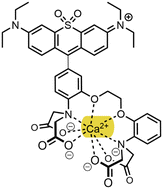
Straightforward synthesis of Solomon-red-BAPTA as NIR fluorescent sensors via metal-free oxidative coupling

Abstract
An effective, near-infrared (NIR) fluorescent Ca2+ sensor, Solomon-red-BAPTA, featuring a dioxothioxanthene moiety was developed for microscopy. A rapid and operationally simple synthetic route is described. The key step involves a room-temperature DDQ-mediated cross-dehydrogenative coupling (CDC) of the fluorescent precursor and BAPTA followed by a one-pot oxidation. The sensor exhibited excellent photophysical characteristics including a 160-fold fluorescence enhancement with excitation and emission maxima at 712 nm and 736 nm, respectively, suggesting high tissue-penetrating capacity. Based on the experimental data, the structure–property relationship was elucidated and further supported by DFT calculations, particularly with respect to the photoinduced electron transfer (PET)-based fluorescence turn-on mechanism.
 Please wait while we load your content...


