


 PLATFORM UPDATE:


MXene–AuPtPdCu nanoalloy-based aptameric immunosensor for differential pulse voltammetric quantification of colorectal cancer exosomes
 *b
*b
Abstract
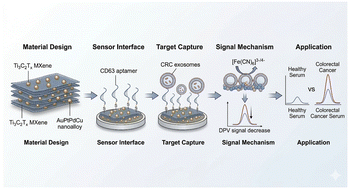
This work aims to develop an ultrasensitive electrochemical aptameric immunosensor for quantitative liquid-biopsy detection of colorectal cancer (CRC) exosomes. We engineered a glassy carbon electrode modified with a Ti3C2Tx MXene–AuPtPdCu nanoalloy nanocomposite, where uniformly dispersed alloy nanoparticles (8.5 ± 1.2 nm) provide a highly conductive and electrocatalytically active interface, and enable stable immobilization of a thiolated CD63 aptamer via Au–S bonding. Exosome capture forms an interfacial blocking layer that hinders [Fe(CN)6]3−/4− redox probe access, producing a concentration-dependent decrease in differential pulse voltammetry current. Under optimized conditions, the sensor exhibited a linear response from 50 to 5.0 × 10⁴ particles µL−1 (R2 = 0.998) with a detection limit of 19 particles µL−1, and delivered 1.8–2.0× signal amplification relative to monometallic MXene-based controls, consistent with the synergistic effects of multicomponent nanoalloys. The platform showed high selectivity against non-target exosomes and serum proteins, good fabrication reproducibility (inter-electrode RSD < 4.5%), and strong storage stability (94.6% signal retention after 28 days at 4 °C). In clinical serum analysis, CRC patients presented significantly elevated exosome levels compared with healthy controls (2.1 × 10⁴ vs. 0.8 × 10⁴ particles µL−1, p < 0.001), and the results agreed well with a commercial ELISA (R2 = 0.995). These findings demonstrate that MXene-supported AuPtPdCu nanoalloy interfaces can substantially enhance aptamer-based electrochemical exosome quantification, offering a sensitive and reliable strategy for CRC-related liquid biopsy.
 Please wait while we load your content...


