


 PLATFORM UPDATE:


Copper-catalyzed one-pot synthesis of isoquinolines via oxidative α-amination under mild and sustainable conditions
 *a
and
*a
and
Abstract
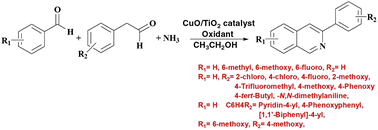
A copper-catalyzed multicomponent protocol is described for the synthesis of structurally diverse isoquinolines from readily available phenylacetaldehyde derivatives, benzaldehydes, and ammonia. A commercially available 4 M solution of ammonia in methanol serves as a practical and comparatively benign nitrogen source, avoiding the use of prefunctionalized amine substrates. The transformation proceeds at room temperature via a modified Pomeranz–Fritsch-type cyclization, enabling direct one-pot access to the target heterocycles in good to excellent yields under operationally simple conditions. The multicomponent design, combined with the avoidance of stoichiometric activating reagents and strongly acidic media, leads to improved atom economy and reduced waste generation relative to conventional isoquinoline syntheses. Mechanistic studies indicate a stepwise pathway involving the formation and isolation of a key 1,4-diphenyl-2-azabutadiene intermediate, while TEMPO trapping experiments support the involvement of radical species. Notably, a heterogeneous CuO/TiO2 catalyst can be readily recovered and reused with minimal loss of activity, further enhancing the sustainability profile of the methodology. Overall, this approach integrates earth-abundant copper catalysis, mild conditions, multicomponent efficiency, and mechanistic insight for the environmentally considerate construction of isoquinoline frameworks.
 Please wait while we load your content...


