


 PLATFORM UPDATE:


Charge-transfer interactions govern the trans influence and electron-induced bond activation in linear Au(i) complexes

Abstract
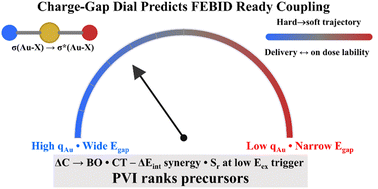
Linear Au(I) complexes with the general formula of X–Au–L (X = Cl, Br, or I; L = OMe2, SMe2, SeMe2, or TeMe2) are model systems that exhibit trans influence and are directly relevant to focused electron-beam-induced deposition (FEBID), where low-energy electrons trigger precursor fragmentation. Using DFT/NBO together with ETS-NOCV/EDA and TD-DFT hole–electron analyses, we show that trends in Au–L bond strengthening and Au–X bond weakening are governed primarily by orbital-interaction/charge-transfer channels, including σ(Au–X)→σ*(Au–L) trans delocalization and ligand lone-pair donation into Au acceptor orbitals, which together modulate ΔEorb and the Au–L Wiberg bond order. Electron-attachment thermodynamics identify the most favorable dissociation channels and define an electron-induced lability metric Glab ≡ −ΔGfrag, min, where ΔGfrag, min is the most favorable (most negative) fragmentation free energy. The overlap metric Sr provides a trigger proxy for localized low-threshold excitations. To integrate these observables without double-counting, we construct a parsimonious precursor viability index (PVI3), combining Glab and interaction stabilization Sint = −ΔEint as benefits and Sr as a penalty; ΔC and WBI are retained as mechanistic correlates rather than as independent score components. The resulting ranking highlights ClAu(S/Se)Me2 as the most balanced candidate within this series, and this work provides a reproducible framework for FEBID-style screening.
 Please wait while we load your content...


