


 PLATFORM UPDATE:


Preparation of biodegradable poly(lactic acid)-b-polyamide 4 block poly(ester amide) and its electrospun fibers
 *abc
*abc
Abstract
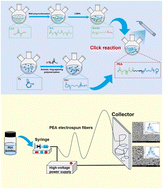
Poly(ester amide) (PEA) contains both ester bonds (–COO–) and amide bonds (–NHCO–) within its molecular backbone. Through strategic monomer selection and molecular structure design, PEAs have the potential to simultaneously exhibit excellent biodegradability and mechanical properties, making them a promising class of materials with significant research interest and application potential. In this study, poly(lactic acid) (PLA) was synthesized from L-lactic acid via melt polycondensation, followed by terminal thiolation modification. Subsequently, a biodegradable PLA-b-PA4 block poly(ester amide) was prepared through a thiol–ene click reaction with the synthesized polyamide 4 (PA4). The molar ratios of polyester to polyamide repeating units in the copolymers were 11 : 26 and 23 : 26. Comprehensive structural characterization of thiol-terminated PLA and the synthesized block poly(ester amide) was conducted using MALDI-TOF MS, FTIR, Raman, XPS, and 1H-NMR spectroscopy. Systematic study revealed that variations in PLA chain length significantly influenced the properties of the PEA, with the PLA and PA4 segments undergoing phase separation in the melt and exhibiting mutually suppressed crystallization behavior. Electrospinning was employed to process the PEA. The electrospinning process reduces the crystallinity of both PLA and PA4. The morphology and properties of the electrospun fibers were influenced by the PLA block ratio. Poly(ester amide)s containing short-chain PLA segments produced electrospun fibers with larger diameters, exhibiting better mechanical strength and ductility. As the PLA chain length increased in the copolymer, bead formation appeared in the electrospun fibers, accompanied by a decrease in fiber diameter and a deterioration in mechanical performance. This study provides experimental evidence and theoretical insights into the structure–property relationships of fully biodegradable block poly(ester amide)s and their application in electrospinning.
 Please wait while we load your content...


