


 PLATFORM UPDATE:


Structural tuning of diclofenac for enhanced medicinal efficacy and reduced adverse effects: an integrating computational validation

Abstract
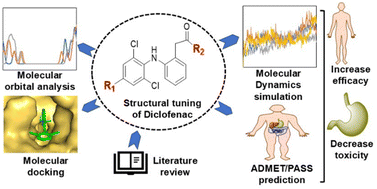
Diclofenac (DCF) is a widely used nonsteroidal anti-inflammatory drug (NSAID), and its clinical application is limited by gastrointestinal, metabolic, and cardiovascular complications. In the present study, DCF and eight newly designed analogues (DCF1–DCF8) were studied by means of integrated in silico techniques from the physicochemical, electronic, spectral, pharmacokinetic, and toxicological perspectives using DFT/B3LYP/6-31G+(d,p) basis set. All the structural modifications led to an overall decrease in electronic energy with respect to DCF; nevertheless, DCF2, DCF3, and DCF7 were thermodynamically stabilized to a great extent. Frontier orbital analysis unveiled smaller gaps with greater softness, especially for the cases of DCF3 and DCF6, which implies an increase in charge transfer tendency. The binding affinities for all the analogues were greater (from −6.9 to −7.5 kcal mol−1) than that of DCF (−6.6 kcal mol−1), and it was confirmed by the number of H-bonds, π–π stacking, and hydrophobic interactions with the key residues. The results of 100 ns molecular dynamics simulations revealed that DCF, DCF2, DCF4, and DCF6 can form tight-binding complexes with 5IKR, which carries the optimal binding affinity and structural stability. ADMET projections indicated elevated intestinal absorption, permeability across the blood–brain barrier, effective renal excretion, favorable biodegradability, and reduced acute oral toxicity for many analogues, particularly DCF4–DCF6. PASS prediction validated the retention of fundamental antipyretic, anti-inflammatory, and analgesic properties, while indicating a tendency for reduced ulcerogenic and hepatotoxic risks in certain derivatives. This study highlights DCF2, DCF4, and DCF6 as promising DCF-based candidates for further optimization and experimental validation as part of safe and more effective NSAIDs.
 Please wait while we load your content...


