


 PLATFORM UPDATE:


Emergency decontamination of leaked unsymmetrical dimethylhydrazine with carboxyl-rich graphene oxide: performance and mechanism
 a
Yuanzheng
Huang,
*a
a
Yuanzheng
Huang,
*a
Abstract
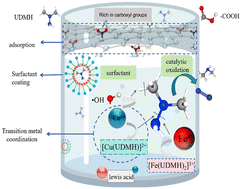
Unsymmetrical dimethylhydrazine (UDMH) is a widely used high-energy liquid propellant known for its extreme flammability and explosiveness. During storage or handling, any leakage of UDMH poses significant safety risks due to its volatility and reactivity, potentially resulting in fire or detonation. Conventional water spray methods are inefficient and consume excessive water, underscoring the urgent need for advanced decontamination techniques to address UDMH leaks. Graphene oxide (GO) presents a promising solution due to its unique two-dimensional nanoscale structure and adjustable surface functional groups, which enhance molecular capture capabilities. In this study, an aqueous dispersion of GO at a concentration of 18 mg mL−1 was synthesized using a modified Hummers' method and further functionalized through carboxylation via an SN2 nucleophilic substitution mechanism. The morphological and structural properties of the resulting material were systematically characterized using SEM, TEM, XRD, Raman, FT-IR, and XPS. The carboxyl-rich graphene oxide demonstrated strong inhibitory effects on UDMH vapor release, primarily through chemical adsorption. Specifically, 4 mL of the modified GO achieved a 23.1% inhibition efficiency against UDMH emissions from a 0.5 g L−1 solution. To improve decontamination performance, the decontaminant was formulated with Lewis acidic metal ions and the surfactant sodium dodecylbenzenesulfonate (SDBS). Metal ions such as Fe3+ and Cu2+ improved inhibition through acid–base neutralization, in situ coordination reactions, and interfacial modulation. Results showed that 10 mmol L−1 Fe3+ increased the inhibition rate to 36%, while 90 mmol L−1 Cu2+ raised it to 32.4%. SDBS contributed through micelle formation and interactions with the organic components of UDMH, enabling 0.5 g L−1 of SDBS to boost inhibition to 35.1%. This work demonstrates the potential of functionalized graphene oxide-based formulations as effective decontamination agents for hazardous energetic substances, offering a viable strategy for emergency response to energy leaks.
 Please wait while we load your content...


