


 PLATFORM UPDATE:


Grading schemes of VGO hydrotreating catalysts according to the classification of their active sites
 a
Sijia
Ding,
b
a
Sijia
Ding,
b
Abstract
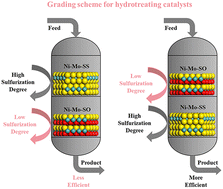
Based on the difference in the degree of sulfidization, hydrogenation active sites can be divided into Type-I and Type-II. In this study, one concept of catalyst grading design based on Type-I and Type-II active sites is proposed. Two NiMo/γ-Al2O3-supported hydrotreating catalysts with Type-I and Type-II active sites were prepared. Based on characterization results, theoretical models of the active sites were constructed, and their catalytic characteristics were predicted by DFT calculations. The catalysts were then evaluated by acridine model compounds and vacuum gas oil systems under four grading schemes. The DFT calculations and hydrogenation experiments results show that Type-I active sites excel in the hydrogenation saturation of lateral aromatic rings, while Type-II active sites preferentially promote the hydrogenolysis of heteroatom–carbon bonds. The catalyst dominated by Type-I active site exhibits high activity at low temperatures; the nitrogen content of the product hydrotreated at 340 °C by the single Type-I catalyst is approximately 68.4% of that hydrotreated by the single Type-II catalyst. However, the Type-II catalyst performs better at high temperatures; the nitrogen content of the product hydrotreated at 370 °C by the Type-II catalyst can be reduced to 1.6 µg g−1, which is only 28.1% of that obtained by the Type-I catalyst. Among the four schemes of grading catalysts combining Type-I and Type-II active sites, the optimal one is to place the catalysts with Type-I active sites first, followed by the Type-II catalyst, which has the lowest nitrogen content of 2.9 µg g−1.
 Please wait while we load your content...


