


 PLATFORM UPDATE:

Mild and efficient synthesis of carbamates using dioxazolones as bench-stable isocyanate surrogates: application in AChE-inhibiting agent development
 *ab
and
Jing
Zhang
*c
*ab
and
Jing
Zhang
*c
Abstract
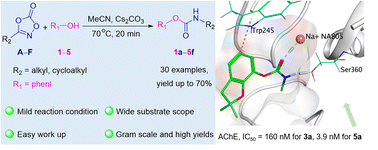
A practical method for carbamate synthesis was developed using 3-substituted dioxazolones as bench-stable isocyanate surrogates. Prepared from hydroxamic acids using triphosgene, these dioxazolones underwent base-promoted decarboxylation to generate isocyanates in situ. The optimized protocol (MeCN, Cs2CO3, 70 °C) enabled rapid (20 min), high-yielding access to diverse carbamates, including commercial insecticides propoxur and carbofuran in both milligram and gram scales. The carbamate-forming step avoided direct handling of volatile isocyanates, generates CO2 as the only byproduct, and exhibited broad substrate scope, affording a 30-compound library. Biological evaluation identified several potent acetylcholinesterase (AChE) inhibitors, with series-5 demonstrating nanomolar-level activity. Molecular docking provided structural insights into structure–activity relationships and potential determinants of insect versus mammalian AChE selectivity. This work offered a scalable route to carbamate agents and a valuable compound library for AChE-targeted discovery.
 Please wait while we load your content...


